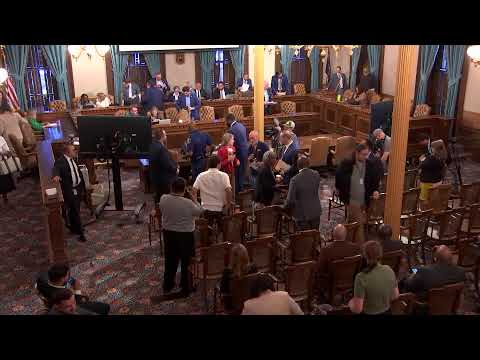
House oversight panel grills Michigan State Police leader after trooper no-confidence vote
Loading...
Summary
Colonel James Grady defended his leadership and personnel decisions before the Michigan House Committee on Oversight after surveys and a Michigan Troopers Association vote showed overwhelming no confidence from rank-and-file troopers; legislators pressed him on morale, discipline, alleged doxxing of employees and budget transfers.
Colonel James Grady, director of the Michigan State Police, testified before the Michigan House Committee on Oversight’s subcommittee on Michigan State Police Appropriations during a public hearing about internal surveys and a vote of no confidence that found large majorities of troopers and command staff opposed to current leadership.
The issue matters because committee members said the scale of dissatisfaction — and specific allegations, including retaliation and doxxing of troopers — could undermine morale, retention and public-safety operations across the state.
Grady told the committee he has launched worksite visits, an agencywide action plan tied to employee-engagement surveys and recruiting initiatives, and said the department has added troopers and earned CALEA accreditation. “I hold myself accountable by coming in and setting the example every day,” Grady said. He told the panel he and his leadership team developed the department’s current strategic plan after reviewing survey results and meeting with staff across Michigan.
But legislators repeatedly pressed Grady about recent survey findings and an external vote reported by the Michigan Troopers Association. Representative Mueller, the committee chair, said the association reported roughly 75% participation in its vote and that 90% of command officers and 98% of troopers cast “no confidence” votes in Grady and his second-in-command, Lieutenant Colonel Amy Brimacombe. Mueller said the employee engagement and ICE (Inclusion, Communication, Engagement) surveys also showed low scores for upper leadership; Grady acknowledged a recent ICE score of about 1.97 out of 4 on questions about upper leadership.
Committee members read verbatim comments from anonymous surveys that described fear of retaliation and reluctance to speak up. Representative Green read multiple survey excerpts, including: “leadership and IA can stop all the retaliation that we are promised to be protected from” and “with the current regime, I will never feel safe, comfortable expressing my thoughts.” Grady said he has not heard those comments directly during his worksite visits and that he believes most members are satisfied, but he told legislators he has formed a survey action plan requiring bureau and district commanders to draft local improvements.
Members pressed Grady on personnel moves that preceded the vote, including nonrenewal of two-year contracts for several senior officers and promotions to executive posts. Grady said contract renewal is discretionary and that members offered fallback options under civil service rules; he defended selecting an executive leadership team with “different strengths” to run the agency.
Lawmakers also questioned Grady about discipline and public statements in high-profile cases. Representative Bridal asked why the department released an initial statement about Sergeant Keeley when charges were first announced and pointed out that federal charges were later dismissed; Grady said the agency completed an internal investigation and submitted it to the attorney general’s office and that charging decisions are then the attorney general’s responsibility.
Several members raised allegations that the department or someone inside it shared names and deposition details of troopers with the media (described in the hearing as doxxing). Grady said he was not aware of those media disclosures and promised the agency would investigate any sharing of members’ personal information. The committee asked for a specific investigation into who authorized or released deposition details to the media.
Budget and administrative questions also featured in the hearing. Grady confirmed a roughly $800,000 legislative transfer to cover legal expenses and said some proposed unclassified executive positions were not filled because of budget uncertainty. He acknowledged an unapproved overspend of roughly $40,000 related to a command conference and said he is taking corrective steps, including reducing travel to meet budget targets.
Legislators cited workforce shortages while questioning Grady: representatives said there are roughly 700 vacancies in the department, about 500 at the trooper level (figures Grady did not have on hand but that committee members cited). Grady reiterated recruiting efforts — billboards, campus outreach, cadet programs — and said the agency has hired nearly 1,000 troopers in the last decade.
The committee did not take formal disciplinary action during the hearing. Several lawmakers asked Grady to return in four to six months with updates on morale and implementation of the survey action plans.
At the start of the meeting, Representative Bruck moved to approve the minutes of the June 24 meeting; the motion was adopted without objection.
The committee closed with requests that the Michigan State Police (MSP) provide vacancy and hiring data, documentation about the $800,000 transfer, and a report on any internal or external sharing of trooper deposition information. The panel also asked Grady to report back on steps taken to address morale and survey findings.