Get Full Government Meeting Transcripts, Videos, & Alerts Forever!
Get email alerts on the Land Use Development topic
No spam. Unsubscribe anytime.
Irvine council opens scoping for Irvine Company’s Oak Park plan proposing up to 3,100 homes on former Oak Creek golf course
Summary
Irvine — The Irvine City Council on May 27 held a scoping session to begin public review and staff analysis of a general‑plan amendment filed by the Irvine Company to create a new planning area called Oak Park that would redevelop the Oak Creek Golf Course and surrounding land.
Irvine — The Irvine City Council on May 27 held a scoping session to begin public review and staff analysis of a general‑plan amendment filed by the Irvine Company to create a new planning area called Oak Park that would redevelop the Oak Creek Golf Course and surrounding land.
Eric Martin, senior planner in the city’s Community Development Department, said the proposed planning area would measure “268 acres” and “as proposed, Oak Park would measure 268 acres in size” and could include up to 3,100 residential units, a K–6 elementary school, a community park, neighborhood parks and related infrastructure. Martin said the application involves changes to text, tables and exhibits tied to the city’s residential mixed‑use overlay and to an MOU negotiated with the Irvine Company.
The scoping session opened the next formal stage of review, Martin said, and will feed the environmental and consistency analyses that staff will prepare. “All general plan amendment requests require a city council scoping session early on in the process,” he said. Staff said the review will include a general‑plan consistency analysis, traffic and environmental studies under the California Environmental Quality Act, and a review of any proposed density‑bonus waivers under state housing law.
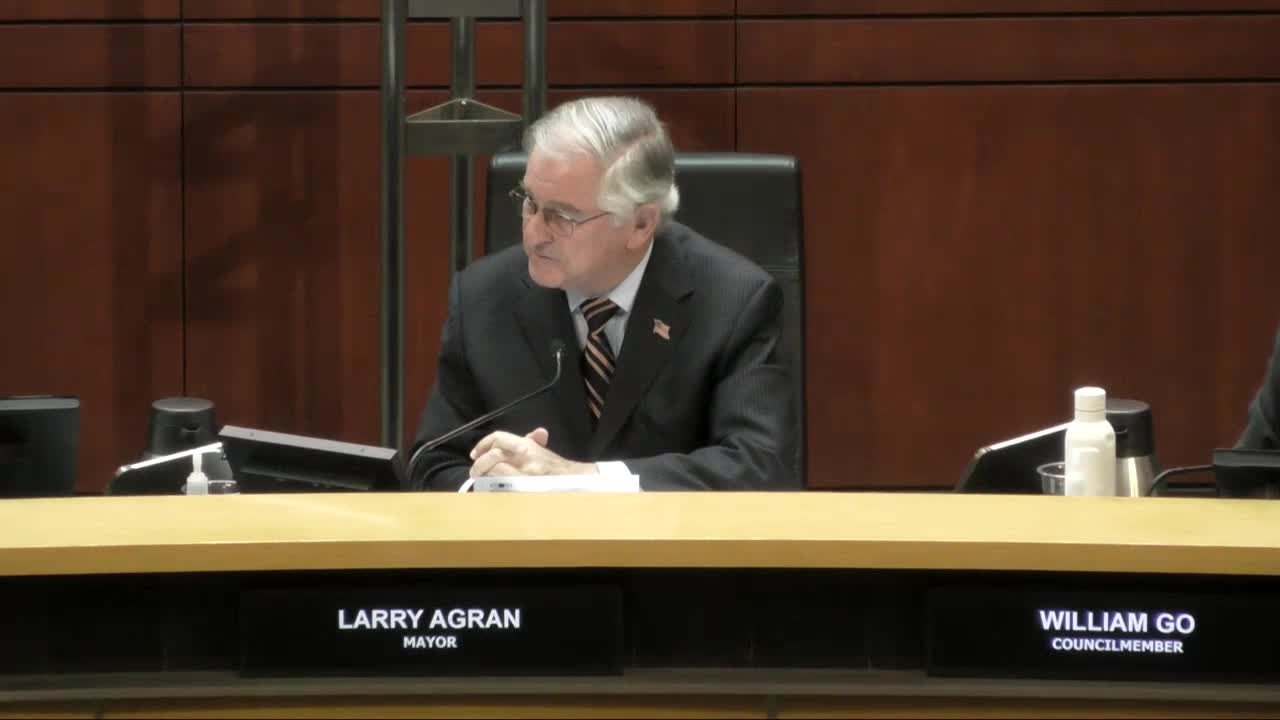
Mayor Larry Agran set ground rules for public testimony, capping public comment at 30 minutes for the meeting and allotting 90 seconds per speaker because of the large number of people who signed up. Carl Peterson, the city clerk, reported 40 requests to speak (39 in person and one on Zoom). Dozens of speakers urged either that the project be denied or significantly scaled back, while others supported further study.
Opponents raised traffic, open‑space and affordability concerns. Philip Benue, a Deerfield Village resident, told the council that “adding traffic from 3,100 new residences would be insane” and urged denial or a sharp reduction of housing. Several speakers said the site is a long‑standing green‑space commitment and that a large residential conversion would conflict with the city’s open‑space preservation goals.
Supporters argued the project could help the city meet state housing obligations and provide homes near jobs. Ryan Bates, who said his children attend Oak Creek Elementary, told the council the plan creates “an opportunity to expand our community, educate children and create truly publicly available open space.” Several other residents and business‑group representatives urged staff and the council to pursue the formal review so that the city can examine tradeoffs and design details.
Irvine Company representative Jeff Davis told the council the project repackages housing units already allocated to the city’s focus area 2 and changes the mix and form of housing. “Our proposal is different than the existing general plan,” he said. Davis said the existing focus‑area land could allow higher‑density development and noted the company’s proposal would add public benefits and include funding mechanisms for libraries, transit and other infrastructure as part of future permit applications.
Council action: the council voted 7–0 to direct staff to conduct one or more public scoping meetings in council chambers to gather input and then hold one or more follow‑up council scoping meetings after staff compiles that input. The motion did not approve the general‑plan amendment, and Martin told the council that any specific development would require subsequent discrete applications (zone change, tract maps, environmental review, affordable‑housing plans and master landscape and trail plans).
What happens next: staff and the applicant will continue outreach and prepare environmental and technical studies; the council’s directive sets the scoping and public‑engagement steps for that process. Formal decisions on land‑use entitlements and any development agreements would occur in future public hearings before the Planning Commission and the City Council.
Why it matters: the proposal would convert an existing golf course and related land uses into a mix of housing, parks and school uses; residents and businesses differ on whether that tradeoff serves public‑policy goals for open space, housing and traffic. The scoping phase will shape the technical questions that the city must answer before any final decision.
Sources: presentation by Eric Martin (senior planner, Community Development), public testimony, remarks by Jeff Davis (Irvine Company).