Get Full Government Meeting Transcripts, Videos, & Alerts Forever!
Get email alerts on the School Safety Firearms Policy topic
No spam. Unsubscribe anytime.
Laramie County School District #1 adopts firearms-on-school-property rule with training, medical-care amendment
Summary
The Laramie County School District #1 Board of Trustees voted 4–2 to adopt a new rule governing concealed firearms on district property, setting training minimums aligned with state law and adding a requirement that training include immediate life‑saving medical care.
The Laramie County School District #1 Board of Trustees on a 4–2 vote adopted a district rule setting requirements for employees and volunteers who choose to carry concealed firearms on school property, including training minimums drawn from state law and an amendment requiring certified training in immediate life‑saving medical care.
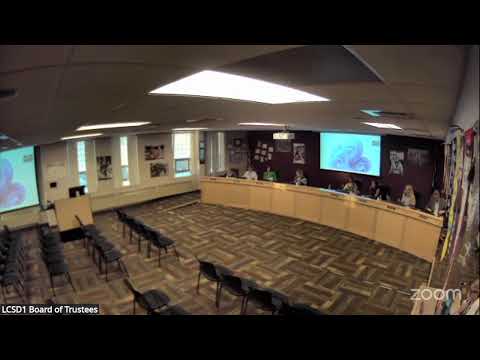
The rule, titled “Board Policies, Chapter 3, Section 8, Rule Governing Firearms on School District Property,” was introduced as a single item of new business at a special board meeting called to address the state law that takes effect the following day. After several hours of discussion, trustees approved the rule as amended.
The adopted rule incorporates the training floor specified in the state statute — an initial curriculum that includes live‑fire, scenario‑based and recurrent training — and was amended during the meeting to require that the training also include certified instruction in immediate life‑saving medical care.
Trustees and district staff framed the vote as a choice between adopting a policy that imposes training requirements for employees and volunteers who opt into concealed carry, or leaving no policy in place at all and thereby allowing anyone with a concealed‑carry permit to enter district property without district‑level regulation. “Enrolled House Bill number 172 goes into effect tomorrow,” a trustee said during the meeting, and the board noted that adopting a rule is the district’s primary remaining lever to require training of staff and volunteers.
Board discussion emphasized safety and training levels. Trustee Burton said, “Sadly, tomorrow, we will be able to conceal carry guns in schools, and that makes me sad,” and urged higher training and medical components. Trustee Hinkle warned that “Gun violence is the number 1 cause of childhood death in this country,” arguing for the maximum training the board could set. Several trustees said they relied on the district’s law‑enforcement and safety experts when judging the adequacy of training hours.
District staff and law enforcement provided technical context. Mr. Ciccarelli summarized state funding guidance: “Two years ago, the Wyoming legislature passed a firearms on school property account. It was pre funded with $480,000,” and cautioned that Department of Education guidance had indicated districts must have a policy in place to access reimbursement, though the district had asked the department to reconsider that interpretation. Sergeant Pete, the sergeant over school resource officers, described training as both technical and a mindset, saying training improves proficiency but that how an individual responds in a high‑stress incident also matters.
Trustees debated two formal amendments. One amendment, proposed to raise training hours substantially (to figures used by neighboring districts, the proposal would have increased live‑fire training from 16 to 47 hours, scenario training to 16 hours and annual recurrent training to 18 hours), failed on a 3–3 tie vote. A second amendment — which removed a narrow reference to a particular course and broadened the training requirement to explicitly include “certified training and immediate life‑saving medical care” — passed and was incorporated into the final rule.
The board recorded the final vote on the amended rule as 4 in favor and 2 opposed. The board chair announced the result and moved to executive session after the meeting business concluded.
The board did not take public comment at this special meeting; trustees said the district had already accepted public input during a 45‑day comment period required for notice of rulemaking. District staff said administrative regulations and implementation details (for example, how the district will track training completions and confidentiality of lists of consented carriers) will be developed after the policy adoption.
Implementation questions the board flagged for follow up include: whether the Department of Education will consider insurance a qualifying reimbursement expense; how training records will be stored and who will have access; whether principals should be notified about which staff have been approved; and whether additional district‑wide life‑saving training should be offered beyond the requirement for consented carriers. The district said administrative procedures and confidentiality safeguards will be addressed in forthcoming administrative regulations.
The board noted that the rule does not compel staff to carry firearms; it establishes requirements only for employees and volunteers who choose to consent to concealed carry under state law. Trustees said they hoped the rule would balance adherence to the new state statute with district efforts to maximize student and staff safety.
The board scheduled its next regular meeting — which will include a budget hearing — for Monday, July 14, 2025.