Get Full Government Meeting Transcripts, Videos, & Alerts Forever!
Get email alerts on the Legislative Oversight topic
No spam. Unsubscribe anytime.
Committee hears bill to restore legislative oversight of long-term public property contracts
Summary
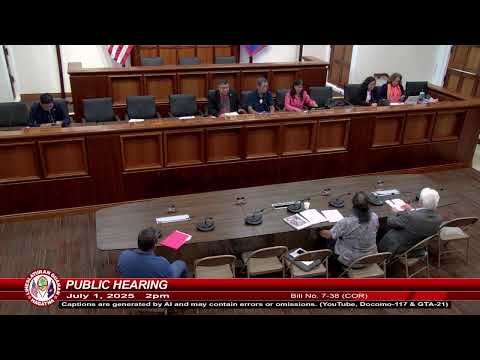
Senators on the Committee on Land, Environment, Housing, Agriculture, Parks, and Infrastructure held a public hearing July 1 on Bill 119‑38 COR, introduced by Senator Teletidegui, a measure to restore legislative approval for exceptional‑term contracts affecting public land and facilities.
Senators on the Committee on Land, Environment, Housing, Agriculture, Parks, and Infrastructure held a public hearing July 1 on Bill 119‑38 COR, introduced by Senator Teletidegui, a measure to restore legislative approval for exceptional‑term contracts affecting public land and facilities.
The bill would reinstate language (formerly found in 5 GCA §5127(d) as described in testimony) that requires the Legislature to review and approve exceptional‑term contracts — those contracts that exceed the ordinary statutory term — and would roll back provisions in Public Law 38‑1 that proponents said removed that oversight.
Supporters told the committee oversight is a guardrail against backroom or poorly negotiated long‑term deals. "Public law 38‑1 was a major step backwards for transparency and accountability," Senator Teletidegui said. Former governors Joseph Ada and Eddie Baza Calvo submitted written testimony backing the bill; both urged lawmakers to reinstate legislative review for long‑term leases and agreements. Public Auditor BJ Cruz and Attorney General Douglas Moylan also testified in support.
Moylan framed the bill as a balance‑of‑powers issue. He recounted a legal opinion his office issued in 2023 concerning a proposed long‑term Department of Defense lease and said the Legislature must be able to "protect our people's financial welfare." In his remarks Moylan said he refused to approve a contested 75‑year lease in the past because, he said, the arrangement would bind taxpayers to large obligations with unclear funding sources.
Committee members pressed witnesses on the practical effect of the current statute and the bill's changes. Much of the hearing focused on whether the statutory ceiling on executive‑branch action should be 5 years (the historical standard), 15 years (the current ceiling under Public Law 38‑1) or some other term. Witnesses and members agreed the threshold matters mainly because it determines when legislative approval is required; several witnesses urged clearer statutory definitions of "exceptional term contract." Attorney General Moylan agreed to provide a written legal opinion defining the term for the Legislature.
Witnesses and several senators also referenced past controversies involving long‑term leases and urged better procedures: Public Auditor Cruz recommended advance planning and a checklist so agencies bring proposed long‑term deals to the Legislature before contracts are executed; the attorney general and others urged a statutory mechanism so that contracts negotiated for terms beyond any statutory cap could be brought to the Legislature via a special bill or a "notwithstanding" clause.
No final vote or formal committee action occurred at the hearing. Committee staff said the committee will accept written comments and work with the attorney general and the Office of Public Accountability to clarify statutory definitions before further action.
Members of the public and officials may still send written testimony to the committee as provided during the hearing. The committee adjourned the public hearing and proceeded to the next agenda item.