Get Full Government Meeting Transcripts, Videos, & Alerts Forever!
Get email alerts on the Economic Development Brownfield topic
No spam. Unsubscribe anytime.
Plaza Corp, state officials preview $100M‑plus downtown brownfield plan as Northside residents press for homeownership
Summary
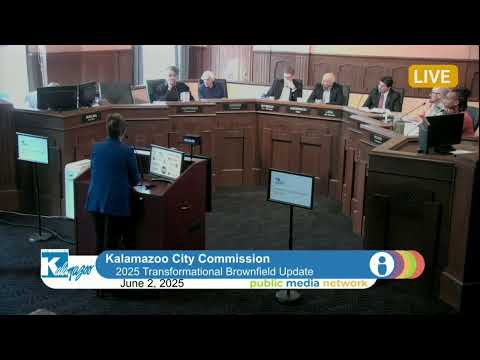
Plaza Corp and state officials presented a multi‑site transformational brownfield plan to the Kalamazoo City Commission Committee of the Whole on June 2, 2025, proposing more than $100 million in private investment and state tax‑capture incentives to convert three downtown properties into housing, retail and a boutique hotel.
Plaza Corp and state officials presented a multi‑site transformational brownfield plan to the Kalamazoo City Commission Committee of the Whole on June 2, 2025, proposing more than $100 million in private investment and state tax‑capture incentives to convert three downtown properties into housing, ground‑floor commercial space and a boutique hotel.
The plan, which project sponsors said has been invited to apply to Michigan’s Transformational Brownfield Program (TBP), would redevelop 619 Porter Street, the SpearFlex building at 261 E. Kalamazoo Avenue and the Michigan Avenue Courthouse (the MAC) at 227 W. Michigan Avenue. Tricia Kidd, representing Plaza Corp, said the three sites together represent "over 100,000,000 in investment" and would deliver new housing, activate commercial space and require brownfield remediation.
The proposal matters because TBP, created under Michigan Act 381 and administered by the Michigan Economic Development Corporation and the Michigan Strategic Fund, makes additional state revenue streams available to large redevelopment projects and is allocated sparingly: project sponsors and consultants said this application is one of a limited number of TBP invitations in the state.
Project details presented at the meeting include a proposed $22 million, five‑story mixed‑use building at 619 Porter with 58 residential units and about 5,000 square feet of commercial space; a roughly $22 million conversion of the SpearFlex building to 57 apartments; and a $50 million adaptive reuse of the Michigan Avenue Courthouse into a 127‑room boutique hotel. Tricia Kidd said the overall initiative would "bring more than a 115 residential units to downtown" when fully realized.
Joe Gasanelli, managing director of Michigan Growth Advisors, and other consultants outlined the financing and incentive stack. They said the combined project cost is just over $100 million, financed roughly 58% with conventional debt, about 30% with owner/investor equity, about 7% via federal historic tax credits on the courthouse project and roughly 3% from near‑term TBP construction‑period savings (sales tax exemption on construction materials and capture of construction worker withholding). Gasanelli summarized longer‑term TBP captures presented to the City: approximately $18.5 million in sales tax capture over 20 years, $13.5 million in residential income tax capture, $3.3 million in construction‑period withholding capture, and about $2.9 million in commercial payroll withholding capture. He said local brownfield real‑estate tax increment capture would be roughly $10 million with an additional $5.8 million at the state level under the brownfield plan.
City staff and consultants described the local approval steps that must occur before state action: staff review, a public hearing before the local Brownfield Redevelopment Authority, then a recommendation to the City Commission and, if supported, submission to the Michigan Strategic Fund for final approval. City consultant David Stedjink said the local process will look "pretty normal" despite the size of the projects, and Jamie McCarthy, the city's development manager, said staff expect some applications to arrive this summer and local approvals to be scheduled for August and September with a potential MSF board review later in the year.
Northside residents used the public comment period to press developers to include neighborhood residents in benefit packages tied to the projects. Natalie Jordan Woods, who identified herself as a Northside homeowner and longtime volunteer, asked the developers to add "resident owner occupied housing and resident owned businesses in the district to their neighborhood enterprise zone application." Marilyn Polley, also a Northside resident and small business owner, said she and other residents "have been there through it all" and urged developers to include resident homeowners and resident home businesses in the neighborhood enterprise application.
City staff and project representatives responded to questions from commissioners about affordable housing commitments, neighborhood benefits and timeline. Joe Gasanelli and project team members said TBP statute requires a written, binding affordable housing agreement with the city as part of the residential income tax capture component, but they did not specify exact affordability levels. When Commissioner Wilson asked whether the developers would follow the commission’s general encouragement for approximately 20% affordable housing at targeted AMI levels, project representatives said they were still working on exact unit mixes and price points and that the binding affordable housing agreement was "TBD" in structure and levels.
Commissioners also asked how the project would coordinate with local authorities that already have tax‑capture authority. Project staff said they will negotiate sharing agreements with the Downtown Economic Growth Authority and the Northside Cultural Business District Authority in June and July before bringing a brownfield plan forward for public hearing.
What happened next: no vote was taken at the Committee of the Whole. Staff signaled they will continue outreach to affected boards, hold required public hearings and return to the City Commission with proposed brownfield plans and tax‑abatement certificates in the late summer or early fall. Project sponsors forecast construction sequencing beginning with 619 Porter (predevelopment in 2026, construction late 2026–early 2027), SpearFlex thereafter and the MAC hotel last; final schedules depend on approvals and financing.
Why it matters locally: project sponsors and staff said the TBP invitation provides state resources that substantially reduce upfront development costs and can unlock projects that otherwise would be infeasible. Northside residents and some commissioners said they want clearer, enforceable community benefits — including homeowner‑targeted incentives, resident‑owned business opportunities and workforce development commitments — before final approval.
The city and project team said they will continue meetings with neighborhood leaders and with the authorities that hold existing tax capture to finalize agreements and the sequence of approvals over the coming months.