Get Full Government Meeting Transcripts, Videos, & Alerts Forever!
Get email alerts on the City Attorney Removal Special Counsel topic
No spam. Unsubscribe anytime.
Charter panel narrows rules for city attorney removal, special counsel after debate on vetoes
Summary
The Lansing Charter Commission amended Article IV language to clarify how the city attorney is appointed, suspended or removed and when the city council may retain special legal counsel; commissioners debated veto-override language before approving the changes.
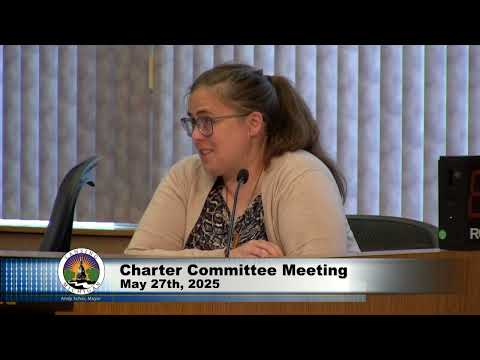
The Lansing Charter Commission on May 27 approved revised charter language clarifying appointment and removal powers for the city attorney and when the city council may retain outside legal counsel.
The action updates Article IV to specify that the mayor may appoint and suspend or remove the city attorney and that the city council may, by a two-thirds vote of members serving, suspend or remove the city attorney. The commission also added a provision allowing the city council to retain special legal counsel when it determines a conflict exists between branches of city government.
Why it matters: the revisions define reciprocal powers between the mayor and council and add procedural detail for conflicts that require outside counsel. Commissioners spent substantial time debating whether a veto override should be possible if the mayor vetoes a council removal action. That change had implications for whether the mayor’s veto would be final in certain removal scenarios.
Kristin, a representative of the city attorney’s office, told commissioners the draft clarifies “when the city council has received an opinion or advice of the city attorney on a matter and concludes that there is a conflict of interest … the city council has the authority to retain special legal counsel to represent city council in the matter.” Commissioners discussed limits on special counsel (Michigan license required and the counsel may not represent the city as a municipal corporation in the same matter).
Commissioner Boyd and others pressed for clarity on whether outside counsel hired by the council would be paid and whether the council should have to specify funding; Kristin said the language affirms the council’s authority to retain counsel and that it makes clear those acts are within the council’s authority (which reduces the risk of later payment disputes), but she did not add a specific funding requirement to the charter language.
The commission also debated whether to keep a cross-reference that would prevent the ordinary veto-override mechanism from applying in some removal cases. Commissioners who favored retaining the cross-reference said it preserved parity between the branches; opponents said it would give the mayor final authority in some instances. After discussion the commission approved the amended Article IV language as proposed. A roll-call vote recorded eight yeas and one nay on the measure.
The commission moved through related sections of Article IV in a series of votes and adopted the proposed changes for sections 0.1–0.9 as amended. The changes will be incorporated into the charter draft sent to the governor and Attorney General for review if the commission proceeds to submit the charter to voters.
Looking ahead: The revisions clarify internal procedures but do not create a new independent appointment process; they preserve the mayor’s appointment role while giving the council a formal method to respond where council believes a conflict exists.