
Battle Creek approves two downtown brownfield plans for mixed‑use housing projects
Get AI-powered insights, summaries, and transcripts
Sign Up Free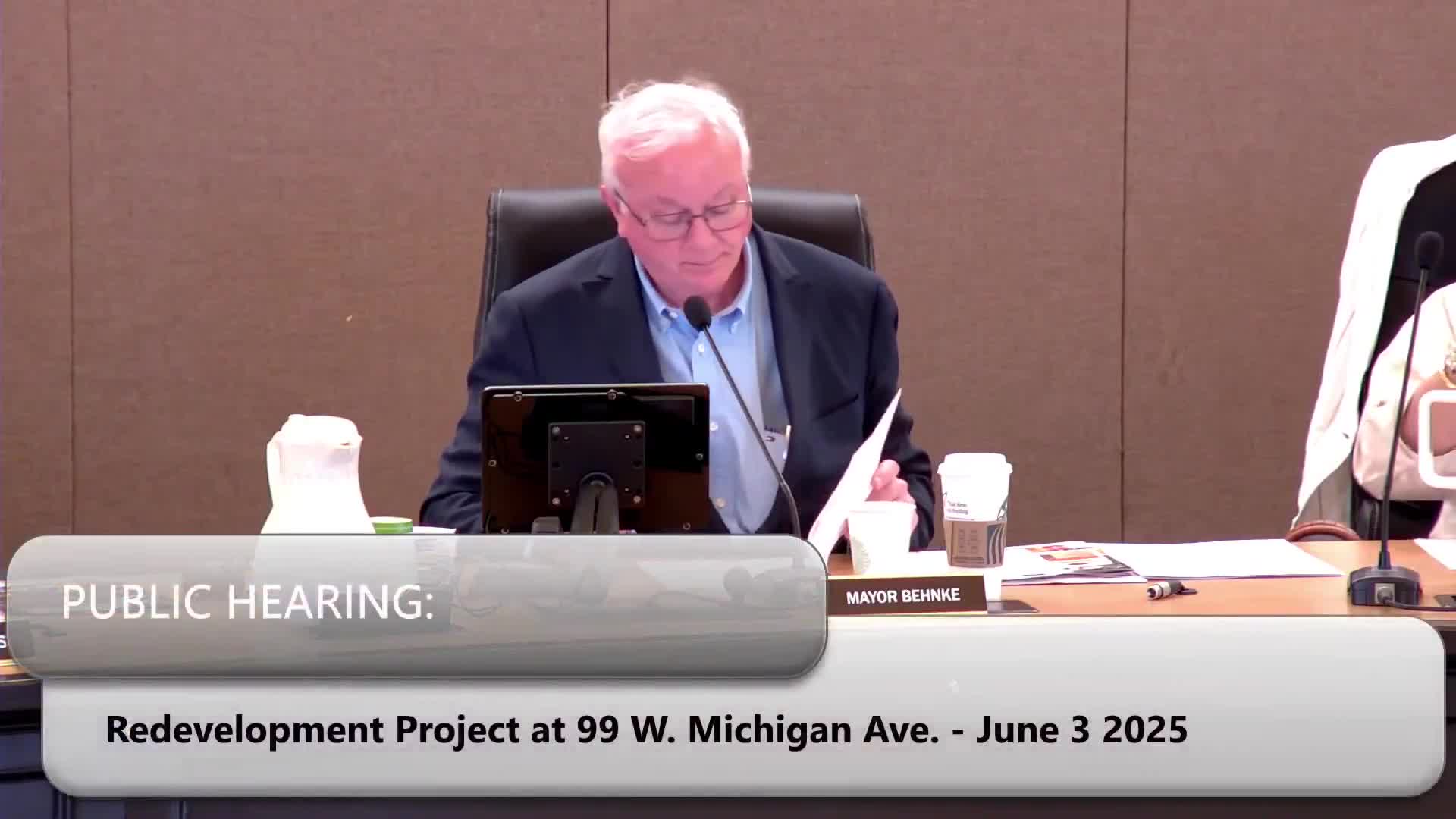
Summary
The City Commission approved brownfield plans for redevelopment at 99 W. Michigan Ave. and 119 W. Van Buren St., advancing two projects that together would add about 209 residential units, structured parking and commercial space while using tax‑increment capture to reimburse developers.
The Battle Creek City Commission on June 3 approved brownfield plans for two downtown redevelopment projects, clearing the way for a mix of apartments, retail space and structured parking at 99 West Michigan Avenue and 119 West Van Buren Street.
The two approvals came after public hearings during which developers and supporters described the projects as investments in downtown housing and commerce and some residents asked how taxpayer risk would be protected.
The Jackson Bean Management LLC proposal at 99 West Michigan Avenue would rehabilitate an existing single‑story commercial building, build a second and third story, refurbish the basement and add rooftop space. Developer Percy Bean told the commission the project would include restaurant space on the ground floor, a basement entertainment area and residential units on the second and third floors — five units on each floor, he said — and a rooftop amenity intended to draw visitors and residents. Bean described the project as a multi‑year effort and said construction costs have increased.
At a separate public hearing, representatives for Northeast Property Group LLC described a larger redevelopment at 119 West Van Buren Street that would replace a city surface parking lot with a mixed‑use complex containing about 199 residential units, a parking deck (about 230 spaces) and roughly 10,000 square feet of ground‑floor commercial space. Michigan Growth Advisers consultant Jared Lutz said the project represents about a $51 million investment and would bring significant new housing to the urban core.
Members of the public asked two recurring questions during both hearings: what amount of eligible environmental and non‑environmental costs would be reimbursed through the brownfield mechanism, and what guarantees protect the city and taxpayers if the developer fails to meet projections. One commenter said the Jackson Bean project had roughly $1,100,000 in eligible reimbursements; another cited about $14,000,000 for the Van Buren project. City staff explained that the brownfield plans use tax‑increment capture to reimburse developers and that reimbursements occur only if the projects generate the projected incremental tax revenue. The city manager told the commission that if projected incremental taxes do not materialize, the developer—not the city’s general fund—bears the shortfall.
Both brownfield plans were adopted by resolution (Resolution 151 for Jackson Bean Management LLC and Resolution 152 for Northeast Property Group LLC). Commissioners who spoke in favor highlighted the need for more downtown housing; a commissioner on the dais noted housing, jobs and quality of life as priorities.
Supporters at the hearings included downtown neighbors and representatives of local business organizations who said residential density and new restaurants or entertainment options would help sustain downtown retail and hospitality. Critics sought clarity on reimbursement amounts and safeguards for taxpayers.
The commission’s approvals authorize the brownfield plans to move forward to implementation steps described in each plan and allow the tax‑increment capture mechanism to be used to reimburse eligible cleanup and redevelopment costs according to the plans’ schedules.
Commissioners did not identify a city obligation to repay developers from the general fund if incremental revenues fall short; the city manager’s explanation stated reimbursements are tied to captured incremental taxes and would not automatically draw on city general funds.
The approvals complete the commission’s statutory step to adopt the brownfield plans; subsequent administrative steps (assessor calculations, intergovernmental authorizations where required and developer reimbursements tied to captured taxes) remain part of the implementation timeline.