Get Full Government Meeting Transcripts, Videos, & Alerts Forever!
Get email alerts on the Municipal Bond topic
No spam. Unsubscribe anytime.
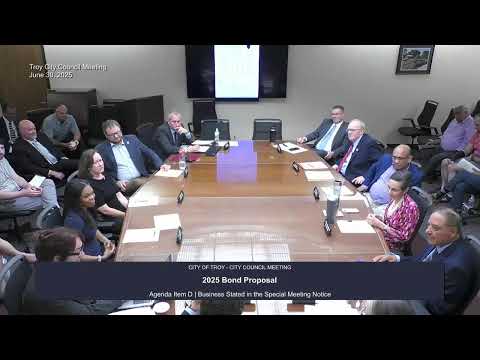
Troy council agrees in principle to place $137 million bond — including $75.9M library — on November ballot
Summary
Troy City Council held a special meeting June 30 and expressed consensus to place a $137,000,000 capital bond proposal on the November 2025 ballot to finance a new library, road work, parks and recreation projects, and public-safety equipment.
Troy City Council held a special meeting June 30 and expressed consensus to place a $137,000,000 capital bond proposal on the November 2025 ballot to finance a new library, road work, parks and recreation projects, and public-safety equipment.
The bond package includes a proposed new 90,000-square-foot library estimated at $75,870,000; roughly $35 million for street projects; about $17 million for parks and recreation (including a proposed lighted pickleball court); and $10 million for public-safety needs such as fire apparatus replacement and upgraded body-worn cameras. City staff said the library figure includes nearly $8 million in “soft” costs for design, bid documents and construction administration.
City Manager Greg Nastasi summarized the capital plan and financing options, and staff offered two ballot approaches: a 0.9-mill option that would allow the library portion to be financed up to 30 years (lower annual cost now but more interest over time) and a 1.1-mill option that would finance the full package over 20 years. Staff presented an illustrative comparison for an average taxable value of $175,000 showing the higher-rate option at about $16.52 per month and the longer-term option (presented in one slide as 0.95 mills) at about $13.86 per month; staff cautioned those are estimates that depend on future taxable value and interest rates.
The council spent the meeting’s discussion period on three linked questions: which projects to include in a single bond question, whether to spread the library cost over a longer borrowing term, and how to communicate the ballot language to residents. Multiple council members said they favored bundling the city’s capital needs into one bond so the city could address deferred maintenance across departments rather than asking voters for separate measures.
Public comment was limited to one speaker. Resident Joey Colby Bernard said, “I am here to support the proposed 0.9 mill 20 rate to fund the new public library,” and argued the existing building is more than 50 years old, too small and “not built for the way libraries function today.”
On project costs and estimates, staff and the consultant HBM told the council that national construction-price trends and inclusion of soft costs pushed the library estimate higher than earlier planning numbers. As Kurt (staff member) told the council, “those soft costs are in that $75,000,000 number, and I think that totals nearly $8,000,000 of the 75,000,000.” Staff said the $75.87 million figure also reflects conservative escalation assumptions to account for inflation and projected bidding two years from now.
Council members asked how state road funding or grants would affect the bond; staff said they would be transparent and could adjust the bond implementation (for example, by not executing a given road project if outside funding is later secured). Staff also reported the city’s library fund balance at roughly $3.6 million with about $700,000 more expected before construction, producing an estimated $5.5–$6.0 million available at the start of construction.
There was no formal roll-call vote during the meeting. Councilors directed staff and bond counsel to prepare alternate ballot language and financing scenarios and to present those options at the next council meeting in mid-July. City staff said the deadline to transmit ballot language to county/state officials requires moving quickly and recommended beginning public-education work as soon as the council adopts direction.
Next steps the council requested: staff will return to the next meeting with draft bond language reflecting the two millage/term options, bond counsel will provide sample ballot wording, and communications staff will prepare public-information materials and outreach plans. Council members discussed additional community engagement but recognized the timeline is tight if language is to be finalized in July.
The council meeting transcript shows sustained, substantive discussion among councilors and staff about financing structure, project scope and voter messaging. Because no formal ordinance or bond authorization was adopted at this meeting, the council’s direction functions as an informal consensus to place a $137 million bond proposal on the November ballot and to return with formal ballot language for review.