Get Full Government Meeting Transcripts, Videos, & Alerts Forever!
Get email alerts on the Organic Act Anniversary topic
No spam. Unsubscribe anytime.
Guam leaders mark 75th anniversary of Organic Act with events, call for continued federal engagement
Summary
Acting Governor Joshua F. Tenorio, legislative and judicial leaders announced a series of events for the 75th anniversary of the Organic Act of Guam and highlighted plans for a naturalization ceremony, courthouse tours and proposed federal legislation; speakers also discussed limits and next steps on political-status work.
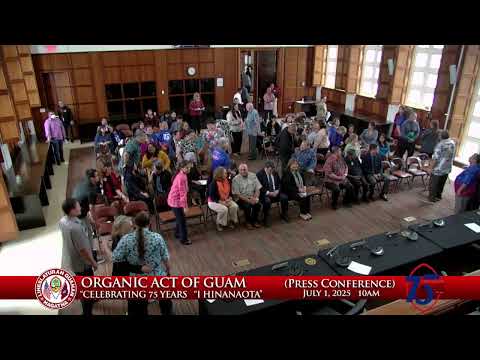
Acting Governor Joshua F. Tenorio and other Guam leaders onstage at the Guam Congress Building on Thursday announced a series of commemorative events for the 75th anniversary of the Organic Act of Guam and underscored the need for sustained federal engagement on the island’s political status.
The celebration begins Aug. 1 and will include a flag-raising ceremony at the Governor’s Complex, a special naturalization ceremony and outreach services, public guided tours of the historic Guam courthouse, and a History Comes Alive Festival at Plaza de España from 12:45 p.m. to 8 p.m., organizers said.
The events are intended to highlight the legal and civic milestones the Organic Act set in motion, and to invite public reflection. “Just about 75 years ago, the Organic Act laid the foundation for a government on Guam,” Acting Governor Joshua F. Tenorio said.
Why it matters: The Organic Act (Aug. 1, 1950) created Guam’s civilian government and extended U.S. citizenship to island residents. Speakers tied the anniversary to ongoing conversations about Guam’s political status and the legal limits that govern how local decolonization processes can proceed.
Delegate James C. Moylan told the crowd he plans to introduce legislation in Congress to create “regular meaningful dialogue between Guam and the federal government,” saying the measure would ensure Guam “has a seat on the table when it comes to issues impacting our future.”
Judicial leaders described anniversary programming tied to civic education. Chief Justice Robert J. Torres Jr. of the Supreme Court of Guam described the court’s role in interpreting the Organic Act and announced that the judiciary will offer public guided tours of the historic Guam courthouse every Tuesday and Thursday from 10 a.m. to noon through Aug. 1. Chief Judge Francis Tydenko Gatewood of the U.S. District Court of Guam said the District Court will host a special naturalization ceremony in the Guam Congress Building and aims to swear in about 75 new citizens on Aug. 1; the court also plans on-site outreach services to help new citizens apply for passports, Social Security numbers and register to vote.
Family members and descendants of early Guam political leaders spoke about the historical struggle that led to the Organic Act and urged continued civic engagement. Victor Luhan, grandson of Carlos P. Titano, and Mike Phillips, speaking for the family of the late Baltazar J. Bordelio, reflected on the tactics and sacrifices that pushed Guam’s political transition in the mid-20th century.
A question-and-answer session with media touched on long-running debates over political status and decolonization. Tenorio and other speakers noted legal and procedural obstacles: local statutes directing steps toward decolonization have been complicated by U.S. court decisions, and Nov. and federal-case law limit how certain local processes can proceed without congressional action. Tenorio said those unresolved legal points mean the path forward is “not very clear” and will require the island’s leadership to reconcile local statutes with U.S. court rulings.
Several speakers urged sustained, organized lobbying of Congress. Attorney Mike Phillips argued that historical progress on Guam often required direct congressional engagement and said, based on past practice, “the only path is the path to Congress.” Delegate Moylan’s pledge to introduce federal legislation was presented in that context as one possible route to formalize regular federal–Guam consultation.
Organizers also disclosed sponsors and partners for the commemoration, including the Guam Preservation Trust and a grant from the Guam Economic Development Authority. Other private sponsors named at the event included CoreTech International, the Guam Visitors Bureau, GTA, Payless Supermarket, Bank Pacific/Bank of Guam, Matson, and several local businesses.
What was not a formal decision: The press conference was an announcement and discussion forum; no votes or official policy changes were made at the event. Several speakers described plans or intentions—such as Delegate Moylan’s forthcoming congressional bill and the District Court’s targeted naturalization ceremony—but those remain proposals or event plans rather than enacted legal changes.
Looking ahead: The commemorative events are scheduled to run through Aug. 1 with multiple public programs aimed at education and civic participation. Organizers encouraged the public to attend events and to consult the Guam Legislature and judiciary websites for tour bookings and naturalization-day details.