Get Full Government Meeting Transcripts, Videos, & Alerts Forever!
Get email alerts on the Historic Preservation Noble Building topic
No spam. Unsubscribe anytime.
Livonia council debates fate of vacant Noble building after structural assessment and cost estimates
Summary
Council members and residents clashed over whether to fund immediate maintenance and how to plan long-term reuse of the long-vacant Noble building after two engineering reports produced widely different cost estimates.
The Livonia City Council spent more than an hour Thursday reviewing two contractor reports and public complaints about the long-closed Noble building on Plymouth Road, and voting on short-term steps to protect the structure.
Council members and residents pressed for action after the administration circulated a limited property condition assessment by NTH Consultants and an earlier, broader OHM report. The two studies diverge: the NTH report identified immediate structural and exterior maintenance needs and estimated about $787,670 in renovations (plus contingency and soft costs bringing a tab cited in council documents to roughly $1.13 million), while OHM’s 02/2023 estimate for building renovation and site upgrades was about $2.835 million. When engineering added HVAC, electrical and window work absent from NTH’s scope, administration said those items could add $1.7 million to $2.0 million, producing a comparable total in the multi‑million dollar range.
Why it matters: residents and preservation advocates said the building — closed since February 2019 because of mold — is an architecturally significant city asset and should be preserved and mothballed; other council members warned that incomplete estimates and missing scopes could mask much higher eventual costs and urged a committee process to settle use, scope and funding.
Council members opened Thursday’s discussion with a reading of the administration’s May memo transmitting the NTH report and the OHM supplemental materials. Council President Matthew McCullough argued the building’s “bones” remain sound and moved to earmark $30,000 from the capital reserve for immediate work and renderings intended to support grant applications and community engagement. “We’ve put five years into this project and let this building rot,” McCullough said. “For $30,000 you can get renderings, get packages ready for people to vote, get grants.”
Councilman Brandon Donovic objected to the $30,000 allocation without a clearer administration plan. Donovic, who chairs the Capital Outlay and Infrastructure committee, noted the city previously budgeted $20,000 for assessments and said the administration had told council that additional 2025–26 funds would be included for Noble in the coming budget. “We were expecting the administration to do their homework, look at both of these reports, analyze both of these reports, and come back before the council with money in 2025 and 2026,” he said. Donovic and others said the NTH memo itself points to a roughly $3 million building‑renovation figure after adding missing scopes, and they asked the administration to present a consolidated plan at committee before the council spent more money.
Public commenters pressed the council for faster action. Resident Laura Jonikoff told the council the administration had “no right to ignore this building for six years,” and said volunteers have been clearing brush and securing the site. Preservation advocates pointed to the building’s architect, Gunnar Birkerts, and urged the city to pursue historic tax credits and a community‑led reuse study.
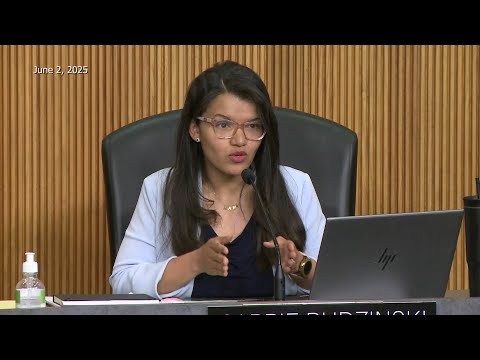
How council voted: McCullough’s motion to allocate $30,000 failed 4–3. A subsequent motion by Councilwoman Carrie Budzinski placed the Noble matter into the Capital Outlay and Infrastructure committee for expedited review; that motion passed unanimously 7–0, with councilmembers agreeing to schedule committee meetings and invite administration and engineering staff to outline what short‑term maintenance (mothballing, ventilation, theft/vandalism prevention) is required and what design/visioning steps would follow.
What the reports say (highlights): administrators summarized the NTH findings as identifying basement water and sludge, mold and water damage on basement walls, blocked roof drains and roof damage, missing downspout sections, animal holes along the exterior, and site grading/drainage deficiencies. NTH’s subtotal for immediate renovation items excluding HVAC and electrical came to about $787,670; with 30% contingency, engineering and construction management the memo presented a $1.13 million figure for rehabilitation of the items NTH detailed. The OHM report was more comprehensive and included HVAC, window replacement, mold remediation, electrical distribution upgrades and site stormwater work, and previously estimated $2.835 million for building renovation (02/2023). Administration told council that additional budget entries to support further condition assessment and site stabilization would be proposed in the 2025–26 budget.
Context and next steps: council directed staff to schedule capital outlay committee review and an economic‑development/strategic planning meeting already set for Aug. 18; council members said short‑term mothballing and security should not wait for an August meeting. The administration recommended continued mothballing, updated condition assessment work, stabilization and a community‑led strategic planning process tied to the Livonia Vision ’21 principles. The committee will evaluate immediate stabilization costs, a scope for renderings and grant‑ready documents, and a timeline for a public visioning process.