Get Full Government Meeting Transcripts, Videos, & Alerts Forever!
Get email alerts on the Budget topic
No spam. Unsubscribe anytime.
Longview School District sees narrow preliminary surplus as board readies July public review
Summary
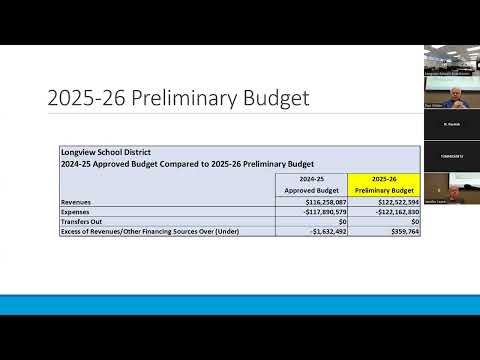
Longview School District presented a preliminary 2025–26 budget showing roughly $360,000 in excess revenue over expenses, outlined upcoming public-review dates and flagged risks from pending state and federal allocations and one-time fund-balance uses.
Bonnie Bowen, the district’s executive director of business services, told the Longview School Board on June 23 that preliminary figures for the 2025–26 budget show $122,500,000 in revenues and $122,200,000 in expenditures, leaving an estimated $360,000 excess at this stage of development.
The board received the update as the district finalizes assumptions for salaries, benefits and categorical funding. Bowen said the district is accounting for a 2.5% salary adjustment (IPD) and changes to benefits generated by the state’s prototypical funding model, and noted the numbers remain “preliminary” and subject to change as OSPI and federal allocations are finalized.
Bowen said the district compared the preliminary 2025–26 figures with the 2024–25 approved budget, when revenues were about $116,000,000 and expenditures almost $118,000,000, including a one-time use of fund balance of approximately $1,600,000. She told the board the district projects a roughly $2,400,000 lower fund balance in May compared with the same month last year and attributed part of the change to that one-time use and to special-education costs whose revenues may lag the expenditures.
Board members pressed Bowen on categorical and federal funding risks. Bowen said the district has received preliminary Title I and Title IV allocations but has not yet received preliminary allocations for Title II, Title III, federal Carl Perkins CTE funds or school-improvement dollars and therefore is budgeting those lines at last year’s levels. She said she was “optimistic” a state solution or additional guidance could arrive if significant cuts occur but that the district must plan for the possibility of reduced federal allocations.
The presentation included program-level changes Bowen highlighted: an approximate $1,200,000 increase in general apportionment driven by prototypical model adjustments and a roughly $2,200,000 increase in special-education revenue tied to removal of the K–12 funding cap and changes in per-pupil amounts. Bowen also reported local levy revenue is projected to increase from about $16.5 million to $17.8 million, reflecting the district’s voter-approved levy 3% annual escalation and recent changes to the levy-equalization formula.
On enrollment, Bowen said the district closed the year about 32 students above the budgeted projection for the annual average FTE and that June typically shows enrollment decline (the district lost 23 FTE from May to June). She noted K–12 special-education enrollment was higher than anticipated while special-education preschool enrollment was lower, which reduced preschool revenue versus last year.
Bowen gave schedule and next-step details: a draft budget and four-year forecast will be available for public review on July 10; Bowen will deliver a board update July 14; the public hearing is set for Aug. 11; and final budget adoption is scheduled for Aug. 26. She said printed copies will be available at district buildings and that the draft budget will be published on the district website, with the formal budget-adoption hearing advertised as required.
Board members asked for clarifications about nutrition and transportation funding. Bowen explained that as a community eligibility provision district, reimbursements and meal counts drive nutrition-service revenue and that transportation revenue is tied to students routed on to-from routes (with extracurricular or activity trips billed to the activity’s originating program or local levy where applicable). She also confirmed the district does not receive state reimbursement for students living within one mile of a school, which affects route funding.
The board did not take any final budget adoption actions at the meeting; Bowen said more updates will follow as state and federal information arrives.