Lifetime Citizen Portal Access — AI Briefings, Alerts & Unlimited Follows
U.S. Department of Education opens competition for national center to train special-education faculty on educational technology
Loading...
Summary
The Office of Special Education Programs outlined requirements, eligibility and a July 25 deadline for a discretionary grant competition to fund a national center to improve faculty capacity to use educational technology, including assistive technology and AI, in special education personnel and leadership preparation programs.
The Office of Special Education Programs at the U.S. Department of Education on June 25 opened a grant competition to establish a national center to improve faculty capacity to use educational technology in special education personnel and leadership preparation programs, announcing applications are due Friday, July 25, 2025, by 11:59:59 p.m. Eastern.
The center will be funded through the Educational Technology, Media and Materials program under the Individuals with Disabilities Education Act and will be awarded under Assistance Listing Number 84.327F, OSEP project officer Tina Diamond said during a department webinar describing the notice inviting applications and application instructions. "This information session will provide you with information about applying for this grant opportunity that was posted in the Federal Register on Wednesday, 06/25/2025," Diamond said.
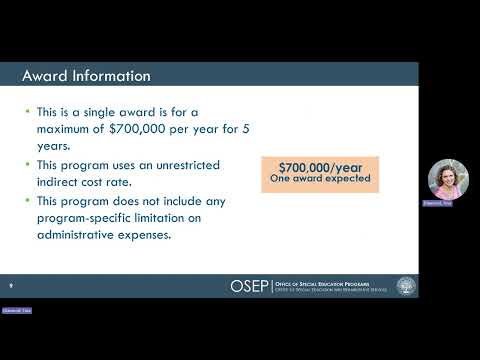
The competition anticipates a single award. The notice states the award "will not exceed $700,000 for a single budget period of 12 months with a total project period of 60 months." Eligible applicants include state educational agencies, local educational agencies (including certain public charter schools), institutions of higher education, public agencies, private nonprofit organizations, freely associated states and outlying areas, Indian tribes or tribal organizations, and for-profit organizations. The webinar emphasized that the center must operate at a national scale; applications proposing a locally or regionally focused center will be ineligible.
The notice defines key terms and priorities the application must address, including assistive technology and artificial intelligence. The presentation cited statutory and regulatory references included in the application materials, for example the statutory definition of assistive technology in "20 U.S. Code 14 oh 1" and a definition of artificial intelligence referenced as "15 U.S. Code 94,013," and reminded applicants that administrative costs must conform to the Uniform Guidance at Title 2 of the Code of Federal Regulations, Part 200, Subpart E.
Applicants must address five expected outcomes in their narratives, which include increasing faculty knowledge and capacity to use educational technologies; establishing and sustaining professional learning networks across institutions of higher education; integrating educational technologies into special education programs; and increasing the number of graduates prepared to use evidence-based technology and practices, especially those that improve literacy outcomes. The narrative should follow the five selection-criteria categories reviewers will use and include a management plan, evaluation plan implemented by an independent third-party evaluator, and evidence of adequate resources and qualified personnel.
Reviewers will score applications on a 100-point scale across the five criteria: significance (up to 15 points), quality of project design (up to 30 points), quality of project evaluation or other evidence building (up to 20 points), adequacy of resources and quality of personnel (up to 20 points), and quality of the management plan (up to 15 points). The webinar stressed that the evaluation plan must provide formative and summative evaluation questions, measures of fidelity and impact, and a dissemination strategy.
The notice includes application requirements and assurances: Appendix A must include a personnel loading chart and timeline; applicants must budget for in-person meetings in Washington, D.C., including a 1.5-day kickoff meeting, an annual planning meeting with the OSEP project officer, a 2-day project directors' conference each year, and up to two additional 2-day trips annually for Department briefings or meetings as requested by OSEP. Awardees may set aside annually up to 5% of the grantee's amount for emerging needs with OSEP approval, and any remaining funds from that set-aside must be reallocated no later than the end of the third quarter of each budget period. The notice also requires that projects engage doctoral students or postdoctoral fellows and post annual progress reports on the project website.
Submission guidance reiterated that applications must be submitted electronically through grants.gov, applicants should register early with grants.gov and the System for Award Management, and that the last validated submission will be the one considered if multiple submissions are made. The presenter warned that grants.gov will time-stamp and then validate uploads, and advised submitting at least a day early to allow time to resubmit if problems occur. Applicants were advised to submit narratives and attachments in PDF read-only format and to follow page limits and formatting guidelines to facilitate review.
The webinar outlined two conditions for ineligibility: application submissions after the published deadline and applications that do not address the national-center priority. The presenter directed applicants with questions to contact her by email at christina.diamond@ed.gov or by phone at (202) 245-6723.
The webinar provided guidance and summarized material in the notice inviting applications and application instructions; prospective applicants were repeatedly advised to read the full notice and application instructions available in grants.gov and in the Federal Register for complete details and requirements.