Get Full Government Meeting Transcripts, Videos, & Alerts Forever!
Get email alerts on the Lyndale Gardens Retail Development topic
No spam. Unsubscribe anytime.
Richfield council weighing PUD changes after years of failed retail interest at Lyndale Gardens site
Summary
City staff, the developer and brokers told the Richfield City Council and HRA on June 24 that the 6,000-square-foot retail parcel at Lyndale Gardens has drawn repeated interest but no lasting tenant; councilmembers signaled support for targeted amendments to the PUD rather than HRA acquisition.
The Richfield City Council and Richfield HRA on June 24 discussed options for the remaining retail parcel at the Lyndale Gardens redevelopment, including a possible amendment to the site’s planned unit development, continued marketing by the property owner, or acquisition by the HRA.
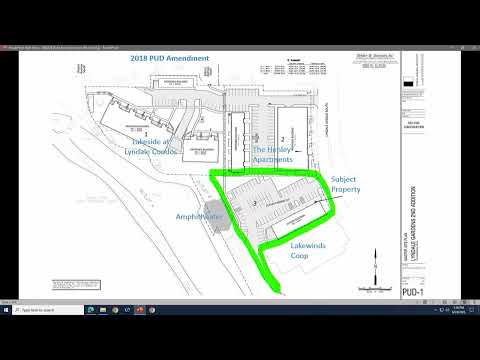
The conversation centered on a roughly 6,000-square-foot retail parcel approved through a PUD that sits behind the Lake Wins co-op and adjacent to a privately owned amphitheater and public amenities funded in part by a Metropolitan Council grant. Jan Youngquist, Richfield’s economic development manager, framed the choices for the council: “Would you consider amending the PUD to broaden the range of commercial uses allowed on the site? Would you want to uphold the PUD requirements and wait for a retail use that would coordinate with the outdoor activity space and amphitheater, or would you consider having the HRA acquire the property and holding it until a preferred development is feasible?”
Developer Colleen Carey and broker Therese Bridal described more than a decade of marketing that produced a small number of serious leads but no completed deals. Carey said she has carried the site since 2013 and noted the carrying costs: “I’ve paid $300,000 in real estate taxes on that property since I bought it.” She described constraints including limited visibility from Lyndale Avenue, underlying soil complications from past site uses and a reciprocal easement agreement (REA) between property parcels that was intended to limit incompatible uses. “It was never intended to be an agreement between everybody. It was supposed to be between me and the coop,” Carey said, adding that unintended assignment of the REA to multiple parcels has discouraged potential tenants.
Bridal, who has conducted long-running outreach to retail and restaurant operators, cited market and cost drivers: “Most recently, one of the bigger challenges has been construction costs… you’re probably getting up to close to over $500 a foot when you include in the land and all the construction and the hard and soft costs.” She said the site’s limited frontage and the coop’s placement make visibility and shared parking difficult, shifting potential operators’ interest away from ground-up restaurant builds toward second-generation spaces.
Councilmembers and others asked about alternatives that have been proposed or considered over the years. Suggested uses discussed included a brewpub or food hall (both proposals were previously withdrawn), mixed-use housing with small commercial components, medical offices, daycare, nonprofit arts programming and converting the parcel to park/parkway space. Several participants urged protections for pedestrian connections to the amphitheater and Richfield Lake; others raised concerns about permitting uses that could be tax exempt. One councilmember noted a recent ruling that could allow some daycares to qualify for tax-exempt status and cautioned that placing a tax-exempt use within a tax increment financing district would complicate the district’s revenue assumptions.
Carey and Bridal also described legal and practical hurdles. Changing the REA would require agreement from condominium owners, apartment owners and the coop; Carey said attorneys believe the REA may not be interpreted correctly by some owners but that prospective businesses do not want to pursue preemptive litigation. The developer said she has a proposal from the law firm Winthrop to seek a declaratory judgment on the agreement for about $50,000 but has not pursued it because there is not a committed tenant.
Councilmembers voiced a hierarchy of preferences while remaining cautious about broadening the PUD too far. Several councilmembers favored a destination retail use such as a brewpub, or mixed-use housing that preserves pedestrian connection and activity space. Others said they would consider medical office or daycare only with strong urban design conditions; multiple members opposed drive-throughs and low-visibility uses. On the question of HRA acquisition, councilmembers generally concluded that HRA ownership alone would not solve the underlying market and legal constraints.
Jan Youngquist closed the session with a summary of the council’s direction: staff should continue working with Colleen Carey on possible PUD amendments that protect access and connectivity while allowing a broader set of compatible uses, and return proposed language and financial/legal implications to the council. “I think what I’m hearing from the group is that we do not want to pursue a negotiation for the HRA to purchase the land, that we are, as a group, generally open to some modifications to the PUD,” Youngquist said.
Next steps identified at the work session include further staff analysis of PUD amendment options, consultation with recreation and financial consultants regarding park conversion and TIF implications, legal review of the REA and follow-up marketing by the owner and broker. No formal vote or ordinance amendment occurred at the June 24 meeting.