Lifetime Citizen Portal Access — AI Briefings, Alerts & Unlimited Follows
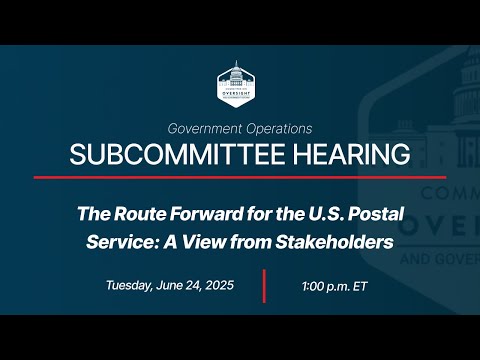
House hearing urges pause to Delivering for America, flags service, pension and rural-access risks
Loading...
Summary
WASHINGTON — Witnesses and members of the House Oversight and Reform subcommittee called on the incoming postmaster general and the Postal Service’s board of governors on Monday to pause implementation of parts of the Delivering for America plan and provide clearer data on operations, citing continued service delays, steep recent losses and risks to rural communities.
WASHINGTON — Witnesses and members of the House Oversight and Reform subcommittee called on the incoming postmaster general and the Postal Service’s board of governors on Monday to pause implementation of parts of the Delivering for America plan and provide clearer data on operations, citing continued service delays, steep recent losses and risks to rural communities.
The hearing focused on the postal service’s finances, operational changes under the Delivering for America (DFA) initiative, and policy options including increased public–private partnerships, changes to how retirement assets are invested and protections for universal service. “The Deliverance for America plan, despite its stated goals, is pushing the Postal Service further away from its core mission of providing reliable, affordable universal service,” said Jim Cochran, chief executive officer of the Package Shippers Association.
Why it matters: The Postal Service is legally required to provide universal service to all addresses. Several witnesses warned that network changes and planned rate increases risk worsening service and driving away volume that funds the agency. They also urged immediate attention to safety for letter carriers after the June death of a Dallas letter carrier, which the National Association of Letter Carriers’ president invoked as evidence of on-the-job hazards.
Industry witnesses and union leaders urged a strategic pause on discretionary capital projects and rate increases while new leadership evaluates results. “A new vision must be implemented to quickly reverse the negative financial results,” Paul Steedler, a senior fellow at the Lexington Institute, told the subcommittee. Multiple witnesses recommended halting construction of new processing facilities, pausing product changes and freezing non-delivery hiring while repairs and necessary upgrades continue.
Operational concerns and the RTO initiative
Several witnesses and members singled out the Postal Service’s regional transportation optimization (RTO) initiative, which reduces end-of-day collection at smaller post offices and changes pickup schedules for many rural communities. Witnesses cited Postal Regulatory Commission findings that RTO has negatively affected service and may not deliver projected savings.
“Slower service in rural communities widens the digital and economic divide,” Cochran said, adding that the plan’s changes “disproportionately affect rural communities and those in remote areas.” Rep. Marie Norton (D) and Rep. Marilyn Randall (D) pressed witnesses about the risk to delivery of medications and ballots in rural districts.
Pensions, investments and financial remedies
Witnesses discussed the Postal Service’s long-term liabilities and the limits on how retirement assets may be invested. Elena Patel, assistant professor at the Marriner S. Eccles Institute for Economics at the University of Utah, said the Postal Regulatory Commission estimates the cost of the universal service obligation at about $6.3 billion in 2024 and recommended that Congress consider an appropriation to cover those costs rather than privatization.
Several witnesses cited numbers reported by USPS and oversight offices: the Postal Service reported $249 billion in pension assets and, as of May 31, about $25.1 billion in the retiree health benefits fund. An Office of Inspector General analysis was cited that hypothesized investing a portion of postal retirement assets in a diversified portfolio would have produced materially larger returns over decades.
Union and public-service perspectives
Brian Renfro, president of the National Association of Letter Carriers, framed postal employees as central to reliable service and urged Congress to protect workers’ safety and the agency’s independence. “If the American people’s mail and packages are to be protected, the people who deliver them must first be better protected,” Renfro said, referring to the recent death of a carrier in Dallas.
Renfro and other union witnesses also opposed privatization, arguing private operators would not maintain the uniform pricing, six-day delivery and unprofitable routes that constitute the Postal Service’s universal service obligation.
Private-sector witnesses urged more public–private partnership models, especially for middle-mile transportation and processing, and restoring downstream entry (destination delivery unit or DDU entry) incentives so mailers can hand off mail and packages closer to their final destinations. Mike Plunkett, CEO of the Association for Postal Commerce, said the Postal Service’s shift away from downstream entry has increased costs and contributed to gridlock at processing centers.
Rates and near-term budget stress
Witnesses warned that a rate increase planned for July (including another increase in the price of a first-class stamp) and a potential loss of volume could further depress USPS finances. Multiple witnesses said the agency is on track to report substantial losses (witnesses cited nearly $9.5 billion in fiscal 2024 and projected losses this year) and urged the board of governors to delay rate changes and pause discretionary capital spending while the new postmaster general conducts an operational review.
Governance and oversight
Several witnesses criticized the Board of Governors’ performance and recommended governance reforms, including improved transparency and potentially a smaller, better-resourced oversight body to review contracts, finances and major strategy decisions. Paul Steedler told the committee that the current board structure “is broken and cannot be repaired.”
What the hearing did not produce
The subcommittee held the hearing to gather testimony and did not take formal votes or issue binding directives. Members invited the incoming postmaster general, David Steiner, who is expected to begin his tenure next month, to engage with the committee and stakeholders.
The hearing record and next steps
Members on both sides of the aisle said they will pursue follow-up oversight with the new postmaster general and the board of governors. The committee allowed members five legislative days to submit additional materials and questions for the record.
Ending
Supporters and critics of the Delivering for America plan agreed on the core stakes: the Postal Service provides last-mile access to medicines, ballots and everyday commerce, especially in rural areas. Witnesses and members urged clearer data, a temporary pause on some DFA actions, and immediate attention to worker safety as the new postmaster general begins his term.