Get Full Government Meeting Transcripts, Videos, & Alerts Forever!
Get email alerts on the Medical Malpractice Arbitration topic
No spam. Unsubscribe anytime.
Guam hearing draws split testimony on measure to repeal mandatory medical arbitration and add judicial prescreening
Summary
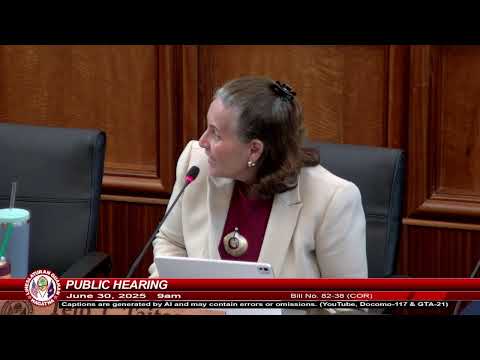
Hearing: On June 30, 2025, the Guam Legislature's committee chaired by Senator Teweetiwi held a public hearing on Bill 82-38 (Do No Harm Act of 2025), a proposal to repeal Guam's mandatory medical-malpractice arbitration law and replace it with a judge-run prescreening process before malpractice claims can proceed to trial.
Hearing: On June 30, 2025, the Guam Legislature's committee chaired by Senator Teweetiwi held a public hearing on Bill 82-38 (Do No Harm Act of 2025), a proposal to repeal Guam's mandatory medical-malpractice arbitration law and replace it with a judge-run prescreening process before malpractice claims can proceed to trial.
Why it matters: Sponsor Senator Parkinson said the bill aims to remove a costly barrier that she says prevents injured patients from getting their claims heard, while creating an early, public judicial review that could filter out meritless cases. Opponents — a broad group of physicians, nurses, hospital leaders and one attorney who spoke during the hearing — said the change would increase litigation costs, raise malpractice insurance premiums, and reduce access to specialists on the island.
Senator Michael Parkinson, the bill—s sponsor, told the committee the status quo effectively "slammed the courthouse door shut" for many Guam residents and argued the proposal balances access and accountability. "My goal is to balance reform that protects patients without unfairly burdening the medical community," Parkinson said. He described the bill as a repeal of the existing mandatory arbitration requirement and the creation of a "pre-litigation screening process handled by our illustrious Guam Superior Court," where a judge could call a neutral expert and issue written findings that would become admissible evidence.
Supporters: Testimony in favor came from several people who described personal harm or long-standing barriers to litigation under the current law. David Lebowski, who described himself as a longtime social-service worker and parent of a child he said died from alleged medical negligence, said the current arbitration law forces families to "drain themselves" or do nothing. He said, "Bill 82 is not about malpractice. It is not about poor people who cannot afford arbitration. . . . It is about having a fair, affordable system for all medical consumers on Guam to be able to have their claims heard and attempt to become whole again."
Other supporting testimony argued that mandatory arbitration is unique in U.S. jurisdictions and imposes upfront costs that many families cannot meet. Senator Parkinson and witnesses repeatedly cited estimates that reaching the first step of arbitration can cost "tens of thousands" of dollars and that some families would need roughly "$80,000" to initiate a malpractice claim under the current statute.
Opponents: Numerous clinicians and health-system leaders opposed the bill. Dr. John Ray Titano, former president of the Guam Medical Society, told senators: "We urge you to defeat Bill 82-38." He said the bill would remove medical peer review from early decisionmaking and produce a court-driven process "without safeguards" used in many U.S. medical-review systems.
Physicians, nurse practitioners and hospital executives warned of financial and workforce consequences. Dr. Jonathan Thorpe, medical director at Guam Seventh-day Adventist Clinic, said the bill would "exacerbate" provider burnout, raise malpractice insurance costs and make recruiting specialists harder. Dr. Alexander Wheelard, CEO of Guam Regional Medical City, said the measure "would add significant costs to our healthcare system" and could threaten the availability of malpractice coverage for hospitals handling high-risk care.
Some clinicians offered alternative reforms. Several witnesses, including emergency and specialty physicians, urged a negotiated, island-tailored fix such as a physician review panel or an improved arbitration rubric rather than wholesale repeal. Multiple speakers proposed a neutral pre-filing medical review or a fund to help meritorious claimants cover arbitration costs; others recommended a stakeholder roundtable to draft consensus changes.
Legal and fiscal notes: Committee staff reported that the Bureau of Budget and Management Research (BBMR) received a fiscal note on 03/19/2025 and that the Unified Judiciary of Guam is reviewing the legislation and "cannot determine a fiscal impact at this time" without more operational details. Attorney Mitch Thompson, who testified in opposition, told senators the bill as drafted is "inconsistent and frankly unworkable" in parts (for example, terms such as "promptly" and "in camera" are not defined in the draft), and he argued the proposal would shift costs to court dockets and could increase settlements for meritless claims because of litigation expense.
Process and next steps: Senator Teweetiwi opened the hearing and said she will work with the Oversight Chair on Health as the bill moves forward; Parkinson said he welcomes amendments and a full committee markup. Several testifiers urged a multi-stakeholder meeting to rework arbitration reform from the ground up rather than adopting the current draft. No committee vote or formal action on the bill was recorded at the hearing.
Ending: The hearing ran through dozens of witnesses representing a cross section of Guam's health system and community members. Committee staff recorded invitations sent to judicial and professional stakeholders for comment; the hearing recessed at the end of the public testimony with senators signaling further consideration and possible amendments ahead of a formal committee markup.