Get Full Government Meeting Transcripts, Videos, & Alerts Forever!
Get email alerts on the Audit Findings topic
No spam. Unsubscribe anytime.
Town auditor issues clean opinion but flags recurring ledger reconciling weaknesses
Summary
Mahoney Sable issued an unmodified opinion on Andover’s fiscal 2024 financial statements but reported repeated and new internal-control deficiencies related to reconciliations between the town and the school district and interfund/bank reconciliations; the auditor recommended procedural changes and filing corrective action with OPM.
Michael Van Deventer, a partner at Mahoney Sable and Company, told the Andover Board of Finance on June 25 that the firm issued “unmodified clean opinions” on the town’s fiscal year 2024 financial statements.
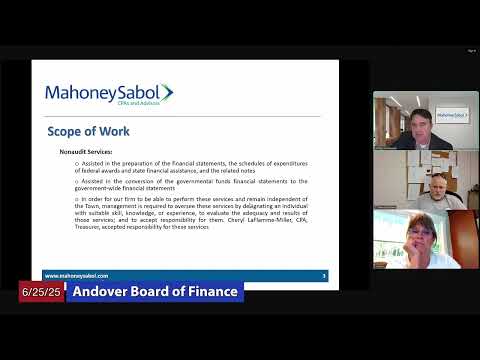
Van Deventer said the audit was performed in accordance with AICPA and Government Accountability Office standards and included federal and state single-audits and agreed-upon procedures on school-year reports filed with the Connecticut State Department of Education. He said the firm also provided non-audit services, such as assistance preparing the financial statements, and that Cheryl, the town treasurer, “has accepted responsibility for those non audit services.”
The auditor said the reports show reasonable assurance the statements are free of material misstatement, but that audits do not test every transaction and cannot provide absolute assurance. He reported no material noncompliance with laws and regulations affecting the opinion, but he identified internal-control issues.
Major points raised by the auditor included: - A repeated material weakness: reconciliation differences between the town’s and the school district’s general ledgers. Van Deventer recommended the town “no longer record or attempt to record balances and activities that are already being accounted for on the school district’s accounting system,” to reduce duplicate entries and year‑end reconciliation work. - A repeated but reduced-severity finding: a prior-year material weakness on school bank and interfund reconciliations was reduced to a significant deficiency this year after improvements; the auditor noted some adjusting entries were recorded after reconciliations and recommended reconciliations be updated for subsequent adjustments. - A reportable instance of noncompliance tied to a late filing of the annual federal ARPA compliance report; the report was subsequently filed and did not change the auditor’s unmodified opinion on the ARPA program.
Van Deventer said the single-audit identified the Coronavirus State and Local Fiscal Recovery Funds (ARPA) as the major federal program for fiscal 2024 (approximately $1,500,000 expended) and that state financial assistance totaled roughly $2,600,000, of which about $485,000 was nonexempt and subject to testing.
The board discussed operational implications. The auditor recommended that the Board of Education continue to provide monthly trial balances and bank reconciliations to the town so the town treasurer can perform oversight without duplicating the school’s accounting records. He also noted the town must file a corrective action plan with the Office of Policy and Management (OPM) for audit findings.
Board members asked for clarification on practical steps; Van Deventer repeated that the recommended change is procedural — stop duplicating the school’s trial balance on the town system and instead rely on provided monthly reconciliations and trial balances. He confirmed no penalties result from the late ARPA annual report in this case and that the filing obligation had been met.