
Board closes loop on budget vote, approves amended FY2025–26 spending after contested session
Get AI-powered insights, summaries, and transcripts
Sign Up Free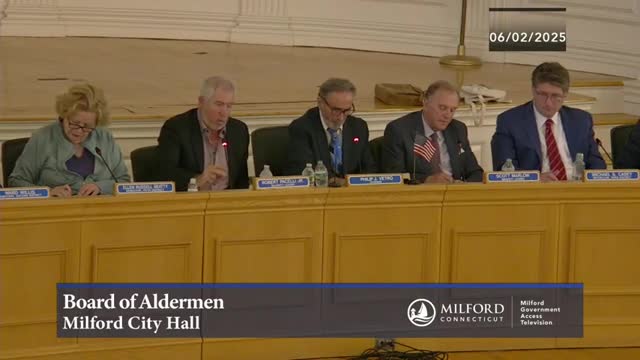
Summary
After identifying a previously unrecorded vote from May, the Board of Aldermen took and passed the outstanding motion to approve revenues and expenditures for the 2025–26 City of Milford budget with amendments; the final roll call was 8-7.
The Milford Board of Aldermen on June 2 voted 8-7 to approve the revenue and expenditure motion for the 2025–26 City of Milford budget as amended, closing a procedural gap from the May 8 meeting in which the final vote on the amended motion had not been taken.
Alderman Anthony Pacelli read the motion that had been left open after May 8 and stated it was his understanding the vote was the only outstanding item. The motion as read approved the revenue and expenditures for the fiscal year as recommended by the Board of Finance and incorporated three amendments adjusting pension, self-insurance and heart-and-hypertension accounts.
Why this matters: The procedural correction completed the formal vote required to enact the budget ordinance and set the mill rate that had already been processed administratively. The issue prompted substantial public comment about property taxes and who is responsible for the increase.
Amendments and fiscal details Alderman Pacelli read the amendments into the record before the vote. The three amendments included (as read): an increase to the Fire and Police pension line from $17,300,000 to $17,700,000; a decrease to the self-insurance contribution from $10,790,713 to $10,301,299; and a decrease to heart-and-hypertension claims from $900,000 to $750,000. City counsel and staff referenced the total ‘‘taxes to be raised’’ figure reflected on the posted minutes as $228,177,914 and a total appropriation figure of $264,664,181 upon which the mill rate had been calculated.
Public comment and aldermanic debate Several residents used the public comment period to voice opposition to the tax increase, arguing partisanship and past fiscal decisions led to higher rates. Jennifer Delvecchio said taxpayers ‘‘got higher taxes’’ after the recent votes and asked what the increase bought residents; Lee Lepper and Tracy Crutchfield expressed similar concerns about affordability and pension shortfalls.
Repeat of the May 8 discussion and procedural issue City Attorney Bertram explained that although the Board had passed the budget ordinance setting the mill rate, the underlying budget motion had not been voted on at the May meeting and therefore needed a formal vote to close the loop. Opponents argued the board should be allowed to re-open amendments; the chair and counsel said the budget discussion occurred May 8 and that only the missing vote remained.
Vote and outcome After debate and a roll-call the board approved the previously unvoted motion, 8 in favor and 7 opposed. Members who voted no expressed that they would have preferred additional time or alternative fiscal choices, while supporters said completing the record was necessary to provide certainty for tax billing and municipal operations.
Next steps With the budget motion recorded, staff will proceed with administrative steps tied to the approved appropriation and the mill rate already submitted for tax billing. The board retained the right to consider future budget transfers or other expenditure actions under regular procedures.