
State Foundation details public-art programs, special fund and commissioning process
Get AI-powered insights, summaries, and transcripts
Subscribe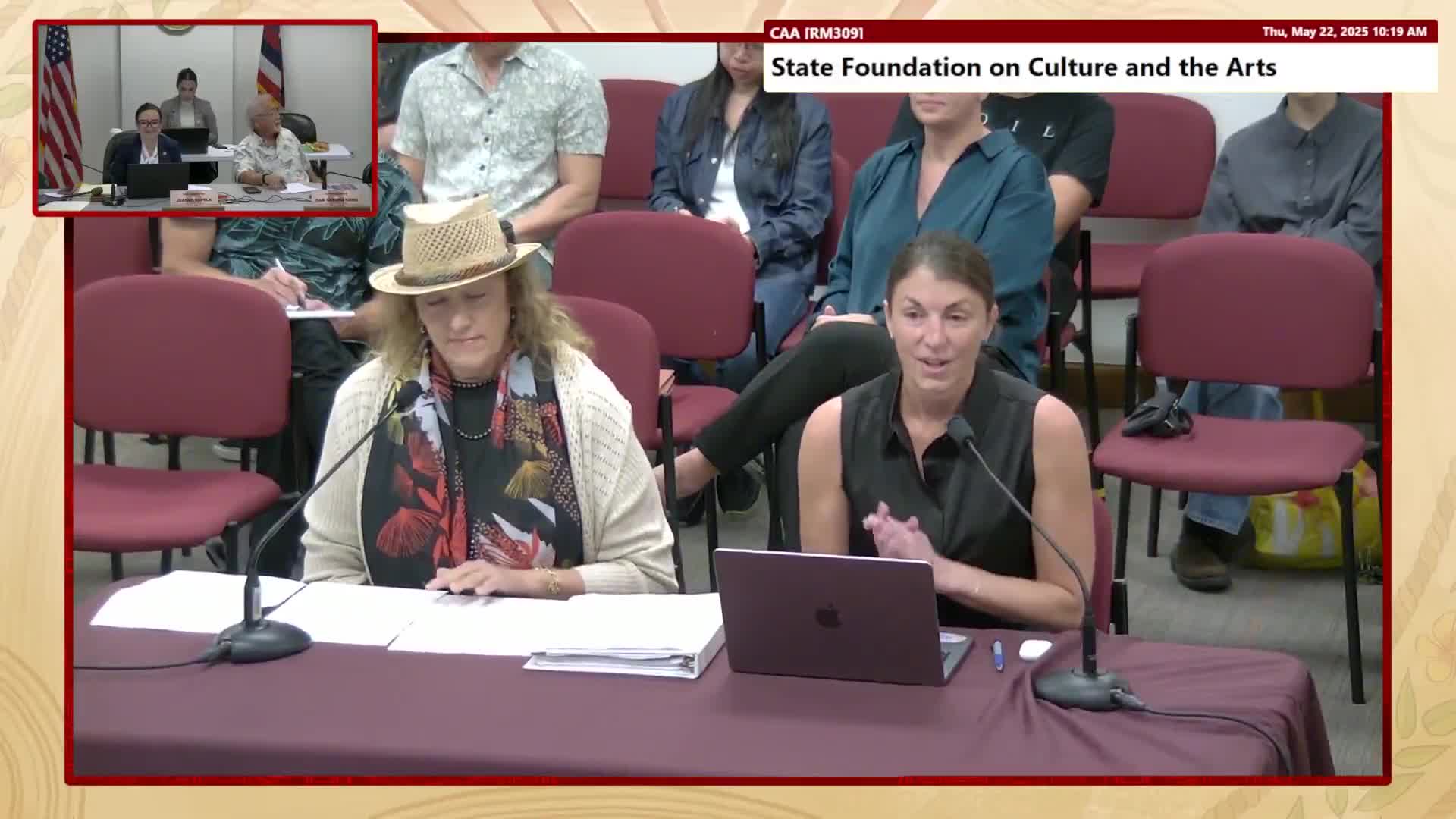
Summary
The State Foundation on Culture and the Arts updated lawmakers on public-art stewardship, the Works of Art Special Fund and how commissions and relocatable works are prioritized and procured.
The State Foundation on Culture and the Arts briefed the House Committee on Culture, Arts & International Affairs May 22 on its public-art programs, the uses of the Works of Art Special Fund and the process for commissioning art in state-owned facilities.
Karen Ewald, executive director of the State Foundation, said the foundation stewards the state’s public art collection, operates the Capital Modern museum and administers grant programs including Artists in the Schools, apprenticeship grants and a statewide cultural extension program.
“We are the state government's arts agency,” Ewald said. “We were established in 1965 … our mission is to promote, perpetuate, preserve culture and the arts in Hawaii.”
Ewald said the Works of Art Special Fund is a restricted pool of money designated for commissions and acquisitions. She told the committee the foundation is developing a spending plan for the special fund and that, historically, the foundation has spent roughly $1.5 million to $1.6 million a year on commissions and acquisitions while the fund allocation is larger. “We don't anticipate utilizing the whole 3.3,” she said in response to a question about the fund’s total balance and annual allocation.
Committee members asked how state agencies and institutions request new commissions. Ewald described a community-based process: a department head or facility sponsor raises the request; the foundation forms an art advisory committee that includes local stakeholders, cultural consultants and facility users; the committee issues a call and selects an artist; and the foundation contracts the artist and works through site coordination and installation. She said the commissioning timeline can take about a year, though construction delays and other factors can lengthen that schedule.
Ewald said the foundation oversees both permanent (commissioned) works and a relocatable collection that is rotated into community sites and exhibitions. “When it comes to relocatable works of art, we’re constantly rotating and filling,” she said. By contrast, commission projects are intended as longer-term site-specific works and go through a more extensive public-selection process.
Committee members pressed the foundation about access for neighbor-island artists and facilities. Ewald acknowledged logistical constraints and staff capacity that limit in-person visits and said the foundation would consider virtual consultations and clearer outreach to make the selection process more accessible.
On loans and outside requests, Ewald said the foundation does loan works to exhibitions and has processed international loan requests. She described a pending loan request from the British Museum as an example of the foundation’s loan program.
Members also raised opportunities to use relocatable works in private-public partnerships and to explore revenue-generating loans and placements; Ewald said those options can be discussed but noted statutory restrictions on the special fund and the need to respect the collection’s conservation and stewardship responsibilities.
The foundation asked the committee for help improving communication with state departments and for legislative and administrative coordination to ensure public-art opportunities in facilities across the islands are visible and accessible to local artists.