Get Full Government Meeting Transcripts, Videos, & Alerts Forever!
Get email alerts on the Rate Of Return topic
No spam. Unsubscribe anytime.
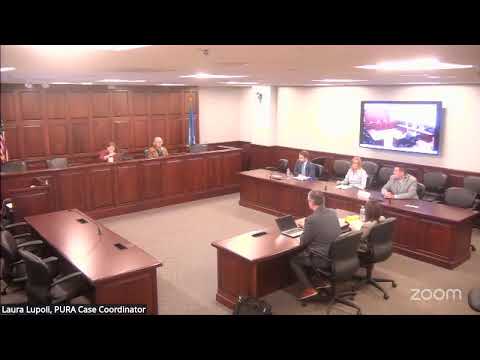
PURA hearing features dispute over Yankee Gas ROE, equity ratio and use of option-implied betas
Summary
Eversource and interveners disagreed over how to set Yankee Gasauthorized return on equity and capital structure during a multi-day Public Utilities Regulatory Authority hearing, with company witnesses defending higher ROE and a roughly 53.8% equity ratio and Office of Education, Outreach and Enforcement and other interveners urging lower ROEs using option-implied measures.
Eversource witnesses and opposing experts spent hours at a Public Utilities Regulatory Authority (PURA) hearing disputing how to set Yankee Gasauthorized return on equity (ROE) and capital structure, matters that determine how much customers pay and how the utility raises money.
The company presented a cost-of-capital panel that included Eversource finance and regulatory witnesses and outside consultants. Company filings and witness testimony showed the companyrequested an authorized ROE in the neighborhood of 10.3% and proposed a capital structure with roughly 53.81% common equity; company witnesses also provided forecasts for proposed long-term debt pricing if issued during the rate year. PURA staff, the Office of Consumer Counsel (OCC) and the Office of Education, Outreach and Enforcement (EOE) pressed witnesses on methodology and data.
Why it matters: The ROE and equity share are central to the utilityrevenue requirement; a higher authorized ROE or larger equity ratio increases the utilitycustomersrates, while too low an ROE can affect a utilitycost of access to capital.
Key positions and numbers
- Eversource witnesses explained the companyproposal and provided debt-pricing estimates (example: a 10-year new-issue rate near the mid-5% range and a 30-year near the mid-6% range when priced in the record). The company also sought permission to file investor reports as late-file exhibits.
- Doctor William (Woolridge) (Office of Consumer Counsel consultant) testified on a range of ROE and capital-structure positions. In questioning he confirmed he had previously recommended a different ROE in prior dockets and that his testimony in this docket implicated a recommended ROE of 9.3375% if PURA adopts his proposed 52.13% equity ratio.
- Aaron Rothschild (EOEfinancial consultant) recommended an ROE of 8.19%, saying his recommendation was "based on my computation of what the market indicates investors require" to provide capital to companies of comparable risk. Rothschild emphasized option-derived measures of forward-looking volatility and betas, including option-implied betas and implied-volatility term-structure charts, as central to his analysis.
Points of dispute
- Data sources and beta calculation: Witnesses debated which beta sources and methods best reflect investor risk. Eversource and some interveners criticized exclusive reliance on Value Line betas, noting Value Line uses weekly returns and a New York Stock Exchange index; others favored S&P Capital IQ or blended approaches. Dr. Woolridge said blending Value Line and S&P CapIQ betas and applying well-known adjustments (for example the Blume adjustment) produced lower betas and a lower ROE than if Value Line alone were used.
- Option-implied betas: Rothschild and other interveners argued option-implied betas and the VIX-style measures provide forward-looking information that caught rapid market changes (for example during COVID-19 and other shocks) earlier than standard historical betas. Company and OCC questioning focused on data sufficiency, liquidity and interpolation: Rothschild calculated option-implied betas for a seven-company proxy group but acknowledged some proxy companies lacked option data for every week in the sample period and that he interpolated or otherwise handled missing weeks for several companies. OCC and company counsel pressed whether interpolating sparse option data could smooth or misstate short-run swings and whether six-month option horizons map to long-term investor holding periods.
- Capital structure at parent versus subsidiary: Company witnesses (Emily O'Neil, assistant treasurer, Eversource Energy Service Company; Jonathan Callan and Doug Horton) testified that Yankee Gas has its own debt issuance program, its own credit metrics and credit ratings and should not be assumed to mirror the Eversource holding-company capital structure. O'Neil answered directly when asked if Yankee Gasshould have the same capital structure as the parent: "I absolutely do not." She and other company witnesses referenced a Moody's comment in the record that discusses Yankee Gasliquidity and an expected equity ratio of nearly 54% at the subsidiary level.
- Interpretation of credit-agency commentary: Rothschild pointed to an apparent inconsistency in S&P Global commentary: he said S&P downgraded Yankee Gas in December 2024 but then described Connecticut's regulatory construct as "credit supportive" in a January 2025 industry outlook. EOE asked PURA to accept that tension as evidence that quote-selection from credit reports should be read in full context; the document will be filed as a late-file exhibit and considered in the record.
Process notes and next steps
- Parties used cross-examination to press methodological matters; PURA granted the company permission to recall three company witnesses for brief rebuttal on a narrow parent-vs-subsidiary capital-structure point.
- The hearing record will include several late-file exhibits. Parties were instructed to submit those filings on June 18; PURA scheduled late-file exhibit hearings to begin June 26 at 9 a.m.
Discussion-only vs. formal action
- The hearing record shows extensive discussion, cross-examination and requests for late-file exhibits. No formal votes or Commission adjudicative rulings were taken during the session recorded in the transcript excerpt; the matter remains an open contested rate proceeding pending PURA decision.
What to watch
- Whether PURA adopts option-implied measures as a material input for setting ROE or instead relies on more-traditional DCF/CAPM approaches, and how PURA resolves the parent vs. subsidiary capital-structure question. Those determinations will directly affect Yankee Gasrevenue requirement and customer rates and will appear in PURAorders following the close of the evidentiary record.
Attribution: Quotes and attributions in this article come from witness testimony at the PURA hearing and are limited to speakers on the record, including Emily O'Neil (assistant treasurer and director of corporate finance and cash management, Eversource Energy Service Company) and Aaron Rothschild (president, Rothschild Financial Consulting).