Get Full Government Meeting Transcripts, Videos, & Alerts Forever!
Get email alerts on the Utilities Water Ownership Change topic
No spam. Unsubscribe anytime.
Officials, residents raise concerns at PURA hearing on proposed sale of Aquarion Water Company
Summary
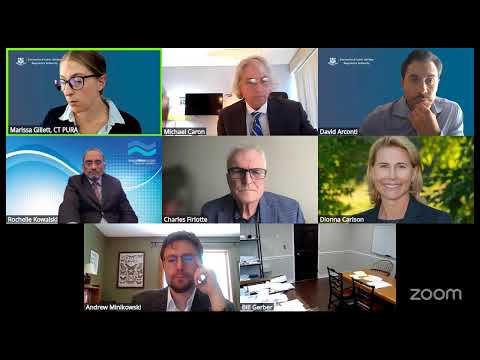
Chair Marissa Gillette of the Connecticut Public Utilities Regulatory Authority convened a public comment hearing on docket 250403 to collect views about a joint application to transfer control of Aquarion Water Company from Eversource Energy to the newly created Aquarion Water Authority (AWA), an entity affiliated with the South Central Connecticut Regional Water Authority (RWA).
Chair Marissa Gillette of the Connecticut Public Utilities Regulatory Authority convened a public comment hearing on docket 250403 to collect views about a joint application to transfer control of Aquarion Water Company from Eversource Energy to the newly created Aquarion Water Authority (AWA), an entity affiliated with the South Central Connecticut Regional Water Authority (RWA).
The applicants—represented on the call by Sunny Lakshmina Raynan (interim president and CEO of the AWA and South Central Connecticut Regional Water Authority), Rochelle Kowalski (senior vice president and chief financial officer) and Lucy Teixeira (president and chief operating officer of Aquarion Water Company)—said the acquisition would preserve local control, maintain existing Aquarion operations and customer rates at closing, and lower the cost of capital because the authority structure allows issuance of tax‑exempt debt. Raynan and colleagues told PURA the AWA would operate alongside RWA and that each of the 59 Aquarion municipalities would have representation on a proposed Aquarion Regional Water District Representative Policy Board (RPB). The petitioners said Aquarion rates would remain a separate schedule and not be “blended” with RWA rates.
Municipal leaders, state legislators and consumer advocates who spoke at the hearing questioned that account and urged PURA to scrutinize—or reject—the application. Key objections raised repeatedly included: lack of transparency in the legislative process that enabled the sale (speakers referenced Public Act 24‑1 from the June 2024 special session), potential loss of municipal property tax revenue if watershed lands convert to an authority pilot payment structure, an opaque financing plan to cover the roughly $2.4 billion purchase price, and the removal of Aquarion from PURA’s economic rate regulation to governance by a large, weighted Representative Policy Board.
State Senator Tony Huang said the authorization was “quietly authorized during the June 2024 special session through an omnibus bill, Public Act 24‑1, with no stand‑alone debate or public hearing,” and urged that a transaction involving a vital public resource require fuller public review. State Senator Ryan Fazio and several first selectpersons and mayors echoed concerns about process and possible consequences for customers and municipal budgets.
Municipal officials highlighted specific financial and governance concerns. First Selectman Gerber (Fairfield) questioned how the acquiring authority would service the purchase debt without “a significant negative impact on Aquarion customers,” and noted he saw “no answer” in the filings for how $2.4 billion of acquisition debt would be repaid. First Selectwoman Deanna Carlson (New Canaan) and others said the proposed governance is “structurally flawed,” calling a 60‑member RPB and an 11‑member expanded authority board (five AWA seats and six RWA seats under the proponents’ proposal) disproportionately weighted in favor of the RWA despite Aquarion’s larger customer base.
Multiple speakers gave examples of revenues that could be affected under a pilot system that replaces municipal property taxes: Ridgefield (speaker cited $365,000), Stratford (speaker cited roughly $600,000), and Wilton (speaker cited more than $100,000); several officials said pilot formulas in other contexts had declined over time. First Selectwoman Jen Tooker (Westport) and others pointed to historical rate increases under each model: they said PURA‑regulated Aquarion rates rose about 8.5 percent over the last decade while RWA’s policy board approved roughly 40.2 percent in the same period, producing an average monthly figure RWA supporters disputed (speakers quoted $64.66 monthly for RWA versus $44.71 for Aquarion).
Speakers representing labor, business and technical advocacy raised separate but related issues. Mark Lemke of SmartWater Connecticut and Charles Furlot (former Aquarion CEO, speaking for MetroCOG and several towns) said Aquarion’s recent capital plans and emergency projects indicate the utility needs strong, transparent planning and that shifting oversight to the RPB would remove independent regulatory review. Rob Powelson of the National Association of Water Companies (NAWC) and other industry commenters warned that some government‑run systems have compliance and investment deficits; NAWC cited historic sanitary survey findings and enforcement items for parts of the RWA system and urged continued independent economic regulation as a consumer protection. By contrast, Garrett Sheehan of the Greater New Haven Chamber of Commerce described RWA as a strong local partner and urged appreciation of RWA’s community engagement.
PURA’s chair closed the hearing by saying comments will be transcribed and placed in the docket. The authority’s next formal step is an evidentiary hearing scheduled for July 17 at 10 a.m.; the commission plans to issue a proposed draft decision on or around Oct. 22 and to consider a final vote at an open meeting on Nov. 19. PURA staff and intervenors will have the opportunity to question the applicants at the evidentiary hearing.
Public comments made at the hearing and written submissions to docket 250403 will be part of the record. Chair Marissa Gillette said written comments can be emailed to PURA’s executive secretary with reference to docket number 250403. The commission will use the record to inform its review but has not yet taken action on the application.