Get Full Government Meeting Transcripts, Videos, & Alerts Forever!
Get email alerts on the Depreciation And Accounting topic
No spam. Unsubscribe anytime.
Expert witness defends use of Iowa survivor curves in Yankee Gas depreciation analysis
Summary
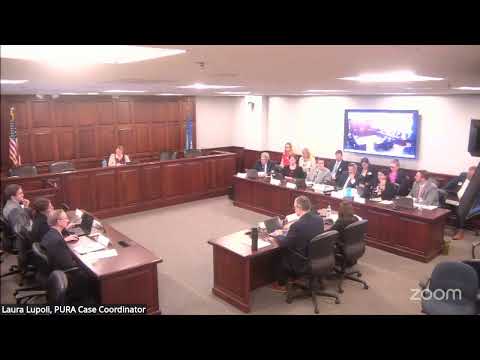
At the late-file hearing, the company’s depreciation expert explained use of Iowa curves and curve-fitting practices described in the 1996 NARUC Public Utilities Depreciation Practices Manual after OCC questioned the methodology.
Yankee Gas’s depreciation panel answered detailed technical questioning from the Office of Consumer Counsel about the company’s use of survivor-curve methods to estimate asset service lives.
Ned Allis, a vice president with Gannett Fleming Valuation and Rate Consultants and one of the company’s depreciation witnesses, told the authority the industry widely uses the empirically derived ‘‘Iowa curves’’ (commonly labeled R, S, L, O etc.) to represent retirement patterns for utility plant. He said the 1996 NARUC Public Utilities Depreciation Practices Manual describes curve-fitting and visual matching techniques that analysts use to select an appropriate curve shape from the Iowa family. “The Iowa curves were empirically developed survivor curves,” Allis testified, adding that the curves ‘‘continue to work very well for utility property’’ and that mathematical alternatives such as Gompertz–Makeham curves were developed for different applications.
OCC accounts examiner Rory Apollonia asked for precise citations in the manual and whether certain curve shapes (H curves) were used in the company’s work. Allis confirmed the company did not use H curves in its Yankee FERC accounts and explained differences between the Iowa set and other mathematical functions used in age-life estimation. Allis told the panel that modern computing power has improved curve-fitting precision since the manual’s 1996 publication but that the fundamental techniques remain consistent.
Why this matters: Depreciation life estimates affect annual depreciation expense and therefore rate base and revenue requirements in a utility rate case. The OCC’s cross-examination explored whether the company’s life-estimation approach is consistent with accepted industry practice and with the published NARUC guidance.
What was decided: The panel confirmed the witnesses had sponsored and adopted late-file exhibit responses and were available for OCC cross-examination. No procedural ruling on the expert’s testimony was issued at the hearing; PURA will weigh the evidence as part of the record.
Quotes: ‘‘The Iowa curves were empirically developed survivor curves…which is one of the primary reasons why they're used so widely for utility property,’’ Allis said. OCC’s examiner confirmed the witness’s familiarity with the NARUC manual and referenced pages and appendices during cross-examination.
Context: The exchange occurred during a late-file hearing focused on admission of additional exhibits and witness availability for cross-examination; parties combined technical confirmatory testimony with procedural scheduling.