Get Full Government Meeting Transcripts, Videos, & Alerts Forever!
Get email alerts on the Licensing Disciplinary Hearing topic
No spam. Unsubscribe anytime.
DPH hearing: expert testifies counselor violated boundaries; prior unemployment ruling admitted as evidence
Summary
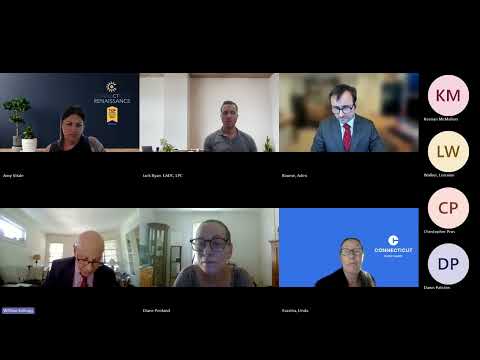
A public hearing before the Connecticut Department of Public Health on June 23, 2025 examined a complaint (docket no. 2023-1156) alleging that respondent Diane Penland, a licensed alcohol and drug counselor, failed to maintain appropriate patient boundaries by exchanging flirtatious or social text messages with an inpatient client.
A public hearing before the Connecticut Department of Public Health on June 23, 2025 examined a complaint (docket no. 2023-1156) alleging that respondent Diane Penland, a licensed alcohol and drug counselor, failed to maintain appropriate patient boundaries by exchanging flirtatious or social text messages with an inpatient client. Hearing officer Aiden Baum admitted multiple exhibits into the record, including a June 20, 2024 decision from an unemployment appeals referee, and heard testimony from the department’s expert, Jack Ryan.
The hearing matters because the department is considering licensing discipline for Penland, and the evidence and expert testimony address whether Penland’s conduct violated professional standards of care for addiction counselors. Attorney Linda Fazina, representing the Department of Public Health, told the hearing that the case centers on boundary violations in text messages and that license revocation would not be out of the question if violations are found. Attorney William Kellogg, for the respondent, said Penland does not dispute the factual content of the messages but disputed that they establish a romantic or sexual relationship and said Penland attempted to report the messages to her superiors.
During a contested procedural phase, Hearing Officer Aiden Baum admitted Record Exhibits 1–8 and Department Exhibits 1–8 into the record. He granted a limited sealing request: Department Exhibit 2, pages 2–3, and Department Exhibit 3 were ordered sealed. The hearing officer overruled the Department’s objection and admitted the respondent’s proffered unemployment appeals decision (respondent’s exhibit A) with a statement that its relevance and weight would be assessed in the context of the full record. The hearing officer also admitted the respondent’s answer to the statement of charges as Record Exhibit 9.
Jack Ryan, accepted by the hearing as an expert in substance use treatment and clinical standards, described relevant training and cited ethical standards for addiction professionals. Ryan testified that the standard of care requires clinicians to keep interactions focused on treatment, to avoid social or romantic engagement with current clients, and not to provide clients with a clinician’s personal phone number in an inpatient setting. He described the exchanged text messages in the record — including a cartoon “skunk” image and replies such as “Come to my office ASAP” — and said those messages were not neutral. Ryan said a proper clinical response to flirtatious or sexual outreach is to “unequivocally shut it down and report it to the supervisor; that is the standard.” He testified that, based on the materials he reviewed, he found boundary violations and did not see documentation showing Penland reported the client’s outreach to a supervisor.
Attorney Kellogg cross-examined Ryan on context, emphasizing the absence of a company-issued phone for Penland, the risk that the client (who Ryan understood to be under Department of Corrections supervision) could be removed from the program if reported, and arguments that Penland made efforts to report the messages. Kellogg asked the referee to consider a June 20, 2024 unemployment-appeals decision involving the same underlying events; the hearing officer admitted that decision as an exhibit for its potential factual value, noting that the legal standards in an unemployment proceeding differ from those in a licensing proceeding.
Department counsel framed the proceeding as a licensing and disciplinary matter limited to allegations of boundary violations and inappropriate texting; counsel said unrelated allegations (the investigative report’s references to inappropriate touching) were not part of the charges before the hearing. Defense counsel indicated Penland had offered to surrender her license but the hearing sustained an objection that settlement offers are not admissible.
The hearing recessed for lunch and was scheduled to reconvene at 12:30 p.m. The hearing officer stated he would later issue findings of fact, conclusions of law and an order in the matter.
No final disciplinary decision was announced on June 23; the hearing record remains open to evidence and further testimony.