Get Full Government Meeting Transcripts, Videos, & Alerts Forever!
Get email alerts on the Professional License Discipline topic
No spam. Unsubscribe anytime.
Licensed counselor testifies she exchanged texts with patient; employer dismissed her July 17, 2023
Summary
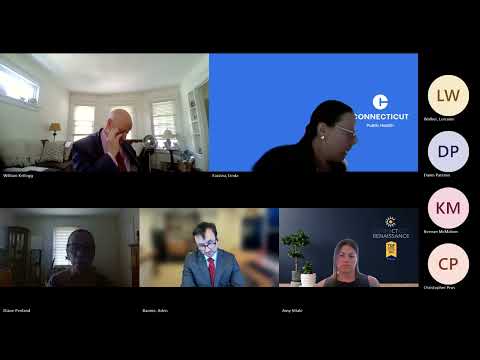
Ms. Penland, a licensed alcohol and drug counselor, testified at a state disciplinary hearing that she exchanged text messages with a patient and acknowledged the conduct was a mistake that crossed professional boundaries.
Ms. Penland, a licensed alcohol and drug counselor, testified at a state disciplinary hearing that she exchanged text messages with a patient and acknowledged the conduct was a mistake that crossed professional boundaries. The texts occurred in July 2023, and she confirmed she was dismissed by her employer, Connecticut Renaissance, on July 17, 2023.
The charges at the hearing center on whether the counselor violated professional-boundary standards by using personal electronic communication with a current patient. The hearing record shows Penland conceded that responding to the patient’s texts was wrong: "Yes. I did," she told the panel when asked if replying to the messages was an error in judgment. Later she added, "I misstepped. I agree. I agree that I misstepped. But I had no ill intention."
The Department’s questioning and documents entered as exhibits established several time and personnel details. Penland said she began working at Connecticut Renaissance in early March 2023 (an offer letter in the record is dated March 6, 2023) and that she worked there about six months before being dismissed on July 17, 2023. She also confirmed she is licensed by the Connecticut Department of Public Health as a licensed alcohol and drug counselor.
Amy Vitale, Connecticut Renaissance’s chief clinical officer, described the Waterbury West residential program: "Connecticut Renaissance Waterbury West. It's a 50 bed program for adult men, of which at the time, of this case, there were 10 beds designated to DOC," she told the hearing. Vitale also described the employer’s policy about agency-issued phones: "The only staff members in the residential program for Waterbury West that have a cell phone and are, permitted to have 1 per policy are the program director, the clinical supervisor, and the driver of the program. There are no other agency issued cell phones at that program."
Penland told the panel she provided her personal cell number to the patient after the patient reported being left waiting outside appointments and said he was "scared" he might use alcohol. She said the program’s operational practice — clients having personal phones and being transported off-site for appointments (sometimes with a driver who did not always stay with them) — left her feeling she had no reliable way to reach or support the patient other than her own phone. Penland repeatedly testified she raised concerns with supervisors and that she attempted to bring the matter to management: she described knocking on her program director’s office, leaving messages, and keeping a written journal of contacts she tried to make.
Vitale and Penland gave conflicting accounts about access to agency equipment. Vitale said staff completed trainings on ethics and program rules on hire and that trainees signed off on trainings including an ethics policy item that lists sharing personal cell-phone information as a boundary violation; she also said clinicians completed behavioral-health and corporate-compliance trainings (records in the hearing show Penland completed several trainings in mid-March 2023). Penland said she repeatedly requested a company-issued phone and a laptop and that, in her view, other clinicians had devices while she did not.
Penland described her professional conflict in deciding whether to report the patient’s texts to supervisors: she said she feared reporting him could lead to removal from the residential program and possible incarceration, which she believed would interrupt therapy and increase the risk the patient would relapse. That concern, she said, contributed to her reluctance to escalate the matter earlier. Counsel and the hearing officer objected at times to lines of questioning about broader operational issues, including PREA training and other program practices; the record contains sustained and withdrawn objections on those points.
The hearing record includes personnel documents admitted under seal as department exhibit 3 and a written response from Penland’s attorney dated April 29, 2024, referenced in the hearing. Penland agreed with language in that response that described her conduct as an "error in judgment" with respect to texting the patient, though she disputed that giving the phone number alone was the principal error.
No final licensing decision appears in the transcript. The panel heard testimony and examined exhibits over two witness presentations (Penland and Amy Vitale); closing arguments at the hearing emphasized professional-boundary standards and whether the text-message exchanges fit the licensing board’s prohibitions. The licensing outcome is not recorded in the portion of the transcript supplied.
Ending
The record at this hearing centers on boundary-crossing by a clinician who acknowledged "misstep" and on whether agency policy, training and supervision were adequate to prevent such breaches. The licensing panel will weigh the testimony, the exhibits and the board’s professional standards before issuing any determination.