Get Full Government Meeting Transcripts, Videos, & Alerts Forever!
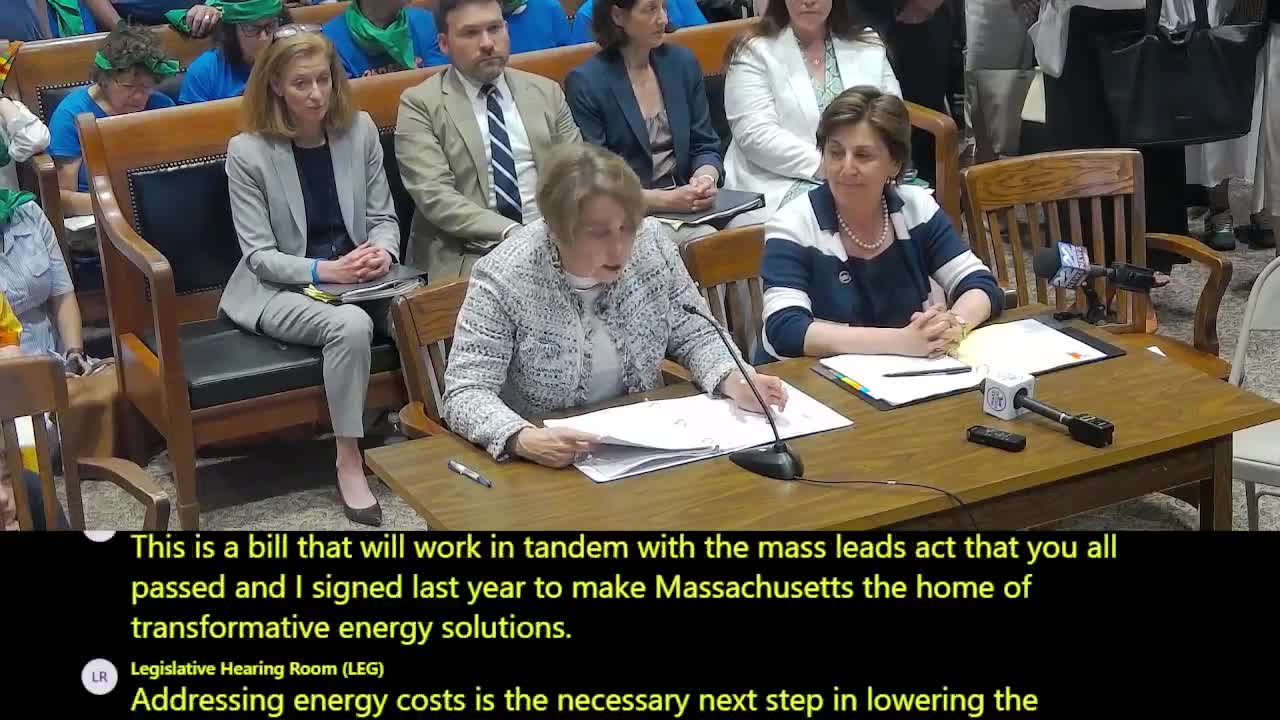
Mass. hearing on Energy Affordability, Independence and Innovation Act draws wide support and sharp questions
Summary
The governor and administration officials presented House Bill 4 1 4 4 as a package designed to lower energy bills and accelerate clean energy supply, while lawmakers and dozens of witnesses pressed for changes on securitization, net metering, geothermal ownership and consumer protections.
The governor and administration officials outlined a sweeping bill they say would lower household and business energy costs while accelerating clean energy and new financing tools.
"This bill will save energy consumers at least $13,700,000,000 over the next 10 years," Governor (unnamed) told the Joint Committee, citing administration modeling and independent analysis the team said it would share with the committee. The governor and her team framed the measure as a package that combines near-term bill relief with long-term policy changes to bring more homegrown and regional clean energy online.
Why it matters: Committee members said they wanted a single legislative vehicle that attempts to address three problems at once: high bills after a volatile winter, the need for more clean generation and storage that can be brought online quickly, and a transition away from an aging gas-delivery system that carries rising capital costs. The hearing drew labor unions, environmental groups, municipal officials, solar and geothermal trades, utilities and consumer advocates.
What the bill would do
- Reduce and restructure certain volumetric charges on bills and expand access to lower, discounted rates for targeted households. - Direct the Department of Public Utilities (DPU) to undertake comprehensive reviews of reconciling charges on customer bills and to require distribution-system planning aimed at lowering the need for costly upgrades. The administration estimated this could save about $1.7 billion over 10 years. - Enable securitization and rate-reduction bonds for energy-efficiency investments such as Mass Save, with the administration saying securitization could save ratepayers conservatively more than $5 billion over a decade. - Reform Mass Save program administration (fewer program administrators, greater coordination), expand targets for moderate-income customers and authorize on-bill and utility-led financing for heat pumps and weatherization. - Create authority and procedures for broader, "all-resource" procurements led by the Department of Energy Resources (DOER) rather than strictly by utilities;…
Already have an account? Log in
Subscribe to keep reading
Unlock the rest of this article — and every article on Citizen Portal.
- Unlimited articles
- AI-powered breakdowns of topics, speakers, decisions, and budgets
- Instant alerts when your location has a new meeting
- Follow topics and more locations
- 1,000 AI Insights / month, plus AI Chat