Get Full Government Meeting Transcripts, Videos, & Alerts Forever!
Get email alerts on the Energy Affordability Act topic
No spam. Unsubscribe anytime.
Mass. hearing on Energy Affordability, Independence and Innovation Act draws wide support and sharp questions
Summary
The governor and administration officials presented House Bill 4 1 4 4 as a package designed to lower energy bills and accelerate clean energy supply, while lawmakers and dozens of witnesses pressed for changes on securitization, net metering, geothermal ownership and consumer protections.
The governor and administration officials outlined a sweeping bill they say would lower household and business energy costs while accelerating clean energy and new financing tools.
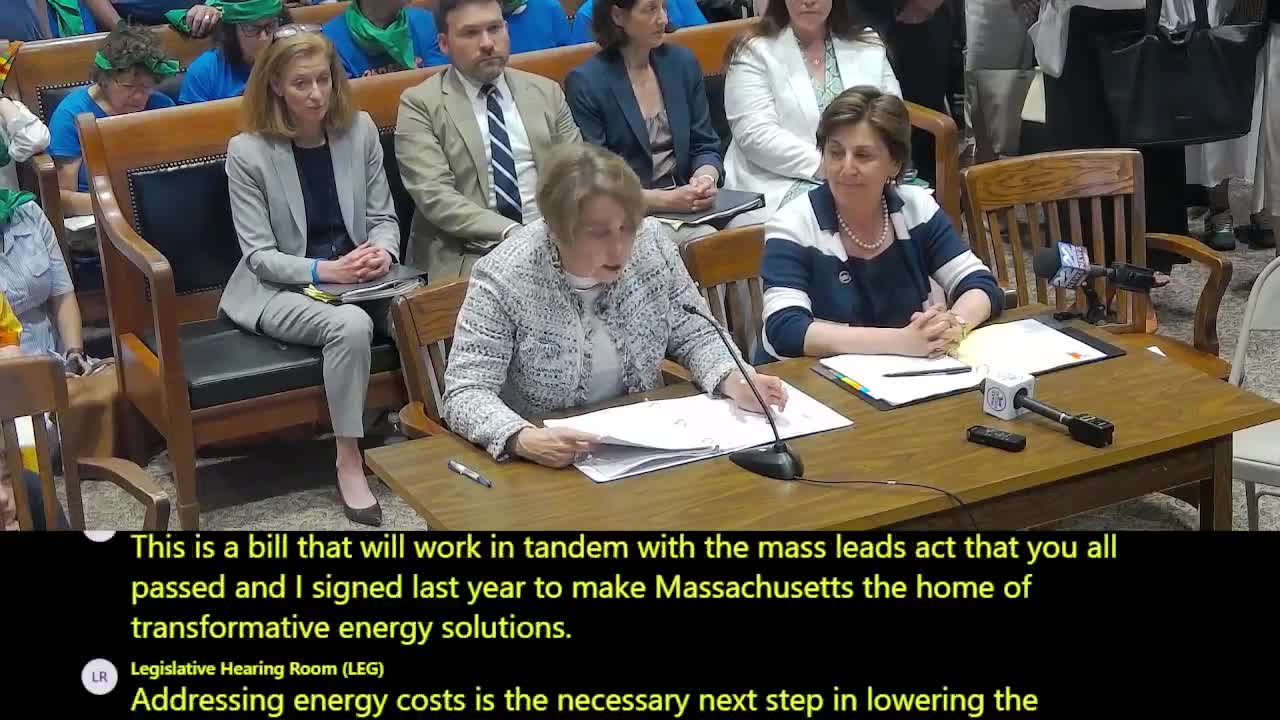
"This bill will save energy consumers at least $13,700,000,000 over the next 10 years," Governor (unnamed) told the Joint Committee, citing administration modeling and independent analysis the team said it would share with the committee. The governor and her team framed the measure as a package that combines near-term bill relief with long-term policy changes to bring more homegrown and regional clean energy online.
Why it matters: Committee members said they wanted a single legislative vehicle that attempts to address three problems at once: high bills after a volatile winter, the need for more clean generation and storage that can be brought online quickly, and a transition away from an aging gas-delivery system that carries rising capital costs. The hearing drew labor unions, environmental groups, municipal officials, solar and geothermal trades, utilities and consumer advocates.
What the bill would do
- Reduce and restructure certain volumetric charges on bills and expand access to lower, discounted rates for targeted households. - Direct the Department of Public Utilities (DPU) to undertake comprehensive reviews of reconciling charges on customer bills and to require distribution-system planning aimed at lowering the need for costly upgrades. The administration estimated this could save about $1.7 billion over 10 years. - Enable securitization and rate-reduction bonds for energy-efficiency investments such as Mass Save, with the administration saying securitization could save ratepayers conservatively more than $5 billion over a decade. - Reform Mass Save program administration (fewer program administrators, greater coordination), expand targets for moderate-income customers and authorize on-bill and utility-led financing for heat pumps and weatherization. - Create authority and procedures for broader, "all-resource" procurements led by the Department of Energy Resources (DOER) rather than strictly by utilities; provide new procurement tools to bring incremental regional resources (offshore wind, Maine onshore wind, Canadian imports, battery storage) into the state's supply stack. - Require reforms to the interconnection process and stand up "energy-ready" zones to streamline connection for new development. - Expand authority for geothermal network deployments and clarify how utilities and third parties may finance distributed thermal energy. - Tighten consumer protections for competitive retail suppliers: curbs on predatory marketing, limits on automatic renewal and variable-rate rollovers, and expanded DPU enforcement authority. - Restrict ratepayer funding for advertising and lobbying by utilities and add new reporting requirements. - Place a temporary moratorium on utility shutoffs during extreme heat events and add other protections for low- and moderate-income ratepayers.
Debate and concerns
Supporters: Labor, community groups, clean-energy developers and municipal officials called the bill a major step toward predictable bills and more affordable electrification. Amy Boyd Rabin, vice president of policy and regulatory affairs, Massachusetts AFL-CIO, said the bill "keeps the cost of energy down for working families, while allowing our state to keep building up a stronger, safer, cleaner and more resilient energy infrastructure." Kristin Gowen of the National Electrical Contractors Association said the bill aligns procurement and workforce standards that will help create "high-road careers."
Securitization questions: Multiple legislators pressed administration witnesses on the costs of securitizing Mass Save and similar programs. One senator asked whether the bill requires an apples-to-apples comparison of "all-in" costs (total interest plus lost tax revenue from federally tax-exempt bonds) versus traditional rate recovery. Administration witnesses said the bill directs the DPU to review rate impacts and overall costs before any securitization plan could go forward, and that utilities would not earn a return on securitized balances.
Net metering and SMART: Industry witnesses warned that a proposal in the bill to require certain net-metered solar projects to enroll in the SMART program could be effectively retroactive and undercut financing for projects that have long interconnection queues. Developers and trade groups asked the committee to make any change prospective and to allow projects to choose the incentive program that preserves their revenue streams.
Geothermal and market structure: The draft would give gas utilities authority to construct ground heat-exchange loops for large customers or campuses, a provision that prompted pushback from existing geothermal businesses. The geothermal trade group asked the committee to limit utility ownership to very large "network" systems (for example, a proposed 1-megawatt minimum) and to preserve a competitive role for local installers.
Alternative Portfolio Standard (APS) and biomass: The bill would repeal the APS, which currently supports some renewable liquid fuels and other resources. Industry representatives told the committee they would accept repeal only if it is replaced by a functioning Clean Heat Standard that carries forward emissions reductions and avoids a gap in climate policy. Environmental advocates and Springfield residents warned against allowing municipal utilities to purchase electricity from woody-biomass plants and asked the committee to bar ratepayer-funded purchases of new biomass power.
Third-party suppliers and consumer protection: The bill tightens DPU authority over marketing and contracts by competitive retail suppliers. Community groups and consumer advocates endorsed the protections on automatic contract renewal and variable-rate products but urged stronger enforcement tools, and some urged an outright ban on residential third-party supply sales.
Municipal utilities: Public-power representatives said municipal light plants (MLPs) already deliver lower rates and worried that new reporting requirements and centralized oversight could impose costly administrative burdens and erode local control. MLP groups asked the committee to tailor reporting to be practical for small utilities and to avoid duplicative state-level mandates.
Nuclear-referendum repeal: The draft contains a controversial section (section 45) that would repeal the 1982 voter-approval requirement for new nuclear reactors. Opponents from coastal and environmental groups urged removal of that section, calling the change an attack on a decades-old ballot safeguard; labor and some industry witnesses urged leaving the option on the table for advanced nuclear technologies.
Consumer-facing changes and near-term relief
Administration witnesses highlighted items that could produce quick bill relief: removing certain surcharges from volumetric charges, expanding discounted rates for electrified heating customers, and improving Mass Save targeting. The administration also emphasized steps to reduce bill volatility and peak-price exposure, including more behind-the-meter solar and storage, demand-response and regional procurement that captures lower-cost wind from Maine.
Process and next steps
The committee heard many panels representing labor, environmental organizations, developers, utilities, municipal officials and consumer advocates. Several witnesses asked for technical changes: stronger clarity in securitization language, protections to ensure retroactivity does not harm projects in long interconnection queues, limits on utility ownership of certain geothermal projects, and stronger DPU enforcement tools for consumer protections.
"Heat waves like the one we're in now are only going to become increasingly common," Amy Boyd Rabin said, urging timely action on both affordability and workforce protections.
Ending note
Lawmakers signaled interest in moving components of the bill quickly but also in holding follow-up sessions to refine technical language. Witnesses from across the policy spectrum told the committee they were ready to work on amendments: industry and utilities on procurement, unions on labor standards and just-transition language, and community groups on protections for low-income and environmental-justice neighborhoods.
No formal votes were recorded at the hearing; the measure will proceed through the committee process for further amendment and markup.