
Supporters and real estate industry clash over House bill to give tenants first right of refusal
Get AI-powered insights, summaries, and transcripts
Subscribe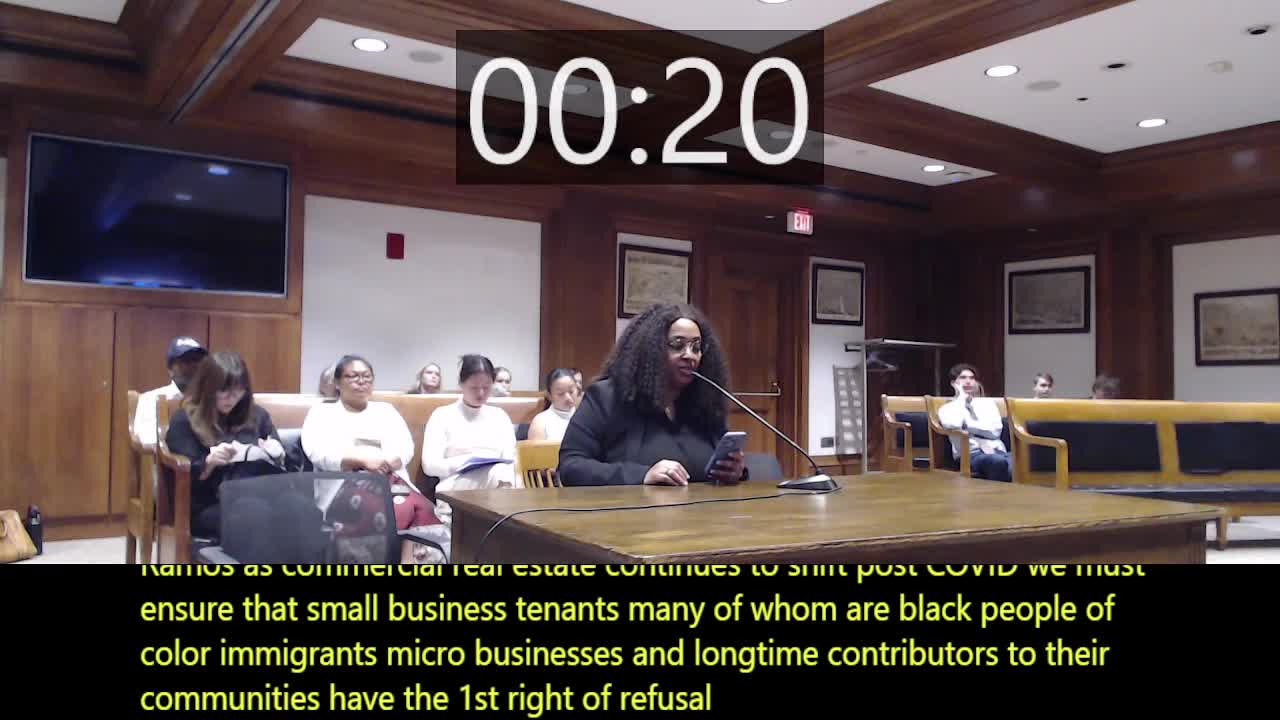
Summary
Witnesses and business owners told the Joint Committee on Community Development and Small Business that House Bill 306 would protect small commercial tenants from sudden property sales, while the Greater Boston Real Estate Board warned the mandate would add costs, delays and discourage investment.
The Joint Committee on Community Development and Small Business heard competing testimony on House Bill 306 on March 12, which would grant commercial tenants a statutory first right of refusal when their building is sold.
Supporters said the change would give small, minority- and immigrant-owned storefronts time to raise capital and avoid displacement; opponents said the mandate would inject delay and uncertainty into commercial real estate transactions.
Alyssa Banelfu Ramos of the Black Economic Council of Massachusetts and Lena Redd, a Springfield-based co-owner of Soul Out Kitchen and First Saigon, told the committee that tenants often receive short notice when owners decide to sell and that a first right of refusal would give them a real chance to remain in place. Ramos said many of her organization’s members “have worked really hard to obtain these storefront brick and mortar businesses” and described receiving “very, very short notice” when properties go on the market.
“Together, these bills will address speed bumps, challenges, and systemic inequities,” Ramos said in testimony that included H.306 among a package of bills.
Jackie McCarthy, director of government affairs at the Greater Boston Real Estate Board, testified in respectful opposition to H.306. “Mandating a tenant’s first right of refusal will add cost and delay to the commercial real estate process,” McCarthy said. She warned it could “impose uncertainty in the sale of commercial real estate, chill market interest and decrease valuations and the commercial tax base.” McCarthy said tenants can already negotiate a right of first refusal into their leases and that a statutory requirement could have unintended consequences for market liquidity and property valuations.
Committee members asked witnesses for data on how often tenants face sudden sales; advocates acknowledged they relied largely on anecdote and organization casework and offered to provide further written information. The committee did not take a vote during the hearing.
No statutory text was enacted at the hearing; proponents asked the committee to consider H.306 alongside broader capital-access and tenant-protection measures.