
House Revenue Committee hears update on HB 3518 funding for county assessment and taxation
Get AI-powered insights, summaries, and transcripts
Subscribe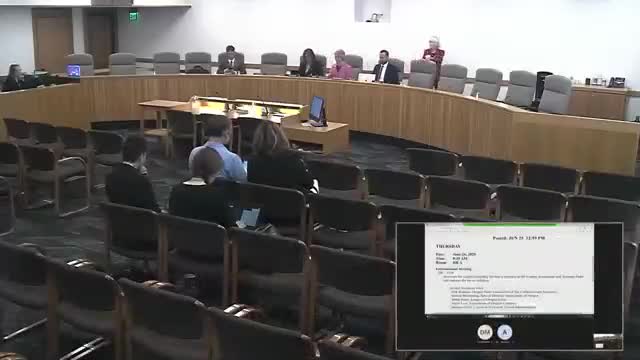
Summary
The House Committee on Revenue met June 26 for an informational briefing on House Bill 3518, which would change funding and administration of county assessment and taxation (CAFA).
The House Committee on Revenue met June 26 for an informational briefing on House Bill 3518, which would change funding and administration of county assessment and taxation (CAFA). Committee members invited county and local government representatives to provide a status update; no vote or formal action was taken.
The bill would alter how CAFA funds—currently redistributed to counties from a portion of certain recording fees and interest on delinquent property taxes—are distributed and administered. Stakeholders and legislative staff described a proposal that includes clearer intent language for investment of additional CAFA funds, new metrics and reporting, and a temporary 0.3% holdback that would be reevaluated for adequacy in a later report back if the bill or a similar measure advances.
"Modernizing CAFA and sufficiently funding county A and T across the state remains to be the number 1 revenue priority for the Association of Oregon Counties," said Justin Lowe, representing the Association of Oregon Counties. Lowe and other county representatives emphasized that adequately funded assessor and taxation offices are needed to catch up on omitted property, maintain healthy reappraisal cycles and support real estate markets and disaster recovery.
Eric Chancellor summarized staff thinking on draft changes. He said lawmakers are aiming for a "balanced solution, specifically a 3 legged solution ... where the public contributes, the districts contribute, the state contributes," and that the interim will be used to work with stakeholders on details. Chancellor also described three near-term drafting priorities: clarifying how new CAFA money would be invested, adding metrics already collected through CAFA grant applications, and building in a future reevaluation of the 0.3% holdback.
Representatives of local governments raised concerns that the proposed funding mechanism not supplant existing local revenue streams. "We think that A and T is symptomatic of the larger property tax system being flawed and broken," said Jenna Jones of the League of Oregon Cities, who said many cities remain uneasy about a percent taken "off the top" of county revenues and want assurances that the new funding would be supplemental, not supplanting.
Hasina Wittenberg of the Special Districts Association of Oregon said the association views assessor and taxation functions as a "core function for counties" and urged the work group to identify which counties are in distress so funding can be targeted to produce demonstrable return on investment. Morgan Ahn of the Coalition of Oregon School Administrators noted the state school funding formula means many K‑12 districts would not see a direct local benefit if local property tax collections rose because receipts are pooled and equalized statewide; she recommended exempting bonds and local option levies from any new assessment and exploring whether other state funding streams used for tax collection (for example, a corporate activity tax allocation used for Student Success Act collections) could play a role.
The committee also heard background figures from an LRO issue brief: a roughly $5 million per‑biennium General Fund appropriation was previously added to CAFA distributions beginning in February (year not specified in the briefing); the Department of Revenue (DOR) takes 10% of redistributed CAFA receipts for administration and centrally assessed work; and CAFA distributions represented roughly 22% of statewide assessor and taxation costs in the 1990s, peaked near 33% in 2003, averaged about 26% in the 2000s, and have averaged about 15% over the past five years.
Staff and stakeholders said there have been ongoing discussions with the Department of Revenue about how DOR reviews county CAFA grant applications and that more specific administrative guidance or rule changes and a fall 2026 report back would be part of the implementation work should legislation pass. "We didn't want to hardwire that into statute," Eric Chancellor said of procedural adjustments, adding that more detailed administrative work will be needed if the policy advances.
Representative Marsh told the panel that the state has a stake in an efficient local tax collection system because greater local collections can reduce state obligations. Several committee members and presenters said they expect the topic to continue through the interim with additional outreach across counties and affected districts; the committee did not take formal action at the meeting.
Next steps identified in the briefing include continued interim stakeholder discussions, additional conversations with the Department of Revenue to specify administrative changes if a bill advances, and a possible statutorily required reevaluation of the 0.3% holdback in a future report back. No motion, vote, or statutory change occurred at this informational meeting.