Get Full Government Meeting Transcripts, Videos, & Alerts Forever!
Get email alerts on the Urban Forestry topic
No spam. Unsubscribe anytime.
Long Branch environmental commission urges tree-planting push, seeks city help for rain-garden install
Summary
An Environmental Commission presentation to the Long Branch City Council outlined a neighborhood tree giveaway and seedling nursery, described two small grants for a rain garden near an elementary school, and sought city Department of Public Works support; the council later voted to go into executive session under resolution R114-25.
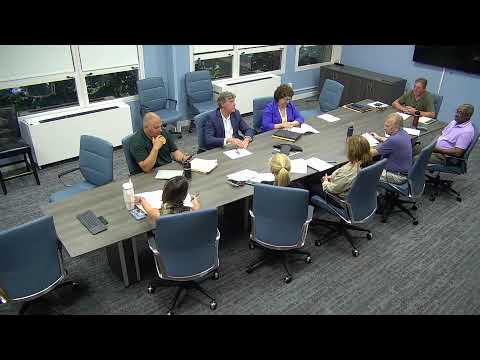
An Environmental Commission presentation to the Long Branch City Council on Oct. 12 outlined plans to rebuild the city's urban tree canopy, pilot a neighborhood tree giveaway and seedling nursery, and advance a rain-garden project funded by two small grants.
The commission's presenters said Long Branch's tree canopy has fallen about 10% over the past decade and described several near-term initiatives to reverse that loss. "We gave away 150 trees this year. We had to buy them," an Environmental Commission member said, adding, "We're gonna build our own nursery, and we're gonna raise them ourselves." The presenters said the nursery will be housed in a community garden and will supply seedlings for future giveaways.
Commissioners said they plan a direct-to-resident neighborhood program that would provide mostly 6-to-8-foot saplings, with volunteers doing planting and homeowners responsible for ongoing maintenance. The commission described a pilot target of about 20 trees for the first round and said the Elks Lodge is considering planting four shade trees along a roadway adjacent to a school. "We're thinking maybe about 20 trees max, and we'll see who responds," the commission's presenter said.
The commission also discussed an existing design to plant trees in Trappin Park, prepared by Catherine Duckett, and said the group could pursue that work if funds remained after the neighborhood program.
On green infrastructure, the commission reported it holds two grants totaling about $8,000 for a rain garden along Avenue Boulevard near an elementary school and a culvert that drains into Jackson Woods park. Presenters described a new design that includes a curb cut and a pipe to carry overflow into the storm drain and said Friends of Jackson Woods would agree to maintain the planting area. "The school is supportive, but the design came back with a curb cut, and then it's got a pipe that pipes all the overflow ... into the storm drain," an Environmental Commission member said.
The presenters asked for assistance from the city Department of Public Works to perform the curb cut and pipe installation, noting the work requires hiring a contractor. Council discussion referenced a prior curb-cut price of about $1,700; the presenters said they expected to hire a contractor for the curb-cut work and requested DPW support for two items the school could not perform.
The commission summarized other ongoing efforts: native-plant garden work in Rust Lake and Jackson Woods, a seed-collection program and fall tree walks, quarterly drop-off dates for foam (polystyrene) recycling, and a green-business recognition program that has certified nine local businesses. "We have 9 businesses that were certified by the green business recognition program," the presenter said, and asked the council for ideas to promote participating businesses.
Presenters also reviewed several grant items: a water-bottle-refill-station grant from New Jersey American water company appears limited to schools and universities, making some applicants ineligible; Elbron Station Park library landscaping and renovation funds previously awarded were reported as put on hold by a change in administration; and two grants for community energy planning and a climate vulnerability assessment were described as awarded on paper but delayed while the state moves the applications into an online approval system. The climate vulnerability technical-assistance award was described as about $5,000.
Council members and other speakers raised practical questions: who would water new plantings (the city's water truck would likely be required for the first few years), whether the municipality could apply for the refill-station grants, and whether the DPW could perform or oversee curb-cut work.
Later in the meeting the council moved to close the public portion and adopted resolution R114-25 to meet in executive session to discuss attorney-client privilege and administrative matters. The resolution was moved and seconded and carried by an affirmative vote; transcript records indicate votes were called verbally as "Aye" with no individual tallies reported.
The Environmental Commission said it would continue coordinating with city staff, Rutgers engineers and school maintenance staff to finalize the rain-garden design and pursue the seedling nursery and neighborhood tree program. The commission requested that the council or city staff advise on available budget or in-kind support for contractor work and initial tree watering.