Get Full Government Meeting Transcripts, Videos, & Alerts Forever!
Get email alerts on the Adoption Tourism topic
No spam. Unsubscribe anytime.
Utah committee opens bill file after testimony on adoption "tourism" and agency practices
Summary
A legislative committee opened a bill file to study so-called adoption tourism after presentations and public testimony alleging out‑of‑state recruitment, large payments to birth mothers, gaps in father notice and concerns about Medicaid use and agency oversight.
A Utah legislative committee voted to open a committee bill file to study "adoption tourism" after presentations from state analysts, adoption professionals and public commentators who raised concerns about out‑of‑state recruitment, birth‑mother payments and notification of fathers.
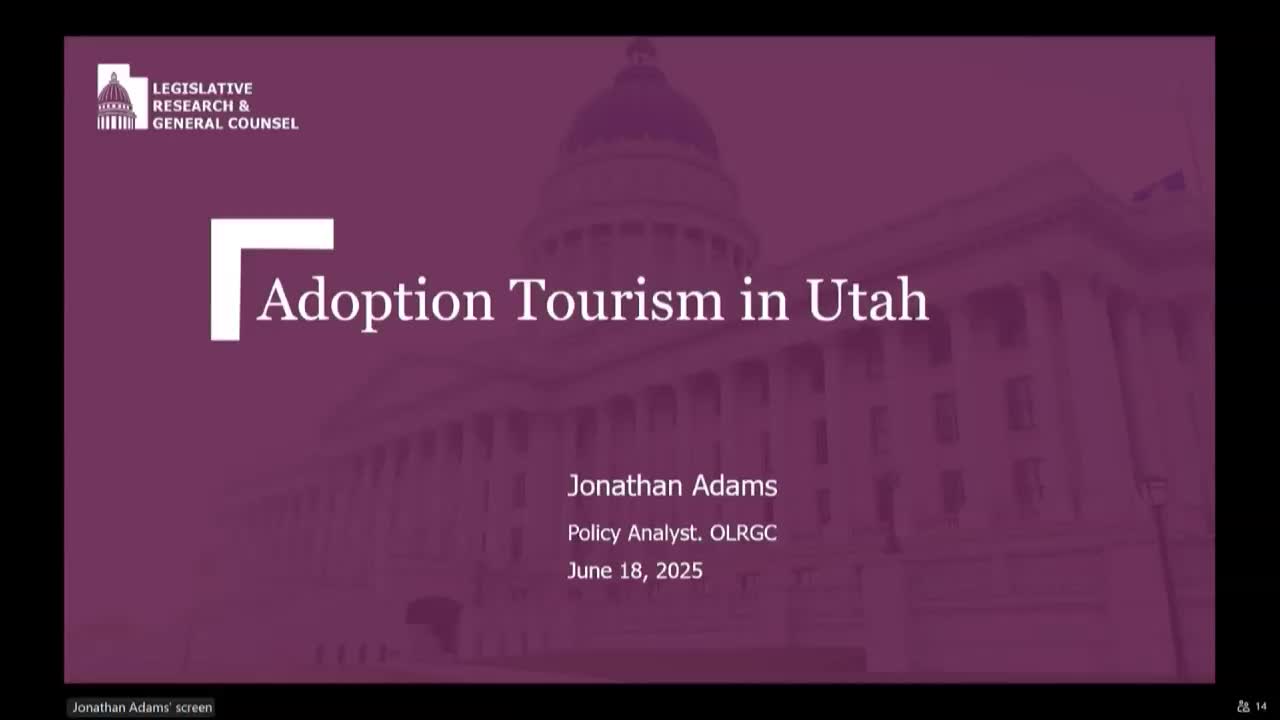
Jonathan Adams, a policy analyst with the Office of Legislative Research and General Counsel, told the committee Utah is a national hub for private domestic adoptions and described laws and practices that make the state “adoption friendly.” Adams said private domestic adoption comprised 77% of recorded Utah adoptions in 2023 and that Utah’s adjusted rate was about 11.1 adoptions per 10,000 households versus a national average of 4.9.
The committee heard extended testimony from Tara Romney Barber, adoption and clinical programs director at Children’s Service Society of Utah, who said in some cases expectant mothers are transported to Utah late in pregnancy and receive housing, medical care and cash stipends. “These indigent women are promised free luxury housing, free medical care, food, transportation, often provided monthly cash stipends for living expenses, and in some cases, a post pay placement cash payout,” Barber said.
Kelsey Vanderblayt Ranyard, co‑founder of Utah Adoption Rights and policy director at Ethical Family Building, said a subset of Utah agencies charges adoptive families substantially more than the national average and described cases she said involved coercive practices. “These agencies charge adoptive families double the national average, around $86,000 per placement,” Ranyard said.
Why it matters: Committee members cited competing policy goals — timely, stable placements for adoptive families and protection of birth parents’ rights and dignity. Presenters and commentators urged legislative review of statutes, agency licensing and enforcement, Medicaid eligibility checks and the putative‑father notice system.
What presenters and witnesses told the committee
- Legal and practice features raised by staff and witnesses: Utah allows a birth mother to consent to adoption 24 hours after birth; once consent is given it is irrevocable under Utah law (Adams). Utah maintains a putative father registry through the Office for Vital Records; to be added a putative father generally must initiate paternity proceedings in court (Adams, Barber). Adams noted Utah and Massachusetts are the only states described in the presentation as having irrevocable post‑birth consent.
- Agency licensing and complaints: Shannon Toman Black, director of licensing and background checks at the Department of Health and Human Services, said the Office of Licensing oversees 15 licensed child‑placing agencies and that the office handled seven complaints in fiscal year 2025, two of which were substantiated. She described annual unannounced inspections and the office’s statutory authority under “26B‑2‑1” (as cited to the committee) to license and investigate providers.
- Medicaid and residency concerns: Jen Strohecker, director of the division of integrated health, described Medicaid eligibility checks and said applications include screening for intent to reside in Utah (employment history, vehicle registration, driver’s license). Strohecker said those signals can prompt further review by eligibility workers but acknowledged the review is not infallible.
Public commenters with direct experience described similar patterns to agency and staff testimony: women transported into Utah, temporary housing and stipends, coordination with particular medical providers, and families paying large sums for placements. Witnesses gave specific allegations the committee may investigate further, including alleged cash payouts of “over $8,000” to some birth mothers and reports that a small number of agencies attract most out‑of‑state placements.
Committee action and next steps
Representative Lou Bey moved to open a committee bill file to examine the range of policy options discussed at the hearing. The motion passed unanimously. The bill file will allow staff and stakeholders to craft specific proposals — examples discussed in testimony included extending the post‑birth consent waiting period, creating limited revocation rights, simplifying putative‑father notice procedures, and imposing more prescriptive rules or caps on birth‑mother payments.
Discussion, not decided: Several committee members cautioned about unintended consequences. Senator Weiler warned against changes that could push women to other jurisdictions or to abortion, and other members emphasized balancing the rights of birth mothers, fathers and adoptive families. The committee did not adopt any statutory language at the hearing; the committee instead authorized a bill file to explore options.
Ending note: Presenters urged the committee to pair any statutory changes with stronger enforcement resources for the Office of Licensing and with safeguards for hospitals and Medicaid oversight so that legal changes achieve the intended protections without foreclosing ethical adoptions.