Lifetime Citizen Portal Access — AI Briefings, Alerts & Unlimited Follows
Federal executive orders aim to speed U.S. nuclear deployment; Utah official briefs committee on implications
Loading...
Summary
The Utah Office of Energy Development summarized four recent presidential executive orders directing faster licensing, supply-chain rebuilding and export initiatives for nuclear energy and outlined possible state roles and timelines.
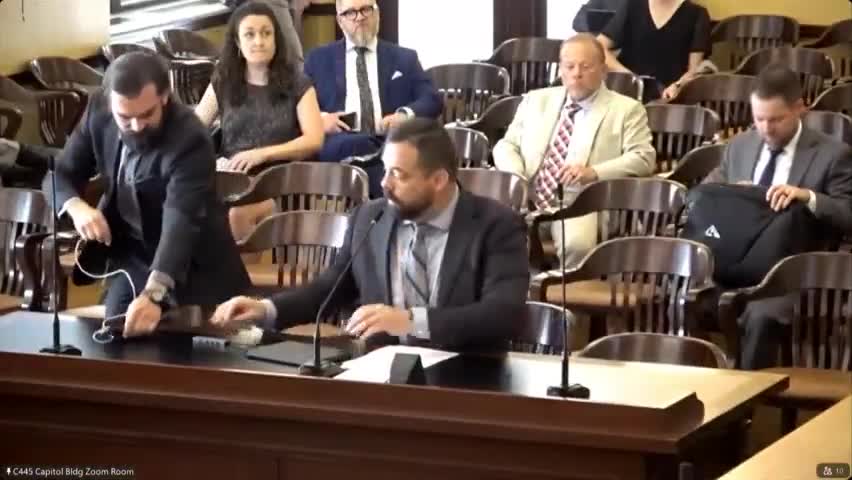
Dusty Monks, director of nuclear programs at the Utah Office of Energy Development, told the Public Utilities, Energy and Technology Committee that four recent presidential executive orders direct a sweeping effort to revive U.S. commercial nuclear energy and cited national security and energy resilience as the core motivation. "In conjunction with domestic fossil fuel production, nuclear energy can liberate America from dependence on geopolitical rivals," Monks said, reading from the orders. He added the orders call the U.S. commercial deployment of nuclear technology "all but stopped domestically" and note that "87% of reactors installed since 2017 are based on designs from two foreign countries."
Monks said the orders seek regulatory certainty, stronger domestic fuel-cycle infrastructure, workforce expansion and an export push. He outlined specific targets directed at the Nuclear Regulatory Commission (NRC): an 18‑month deadline for a new reactor license decision, a 12‑month cap for renewing an existing reactor license and a requirement that the NRC create a high‑volume licensing path for micro and small modular reactors. "These are deadlines, not guidelines," Monks said, noting current review times average three to four years.
He warned about capital sensitivity for nuclear projects, using the Vogtle units as an example: "One‑day delay on that type of a project is $2,000,000," Monks said, to explain why the orders propose fee caps and time limits as incentives to shorten reviews. The executive orders also question the continued use of the linear no‑threshold (LNT) model and the ALARA standard for radiation exposure, calling the models scientifically flawed in places and asking agencies to develop more ‘‘scientifically based’’ exposure guidance.
Monks reviewed additional agency directives the orders contain: DOE authority to self‑regulate some test reactors, DOE and DOD timelines to site and operate demonstration reactors on federal sites and U.S. export initiatives that would shorten DOE export review timelines to about 30 days. He said the orders direct the use of the Defense Production Act for bulk purchases of HA‑LEU (high‑assay low‑enriched uranium) and call for a draft plan to expand U.S. conversion and enrichment capacity.
Several lawmakers asked how Utah could participate. Senator Sandel asked for three bullet points on how the state could engage; Monks pointed to expected federal funding flows, greater availability of federal lands or DOE sites for siting, and the need to prepare state permitting and workforce programs. "We have federal lands that could be opportunities to site a reactor or a facility," he said. Representative Peck asked whether industry had already approached Utah; Monks said Utah has been receiving interest from vendors and stressed the state’s uranium mining and milling assets and existing facilities.
Monks concluded that the orders set aggressive national targets — demo reactors by 2026, full‑scale builds underway by 2030 and a quadrupling of U.S. nuclear capacity by 2050 — and that the central challenge will be balancing speed with uncompromising safety if agencies implement the reforms.