Get Full Government Meeting Transcripts, Videos, & Alerts Forever!
Get email alerts on the Digital Identity topic
No spam. Unsubscribe anytime.
Utah agencies begin public outreach and technical study to implement state‑endorsed digital ID after SB 260
Summary
The Department of Government Operations outlined this summer’s public engagement, vendor outreach and technical study to implement a state‑endorsed digital identity established by Senate Bill 260, emphasizing privacy, cryptographic approaches and acceptance in digital wallets.
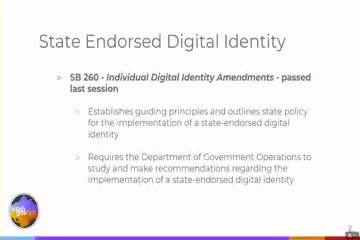
The Department of Government Operations told the Government Operations Interim Committee on June 18 that it is carrying out public engagement, vendor outreach and technical study to implement a state‑endorsed digital identity established this year by Senate Bill 260.
The program, Marvin Dodge, executive director of the Department of Government Operations, said, will follow principles written into law and focus on privacy, guardianship, selective disclosure and issuing a trusted online credential that citizens can control. “Individuals own their own identity,” Dodge said, describing government’s role as verification and endorsement rather than ownership.
Why it matters: SB 260 directs state officials to study how to implement a state‑endorsed credential that can be used online without giving third‑party systems continuous tracking ability. Committee members and department leaders emphasized two near‑term priorities: soliciting public input from across the state (town halls and a request for information to vendors) and returning specific policy, technology and statutory recommendations by the fall.
Details of the process: Dodge said the department has started a speaker series and town halls, including one hosted by Representatives Shepherd and Chevrier; Utah Valley University is preparing white papers to frame technical and policy tradeoffs; and the state will soon issue a request for information to industry vendors. The department is also exploring practical ways to use existing consumer tools (for example, storing a credential in an Apple Wallet) rather than requiring the state to build new consumer apps.
Security debate and approach: Committee members pressed officials about security. Dodge and colleagues noted the state already blocks large volumes of malicious traffic and has resources to help local jurisdictions with cybersecurity. A central debate is architectural: some jurisdictions favor an online verification “phone home” model while Utah officials, led in the discussion by Alan Fuller, argue for a cryptographic approach that enables verification without remote logging. Fuller said, “We can embed in that digital identity an advanced capability to say this is valid and I can check it, without that logging capability,” and that Utah should help shape national and international standards so logging‑based designs do not become the default.
Practical adoption questions: Committee members pressed on real‑world acceptance: for a credential to be useful it must be accepted in mobile wallet ecosystems and by routine verifiers such as law enforcement and state liquor stores. The group discussed how mobile driver’s licenses are currently used in some settings (for example, some airports have special lanes to accept mobile licenses) and emphasized that interoperability and broad acceptance will be essential for the system to work at scale.
Next steps and timeline: The department will continue town halls and vendor outreach through the summer, issue an RFI and report recommendations this fall, including proposals for policies, standards, potential statute changes and cost estimates. No formal actions or votes were taken by the committee on implementation; the item was presented for information and discussion.