
Superintendent presents revised 2025–26 spending plan after budget defeat; board directs team to aim to lower levy
Get AI-powered insights, summaries, and transcripts
Subscribe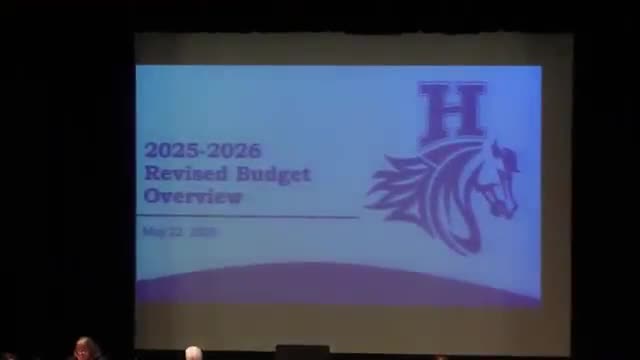
Summary
Superintendent Douglas presented a revised 2025–26 spending plan after the district's initial budget was defeated 50.9% to 49.1%, and the board directed administration to try to lower the tax levy further while preserving staff and programs.
Superintendent Douglas presented a revised 2025–26 spending plan to the HORSEHEADS CENTRAL SCHOOL DISTRICT Board of Education on May 22 after the district's first proposed budget failed in a public vote, 50.9% to 49.1%.
The revised plan trims expenditures and uses a mix of reduced purchases, unfilled positions, and newly available state aid; it also recommends using $1.3 million in debt-service reserves to lower the tax rate. Douglas told the board that "you only have 2 attempts" to win voter approval before the district is placed on a contingent budget and that administration has been working to keep reductions "away from students" and staff where possible.
The nut graf: the board is balancing two choices under New York law — resubmit a revised budget for a second public vote or allow the district to enter a contingency budget prescribed by statute. The contingency route would force deeper, more prescriptive cuts; Douglas said a contingent budget would require about $3.5 million in reductions and warned it would affect programs and operations.
Most important facts: the revised package includes the following reductions and adjustments identified by district administrators: removal of a planned assistant principal; not filling a retiring principal-account-clerk position (administrative attrition); proposed temporary restructuring of world-language staffing after two retirements and a five-month unsuccessful recruitment (Douglas quantified that change at about $146,000); postponing or eliminating one of two planned service/maintenance vehicles (roughly $75,000 saved); adjustments to BOCES special-education purchase lines because BOCES is having hiring difficulties; and a recalculation of health insurance stop‑loss projections (a projected savings of about $269,000 because the district has not been hitting stop‑loss thresholds). Douglas also said the district recently learned it can shift some project-related spending into the capital/construction budget for one or two years, temporarily reducing operating-budget pressure.
On revenue and levy math, the superintendent showed the tax-cap calculation comparisons: the defeated budget earlier this spring used debt-service offsets that produced a larger levy change (the earlier package corresponded to a 7.4% change in levy under the state calculation); the revised plan reduces the levy increase to roughly a 4.7% change year‑over‑year under one scenario (numbers vary by the final debt‑service amount used). Douglas recommended retaining the $1.3 million debt‑service drawdown because it produces the lowest potential tax rate projection and is a conservative approach to limit immediate tax impact.
Board discussion focused on tradeoffs. Members asked for dollar-level detail associated with each reduction, pressed for clarity about which positions or programs would be affected if deeper cuts are required, and weighed the political and practical question of whether a lower levy would produce a higher probability of passage at the polls. Board members repeatedly emphasized a preference, where possible, to "keep it away from students and programs." The board voted to set a special meeting to finalize the budget on May 28 and instructed administration to continue working over the coming days to reduce the levy (the informal direction, repeated in post‑executive‑session discussion, asked administration to target the projected rate down to about 7¢ per $1,000 of full value or better if feasible).
Public commenters urged passage and asked for clearer transparency about what would be cut if the budget fails again. Residents repeatedly asked the board to explain the contingency budget consequences; Superintendent Douglas said the administration will present a clearer contingency picture to the public and scheduled the follow‑up meeting so materials can be finalized by the statutory deadline.
Ending: the board left the presentation with three near‑term tasks for administration: (1) refine the revised budget materials and specific line‑item reductions for the May 28 meeting, (2) prepare a clear, itemized contingency slide deck showing what cuts would look like if the budget fails again, and (3) continue outreach to inform voters before the June 17 revote. No new budget was adopted at the May 22 meeting; the board will act after its May 28 finalization meeting.