Get Full Government Meeting Transcripts, Videos, & Alerts Forever!
Get email alerts on the Land Use Zoning topic
No spam. Unsubscribe anytime.
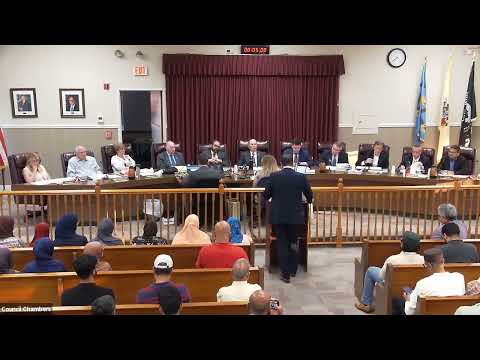
Sayreville planning board denies proposed mosque at 214 Ernston Road over parking and site variances
Summary
The Sayreville Planning Board voted to deny an application for a new house of worship at 214 Ernston Road after finding the project’s requested variances and proposed on-site parking insufficient to protect public safety and neighborhood capacity.
The Sayreville Planning Board voted to deny an application for a new house of worship proposed for 214 Ernston Road after concluding the project’s requested variances and its plan for on-site parking were inadequate to prevent traffic, parking and pedestrian-safety impacts.
The applicant’s attorney, Mr. Sachs, had told the board the project had been revised since it first appeared in April 2024, including a reduction in maximum occupancy from 454 to 321 people and a smaller building footprint. “We reduced that by almost a third, down to 321 occupants,” Sachs said, and described a list of conditions the applicant offered to mitigate impacts, including splitting Friday afternoon services into two sessions, hiring police officers for traffic control, using off-site shuttle parking and conducting a traffic study within the first year of operation.
The board’s professional and legal advisors reminded members that houses of worship are treated as inherently beneficial uses under New Jersey law, meaning applicants do not need to prove the positive criteria but must show they do not create adverse consequences under the negative criteria. The borough attorney summarized that framework for the members before the vote, saying the board must consider whether off-site traffic consequences are within its scope and what conditions could mitigate localized impacts.
Board members who voted against approval said the applicant had not met that burden. Several members, including Mr. Mueller, said the proposed 107 on-site parking spaces fell far short of the ordinance-based requirement of 250 spaces and that the applicant had not credibly demonstrated a reliable plan to prevent spillover parking into neighboring streets. “If you apply these ratios to the 321 occupancy limit… you’re still going to need at least 160 parking spots based upon the actual usage,” Mueller said. Multiple members also cited the lack of a designated loading dock and the concentration of waivers and variances as evidence the site was not suitable for the proposed use.
The board’s conditions and waiver list that had been read into the record included 27 numbered items. Key commitments the applicant offered were: no call to prayer announced outside the building; no occupancy in the minaret; restricting Friday ritual services so no other activities occur at the same time; employing off-duty police for traffic control during Friday services and Ramadan; two on-site traffic monitors; a requirement to close the on-site parking lot when capacity is reached; a required operations manual; a copy of an executed lease for 22 off-site parking spaces on Johnson’s Lane; and an obligation to submit a one-year post-opening traffic study and meet with the police and board professionals if traffic rose more than 5% above the original study.
Board members also questioned whether overflow parking on nearby commercial lots would be reliable over time and whether the proposals were enforceable. Several members said they were not convinced that self-imposed occupancy limits and monitoring would prevent neighborhood spillover if the facility’s attendance grew.
After discussion and roll-call recording of multiple “no” votes from board members, the chairman announced, “Application denied.” The board then moved to other agenda items and closed the meeting.
The public comment period following the decision included residents who thanked the board for its process and suggested the borough revisit its minimum lot-size standard for religious uses; one commenter recommended returning to a three-acre minimum to reduce the chance of similar proposals in congested neighborhoods.
Votes at a glance Motion: approve the application with the conditions read into the record (mover/second not specified in the transcript). Outcome: application denied. Recorded yes/no votes in the transcript: Mr. Mueller — no; Mr. Cantel — no; Ms. Lorman — no; Mr. Shaw — no; Ms. Setaka — no; Mr. Velozin — no; Mr. Williams — no; Councilman Zabrowski — no; Chairman Tighe — no. (The transcript records multiple recorded “no” votes; no affirmative votes are explicitly recorded in the transcript.)
Why this matters The board’s denial underscores the practical limits of conditional-use approvals where on-site parking and circulation are central to neighborhood safety and zoning compliance. Even with legal protections for houses of worship under the municipal land use law, applicants must demonstrate that variances and conditions will not produce a substantial detriment to the public good.
What’s next The board noted the application process had spanned roughly 14 months and that planning matters, including an affordable-housing study and other applications, will return to the board at its next meeting on June 18. The applicant may choose to revise the site plan and return to the board, but any resubmission would need to address the parking, loading and enforceability concerns the board raised.