
Council urges restore to regular streets maintenance cycle, flags chip-seal backlog
Get AI-powered insights, summaries, and transcripts
Subscribe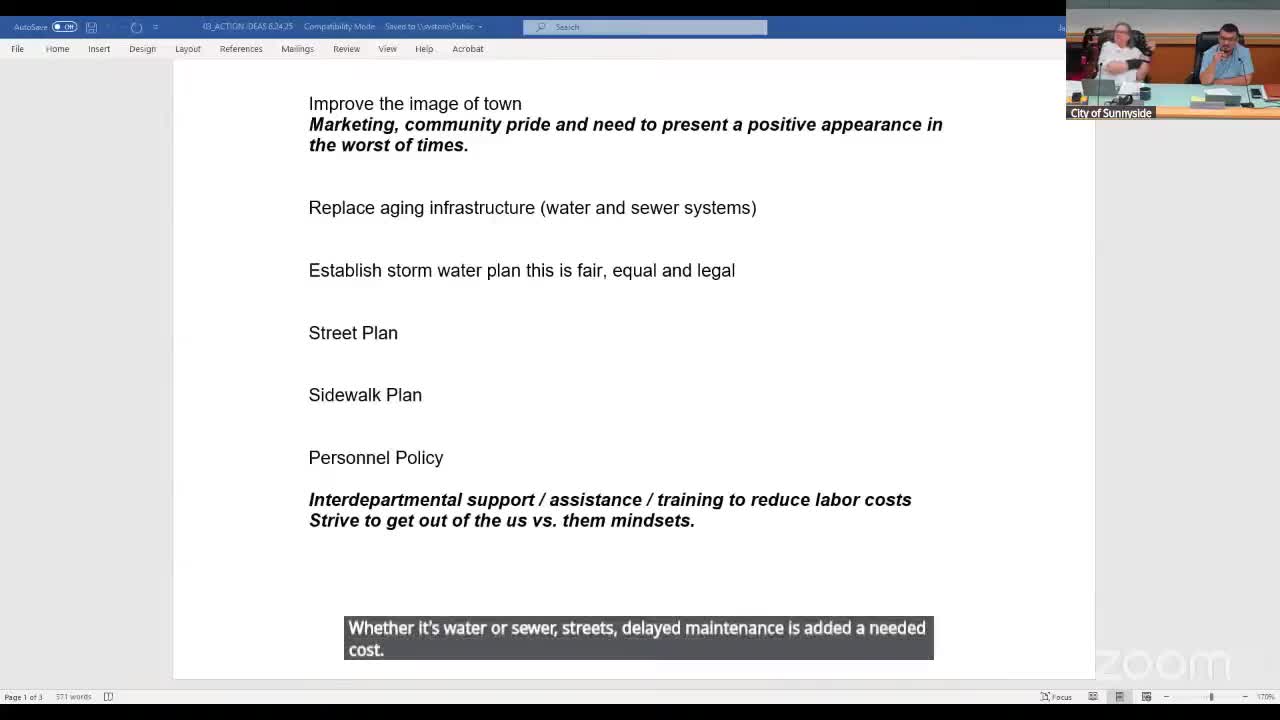
Summary
Sunnyside councilors said deferred chip‑seal programs and heavy truck use in residential areas have degraded pavements; they urged reestablishing a predictable maintenance cycle and reviewing truck routing and ADA work that competes for transportation funds.
Council members said the city’s streets are suffering from deferred maintenance after chip‑seal work slowed during and after 2020. They urged reestablishing a multi‑year maintenance cycle for chip sealing and cautioned that delaying routine work increases replacement costs.
Why it matters: Proper, regular surface maintenance (chip seal) extends pavement life and is substantially cheaper than full street replacement. Councilors warned that skipping preventive work has led several neighborhoods to the point of alligatoring and faster deterioration.
Key points: The council recalled a prior seven‑year chip‑seal cycle that lengthened to 12 years in recent years because of budget and material shortages. Members said restoring the maintenance cycle would require increased funding and, for faster progress, larger annual expenditures for several years. They also discussed transportation benefit district (TBD) uses, ADA sidewalk repairs that draw on the same funds, and a need to revisit truck‑route enforcement to protect residential streets.
What was not decided: No specific appropriation was adopted. Council requested staff to inventory pavement conditions and return with a prioritized pavement-maintenance plan and cost estimates to inform the budget.
Ending: Councilors asked staff to propose a practical funding path to restore a regular maintenance cycle and to evaluate truck routing and ADA obligations relative to other transportation priorities.