
FSEC recommends governor approve Carriger Solar and 63 MW battery; council approves recommendation 6-1
Get AI-powered insights, summaries, and transcripts
Subscribe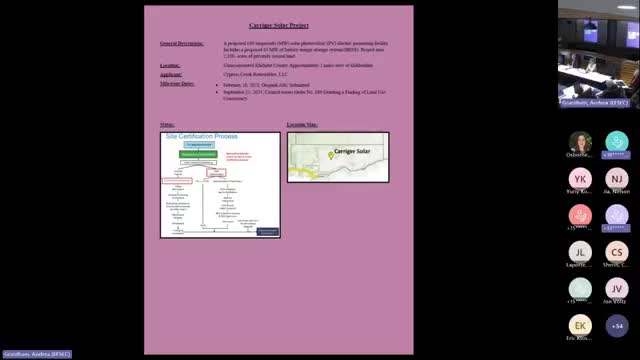
Summary
The Energy Facility Site Evaluation Council voted to recommend that the governor approve the draft site certification agreement and recommendation report for the Carriger Solar Project in Klickitat County, advancing the 160-megawatt solar project paired with a 63-megawatt battery storage system despite local opposition.
The Energy Facility Site Evaluation Council voted to recommend that the governor approve the draft site certification agreement and accompanying recommendation report for the Carriger Solar Project in Klickitat County, moving the project forward despite public opposition and concerns from local officials.
FSEC staff said the draft site certification agreement and a revised mitigated determination of non-significance (RMDNS) were revised after direct consultation with the Yakama Nation and public comment and were published for public review in June. "We refined the draft SCA to address several of the Yakama Nation's concerns following the June 4 meeting," said Joanne Snarski, siting specialist for the council. "Those revisions and other edits were published for comment and are reflected in the draft that the council considered today."
The Carriger project is proposed as a 160-megawatt solar-only generation facility paired with a 63-megawatt battery energy storage system on privately owned land in Klickitat County. Project materials state the application would occupy up to 1,326 acres within a 2,108-acre lease boundary; those figures come from the project's SCA materials presented to the council.
Why it matters: FSEC is the state body that reviews and, where appropriate, certifies large energy facilities and recommends approval to the governor. A recommendation from FSEC does not itself grant construction authority; it forwards a proposed SCA and staff report to the governor for final action. The council’s approval means the application advances to the executive for consideration, while permit-level details and required plans remain subject to conditions and further review.
What staff told the council
Snarski and Sean Green, FSEC’s State Environmental Policy Act specialist, said staff incorporated mitigation measures into the RMDNS and the draft SCA after the Yakama Nation requested additional protections. Specific changes described to the council included: a requirement that the applicant provide the Yakama Nation an opportunity to review the project’s initial and detailed site restoration plans; language to ensure tribal access to public lands is retained throughout construction; and a requirement that the applicant evaluate available battery chemistries at the time of replacement and submit a comparative assessment to FSEC.
Staff said the RMDNS includes five key changes from the earlier determination, including revised laydown yard setbacks (1,200 feet for primary yards and 800 feet for ancillary yards), a combined approach to visual screening on the shared boundary with a Department of Natural Resources parcel (earthen berms, rock piles and native vegetation rather than continuous berms), an administrative cleanup, and a requirement to install an opaque, enclosed 10,000-gallon water cistern to assist in smoke-containment during a battery fire event.
On safety and emergency response
Council members pressed staff and the applicant on fire response and emergency notification. "The SCA also requires that the applicant prepare a fire response plan and emergency management plan in cooperation with the county and the local fire protection district," Sean Green said. He added those plans must be approved by FSEC prior to the start of construction and updated annually. Green also said the applicant has begun coordinating with the local fire chief on access, keys and spacing in panel rows to allow emergency equipment to pass.
Klickitat County representative Matt Chiles told the council county emergency services do not have capacity to fight a large battery fire and asked what the applicant will provide. "I appreciate the adjustments that have been made, but emergency response and firefighting remains my biggest concern over the whole project," Chiles said. Chiles also urged FSEC to prioritize battery chemistries that minimize thermal runaway risk when replacement is planned.
On water availability and operations
Councilors asked about potable water for the maintenance facility. Staff said the draft SCA requires the applicant to secure legal water use prior to the start of construction and again prior to operations; if legal water is not secured, the applicant would not be allowed to start construction and would be noncompliant with the SCA. Staff noted some solar projects use intermittent staffing patterns and nontraditional potable water connections (for example, new service connections or permitted systems), but long-term reliance on trucked water for a permanent facility would not meet public-health rules.
Public comments and other concerns
Staff reported sixteen comments on the RMDNS (one from the Yakama Nation, one from the applicant and 14 from members of the public), with the most frequent substantive concerns addressing fire hazard, visual aesthetics and loss of farmland. The Yakama Nation’s submission questioned whether FSEC’s TCP (traditional cultural property) mitigation was sufficient; staff said they used Bureau of Land Management visual contrast methods and consultant input to quantify visual impacts and concluded the proposed mitigation would reduce impacts to below significance as defined by SEPA. The applicant requested clarifying language that the natural screening is "periodic" rather than continuous; staff agreed to include that clarification in the final text.
Council action and vote
Stacy Brewster, representing the Utilities and Transportation Commission, moved to approve the draft SCA as amended and the staff report recommending that the governor approve the Carriger Solar Project; Councilor Campbell seconded. After discussion, the council conducted a roll-call vote. The clerk announced the tally as six ayes and one nay; the motion passed and the council's recommendation will be forwarded to the governor for consideration.
What happens next
If the governor accepts FSEC’s recommendation, project-level plans required by the SCA — including the final fire response and emergency-management plans, the detailed site restoration plan and the final financial assurance instrument — must be submitted and approved per the SCA conditions before construction or operations, as specified. Staff told the council they will finalize the RMDNS and the SCA text to incorporate the minor wording clarifications discussed at the meeting.
Ending
Councilors said they expect continued engagement as the project proceeds. Chiles thanked the council for adjustments made to the application, while reiterating that many county residents remain strongly opposed to the project’s siting.