TAG debates statewide single-exit requirement, tables action to develop fire‑department criteria
June 27, 2025 | Building Code Council, Governor's Office - Boards & Commissions, Executive, Washington
This article was created by AI summarizing key points discussed. AI makes mistakes, so for full details and context, please refer to the video of the full meeting. Please report any errors so we can fix them. Report an error »
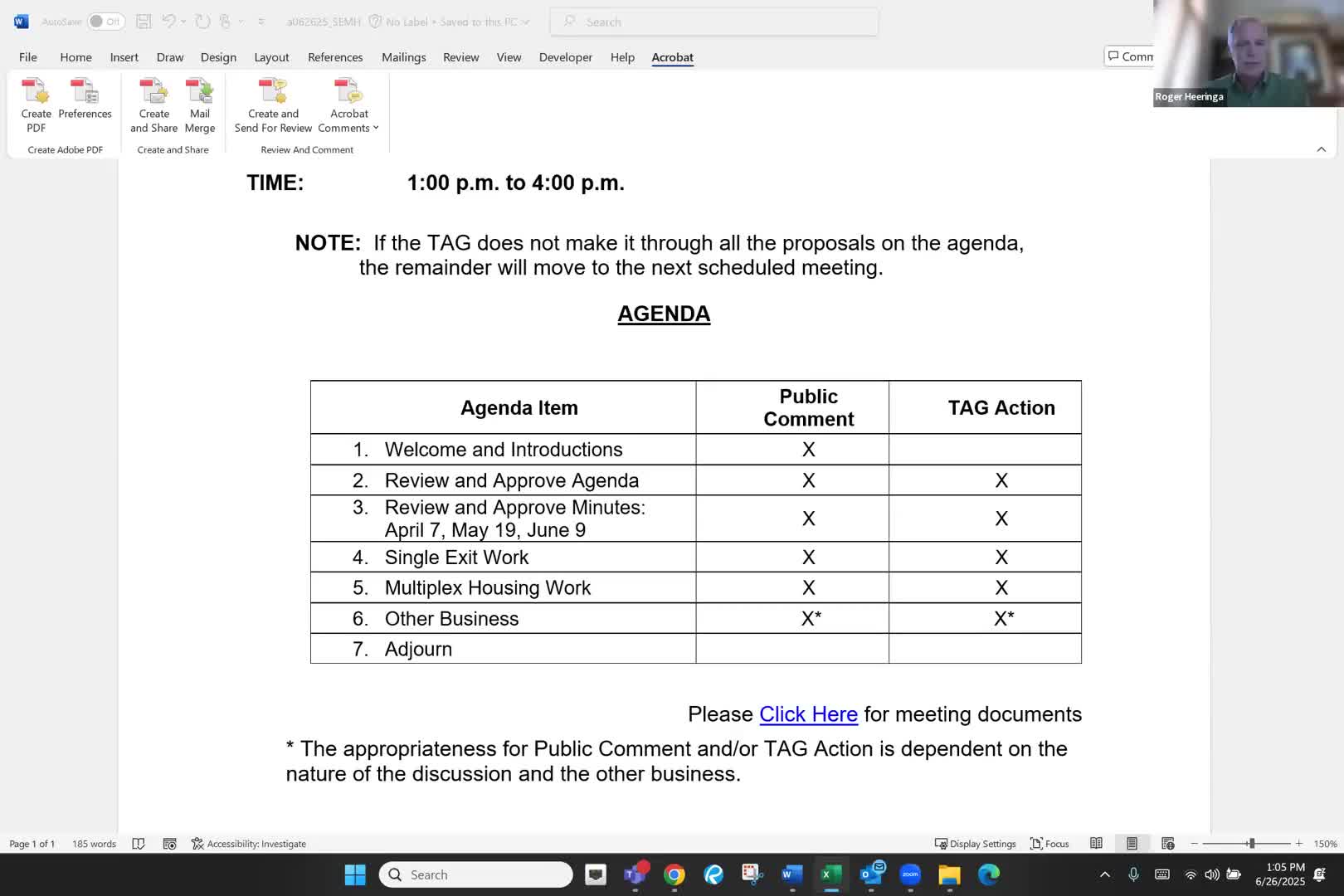
Why it matters: the legislature directed the TAG to prepare code language allowing a single exit to serve multifamily residential structures up to six stories in some form. TAG members agreed the RCW requires the council to provide a statewide mechanism but disagreed over how to balance life‑safety protections, local firefighting capacity, and the bill's cost‑reduction intent.
Most urgent decisions and next steps: the TAG voted to table the single‑exit discussion and directed volunteers from the fire service and code officials to develop proposed criteria on professional fire‑department presence, response times, water supply/fire flow, and related mitigation (sprinkler systems, stair fire‑rating, smoke control) for review at the next meeting (July 15, 2025). That follow‑up will inform whether the single‑exit language is placed in the mandatory body of the code or implemented as a mandatory appendix referenced by the model code.
Key details from the meeting:
- Legislative directive and code cycle: TAG members referenced the Revised Code of Washington (RCW) language that directs TAG work and cited the next code cycle timeline: code text to be finalized by July 2026 and effective November 2026; the TAG set internal drafting targets (discussion noted a Jan. 31 target to finish working text and a suggested two‑month public comment window). (Speaker: Roger Haringa)
- Mandatory vs. appendix approach: TAG chair Roger Haringa said the TAG should proceed under the assumption that language will be "in the building code that is a requirement throughout the state," while other members noted that appendices can be adopted locally and that moving an appendix into mandatory statewide language would require additional technical requirements to ensure public safety.
- Fire department capability and water supply: several members, including members representing fire interests, warned that making single‑exit provisions mandatory statewide raises unresolved questions about local firefighting capacity, aerial apparatus availability and staffing, water supply and fire flow, and volunteer vs. professional department capabilities. Mike Messer (fire service representative) emphasized firefighting limits and said the group must codify the conditions under which single‑exit buildings are safe. Jeremy Moore (TAG member) warned that many counties lack ladder trucks and that volunteer departments vary widely in capability.
- Protection and mitigation measures under discussion: TAG members discussed requiring enhanced stair fire ratings and smoke control/pressurization, and debated sprinkler options (full NFPA 13 systems versus residential NFPA 13R/13D solutions). Fire experts advised that 13R and full 13 systems are hydraulically different and that mixing system types in one building is technically complex.
- Performance‑based versus prescriptive approaches: some TAG members proposed documenting performance objectives (for example, limiting exposure of the single exit to untenable conditions) and using a performance framework to decide prescriptive choices. Others argued a full performance‑based rewrite exceeds the TAG's available time and recommended using performance language only to justify prescriptive provisions.
What the TAG decided (formal action): the TAG tabled the single‑exit discussion for detailed follow‑up. Volunteers from the fire service and code community were asked to prepare draft criteria (fire‑department presence/response, water supply/fire flow, sprinkler approach, stair rating/smoke control) for the next meeting.
Ending note: TAG members agreed the state RCW directs work on single exit but that to make the requirement mandatory statewide the TAG must specify the operational conditions (fire‑department and water‑supply benchmarks) under which single‑exit buildings may be allowed. The TAG will revisit the topic at its next scheduled meeting (July 15, 2025).
View the Full Meeting & All Its Details
This article offers just a summary. Unlock complete video, transcripts, and insights as a Founder Member.
30-day money-back guarantee
Sponsors
Proudly supported by sponsors who keep Washington articles free in 2025

