
William Penn school board meeting: administrators recommend 3.9% tax increase; larger shortfall, transportation cuts and borrowing discussed
Get AI-powered insights, summaries, and transcripts
Subscribe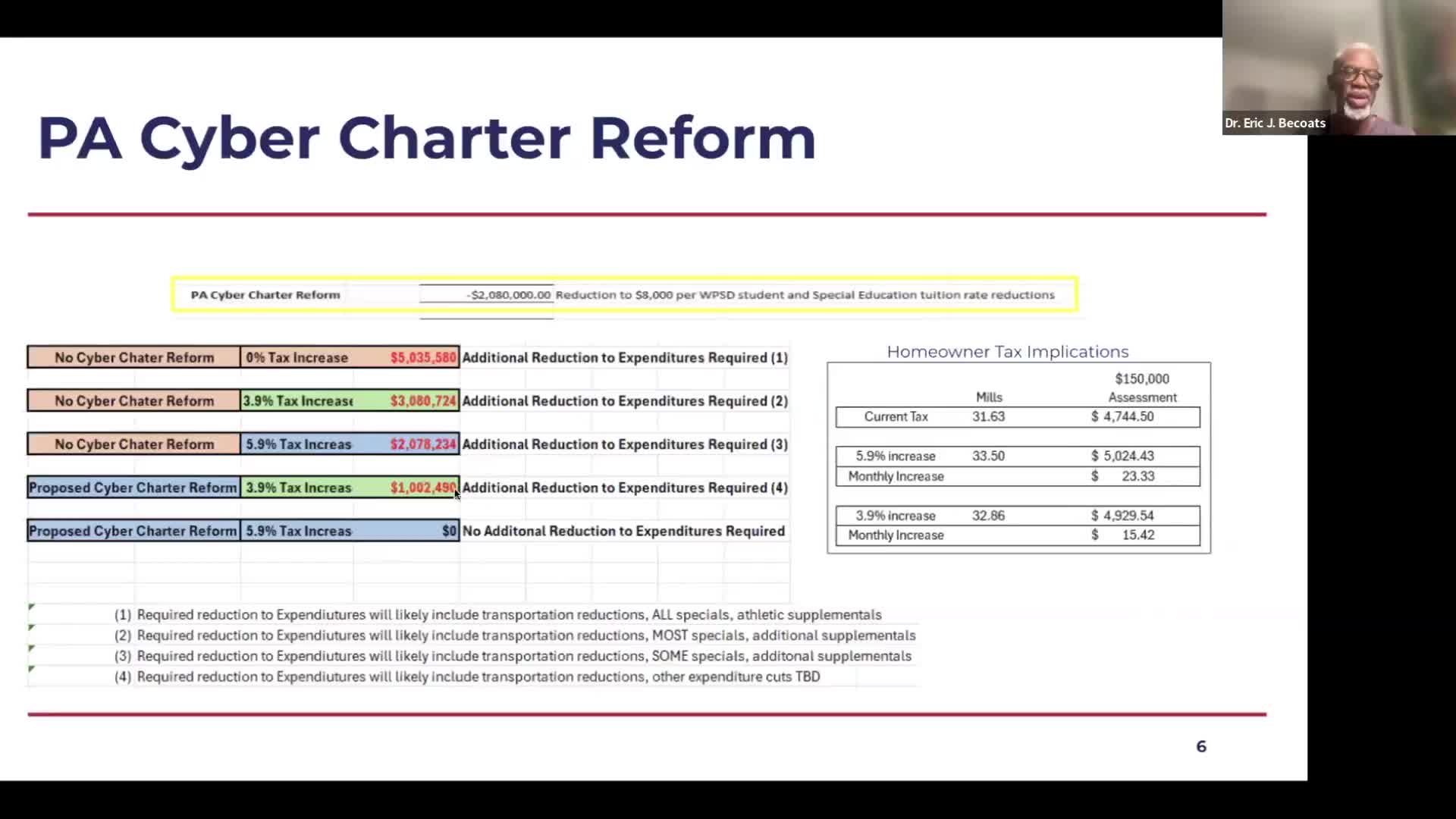
Summary
William Penn School District officials on Wednesday presented a proposed 2025–26 budget balanced on paper at roughly $135 million and centered on a recommended 3.9% real estate tax increase, but warned the plan depends on uncertain state funding and possible “cyber charter reform.”
William Penn School District officials on Wednesday presented a proposed 2025–26 budget balanced on paper at roughly $135 million and centered on a recommended 3.9% real estate tax increase, but warned the plan depends on uncertain state funding and possible “cyber charter reform.”
Dr. B. Coates, a district staff member who presented the budget, told directors that “this budget is balanced at $135,000,000” and that the proposal assumes both state adequacy funding and changes to how cyber charter tuition is reimbursed. He said the draft includes a 5.9% tax increase as one scenario and shows alternative outcomes at 3.9% and 0% depending on whether state actions materialize. The presentation also showed homeowner impacts for a $150,000 assessed home of about $15.42 at 3.9% and $23.33 at 5.9% and noted those figures do not reflect homestead reductions.
Board member Jen Hoff said she will move at the board’s June 30 meeting to approve a budget based on a 3.9% tax increase. “On Monday, we will be voting on a budget. I will recommend a 3.9 via motion,” Hoff said. No formal vote took place at Wednesday’s advisory meeting; the board is required by law to adopt a balanced budget on June 30.
Interim Chief Financial Officer David Sebowski, who said he has served as the district’s interim CFO for eight months, urged caution and painted a grimmer picture of the district’s finances. “I gotta say, by far, the worst school district I’ve been at,” Sebowski said, adding that he believes actual expenditures could be closer to $140 million and that projected revenue assumptions — including state aid and federal Title funds — are uncertain. Sebowski recommended the board consider a higher tax proposal, saying he thought a 5.9% increase would better protect programs and staffing.
Directors and staff discussed possible reductions if the district receives less state funding or if cyber charter reform does not pass in the form expected. Dr. Coates said that under lower tax scenarios the district would need to identify reductions ranging from about $1 million to $5 million and that transportation line items are likely to be among the first areas reviewed. When asked how much of the transportation budget might be affected, staff said the transportation budget is roughly $7.6 million and that changes on the order of $1 million could be achievable by consolidating routes or reducing bus runs for exceptions currently provided for safety or special circumstances.
Board members and staff also discussed exercising the district’s borrowing authority (an “authority bond”) as a contingency. Ed Norris, a district financial staff member, said total debt service for next year is budgeted at about $5.5 million and later clarified that an additional authority-bond-related payment would be $500,000 in 2026 and about $1 million annually beginning in fiscal 2027 if the district borrowed at projected levels; staff described the bond as a long-term option and a last resort.
Directors emphasized competing priorities: minimizing the immediate tax burden on homeowners while avoiding cuts to personnel, special subjects, extracurricular activities and transportation that could harm student services. Board member Callahan recommended passing a 3.9% increase on Monday and continuing to seek $1 million in savings, with the option to revisit borrowing if state revenues fail to materialize. Another director said she would vote only for a smaller increase (1.5% or less).
PFM, the district’s financial advisers and staff present in the meeting, were cited for modeling debt and cash-flow options; staff said they will follow up with detailed debt-service breakout and further numbers before the June 30 vote. Dr. Coates and other staff emphasized that several material items remain unknown — state basic education funding, federal Title allocations and the outcome of cyber charter policy proposals — and that the board must adopt a balanced budget by law even while awaiting final state figures.
The board and staff invited the public and budget advisory members to Monday’s in-person/hybrid meeting, where directors will vote on a budget. If the board passes a budget at less than the maximum tax increase and subsequent state action or revenues leave a gap, staff said the district could consider using its borrowing authority or make midyear reductions after additional analysis. Staff and some directors also signaled willingness to pursue further legislative or legal remedies related to a 2014 fair-funding court decision that directed additional state support to the district but has not yet yielded full legislative relief.
For now, the immediate, formal action on the budget was scheduled for Monday, June 30; the board planned to vote then on a motion to adopt a balanced budget based on the 3.9% tax proposal recommended by Hoff.