
Riviera Beach presents draft Arts in Public Places master plan; consultants recommend new code and funding streams
Get AI-powered insights, summaries, and transcripts
Subscribe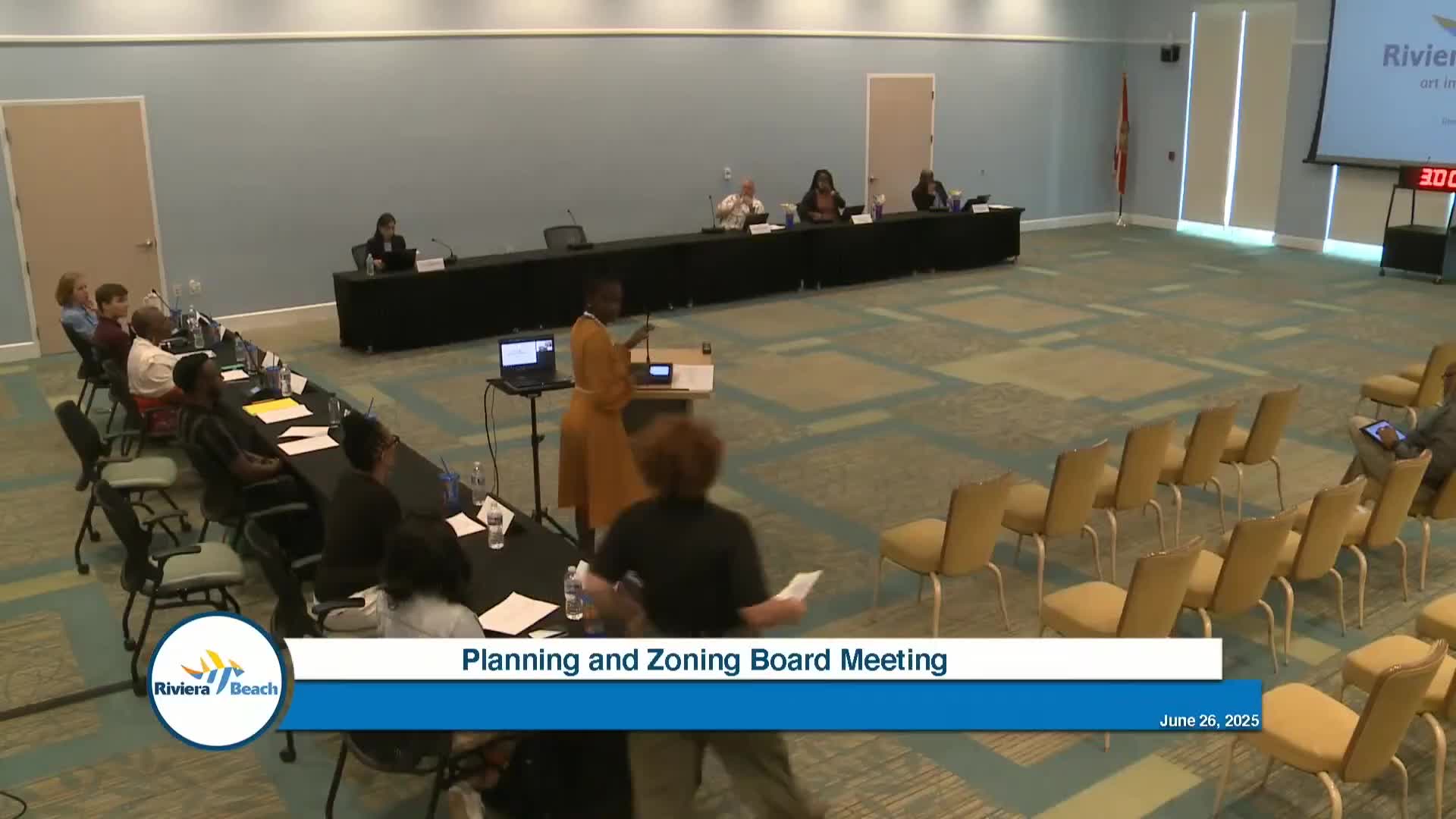
Summary
Riviera Beach planning staff and the newly formed Arts and Public Places advisory board presented a draft Arts in Public Places master plan to the City of Riviera Beach Planning and Zoning Board on June 26, 2025.
Riviera Beach planning staff and the newly formed Arts and Public Places advisory board presented a draft Arts in Public Places master plan to the City of Riviera Beach Planning and Zoning Board on June 26, 2025. The presentation outlined recommended locations and types of public art and policy changes to support a sustainable program.
The plan, led by Suneet Simon, principal planner in long-range planning and development services, and presented by Terrell Goldwire, chair of the Arts and Public Places board, and consultant Gabrielle Smith of Design Local, sets a vision of public art as a "source of positive and enriching connection across cultures, neighbors, neighborhoods, and beyond." It recommends a mix of permanent and temporary works, functional pieces such as artist-designed benches and bus-stop enhancements, murals beyond building facades, kinetic sculptures at the marina and gateway treatments on major roads.
Why it matters: the draft pairs creative recommendations with proposed policy changes intended to fund and sustain public art. Consultants urged adoption of updated public art ordinances, expansion of funding sources, and consideration of a public art administrator to manage installations and programming if the program expands.
Consultants described the outreach and evidence behind the recommendations. Gabrielle Smith said the team conducted focused stakeholder conversations, tabling events and a community survey that "got a little over 200 responses," in which murals and sculptures were the most commonly requested types but respondents also rated functional and temporary/interactive installations highly. Smith said priority locations included downtown, the municipal beach access, the marina, parks and sites along Singer Island and Congress.
Recommendations presented to the board included: using crosswalk and court murals and sculpture trails to bring art into daily spaces; employing functional art to encourage walking and activation of the municipal beach access; temporary festival programming such as sand-sculpture events; gateway and wayfinding installations on major roads; bus-stop and utility-pole art; and small-scale, low-cost activations like chalk or water-activated festivals to enliven pedestrian corridors.
On funding and administration, Suneet Simon described the city's existing revenue streams: "Whenever a developer shows up and the development has a value greater than $50,000, 1% of those developer dollars go into arts in public places," plus a smaller share from BTR licensing dollars handled by city staff. The consultants also recommended codifying the funding approach in an updated public art code and expanding relationships with public and private partners to ensure sustainability.
Board and public reaction was supportive. Terrell Goldwire, chair of the advisory board, said the board seeks to honor the city's history and culture and asked for installations that go beyond traditional murals to include interactive and temporary works. One attendee, identified in the record as a resident, urged preservation or reinstallation of an existing mural at the corner of Broadway and Blue Heron if redevelopment occurs and suggested creating small park space at that intersection instead of additional commercial development.
No formal policy votes on the master plan or ordinance changes occurred at the meeting; the presentation closed with staff and consultants thanking the board and audience and noting next steps for refining the draft and appendices. The Arts and Public Places board said it meets the third Tuesday of each month in the Development Services conference room; consultants and staff said the plan includes appendices with draft ordinance language and suggested funding mechanisms.
Votes at a glance: The meeting included routine procedural votes. A motion to adopt the meeting agenda passed unanimously by voice vote with Board members Anthony Brown, Lucy Joseph and Vice Chair Frank Fernandez recorded as voting yes; the planning and zoning board later voted to adjourn, also carried by voice vote with those same three members recorded as yes. No motions to adopt the Arts in Public Places master plan or to amend the public art code were taken.
Ending: Staff said appendix materials including draft code language and recommended phasing will be available with the final plan, and consultants asked for board and public feedback as the draft moves toward adoption and potential code updates.