Get Full Government Meeting Transcripts, Videos, & Alerts Forever!
Get email alerts on the Land Use Zoning topic
No spam. Unsubscribe anytime.
Mesa staff propose zoning amendment for data centers, setting new design and operational standards
Summary
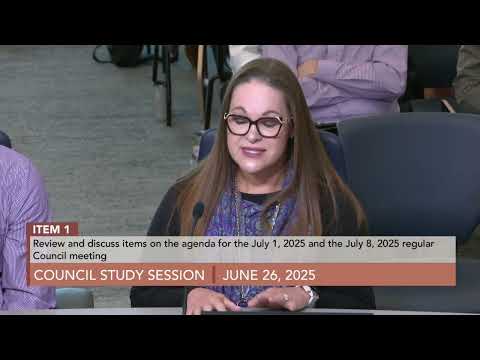
City staff told the Mesa City Council on June 26 that proposed text amendments would define data centers and add new development, utility and operational requirements, including separation from residences and initial and ongoing sound studies.
City staff told the Mesa City Council on June 26 that proposed zoning changes would create a formal definition and specific standards for data centers, a use the city says has rapidly expanded in recent years.
Staff described the text amendment package as a recalibration to address the “scale and proliferation” of modern data‑center facilities. City planning staff said 15 data centers have been constructed, approved or are under construction in Mesa in the past six years, representing roughly 1,500 acres and about 15,000,000 square feet of development. The proposed changes would add a specific definition, require approval of data centers only in the General Industrial (GI) and Heavy Industrial (HI) zoning districts via a Planned Area Development (PAD) overlay, and add objective development and operational standards in a new section of the zoning ordinance.
Key proposed rules staff described include: • Minimum separation of 400 feet from residential zoning districts or sensitive uses; the 400‑foot figure would be measured from the data‑center property to the nearest residential property line or use, not merely from the data‑center building face. • A maximum building height of 60 feet unless an exception is approved through a PAD. • Application submittals that would include a “good neighbor” policy, an initial sound study to establish baseline ambient levels at the nearest residential property line, a water‑consumption and thermal‑management report (to show cooling plans and whether water cooling is proposed), and an electric and natural‑gas energy service report for properties inside the city service area. • Ongoing operational requirements: a post‑occupancy sound study within 30 days of certificate of occupancy and annual sound studies for the first five years; restrictions and public notices tied to use of backup generators; and screening requirements for substations and mechanical equipment. • Updated parking standards (staff revised an initial calculation after industry comment to a formula of 1 space per 5,000 square feet for the first 200,000 square feet and 1 space per 10,000 square feet thereafter).
Staff said the amendments are not a ban. They emphasized that data centers would remain possible under GI and HI zoning with a PAD and that a waiver process will allow certain Light Industrial parcels to request approval for three years under a Prop 207 waiver process established by state statute and voter‑approved Proposition 207. Planning and Zoning recommended the change and a vote record was corrected to show a 6‑1 recommendation.
Council members asked detailed questions about water and energy. Mayor and Council Member Duff urged restrictions on water cooling, citing Colorado River and CAP water constraints; Energy and Water staff said the city already uses a large‑water‑user ordinance that caps municipal allocations for large users and requires them to procure dedicated water rights for additional use. Staff also described constraints from air‑quality permitting for on‑site generation and noted a permit and utility interconnection would be required for any generation beyond backup.
Staff said they have received robust written comments from residents (more than 175 residents) and from industry stakeholders (about 37 stakeholders representing roughly 27 organizations) and that staff revised several provisions based on feedback, including clarifications on substation screening, sound‑study requirements and the waiver process. The amendments are scheduled for introduction on July 1 and for action on July 8.