
High Springs water staff outlines personnel, testing and SCADA costs in budget briefing
Get AI-powered insights, summaries, and transcripts
Subscribe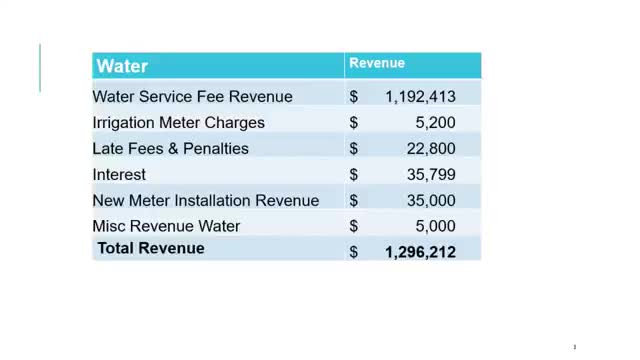
Summary
A water department presenter summarized key budget items for High Springs’ water utility, including five staff members, employer benefit costs, monthly bacteriological testing, contract services and SCADA communications that support remote monitoring and on-call dispatch.
High Springs water department staff outlined core operating costs for the town’s water utility, emphasizing personnel expenses, monthly lab testing and remote monitoring systems.
In a briefing, a Staff member, Water Department, said the department has five employees and that “my salary is included in that and also the utility superintendent.” The presenter identified employer contributions and benefits as standard budget items, listing Social Security and Medicare (FICA), retirement, life and health insurance, workers’ compensation and unemployment insurance.
The presenter described miscellaneous revenue sources, saying fees charged when a new house is connected are included under meter-installation fees and “miscellaneous revenue water,” and called those incomes “minor and irregular.” Contract services were listed separately; the presenter said a contractor performs multiple tasks for the water department, including preparation of the Consumer Confidence Report and other items the department requests.
On water-quality monitoring, the presenter said the utility sends bacteriological samples to the health department for monthly testing, noting that lab testing is a recurring operating cost. “We have to test the water,” the presenter said.
The briefing also described the town’s supervisory control and data acquisition system. “SCADA is basically supervisory control and data acquisition system. It's how you communicate. I can communicate with the water plant all off my phone. I can control the pumps. Anything that happens, any alarm, it goes straight to us and we can talk to it real time,” the Staff member said. Wireless communication services were noted as the expense category that covers SCADA and the call-center dispatch used for on-call staff.
No formal motions or votes were recorded in the briefing segment summarized here. The discussion focused on budget line items and operational descriptions rather than on policy changes or approvals.
The presenter also listed training and travel, professional services, and monthly lab testing as operating-budget items, and described longevity pay tied to years of service (noting example payments after five, 10 and 15 years).