
Kings Park board reviews first reading of new law-driven ban on studentsinternet-enabled devices during school day
Get AI-powered insights, summaries, and transcripts
Subscribe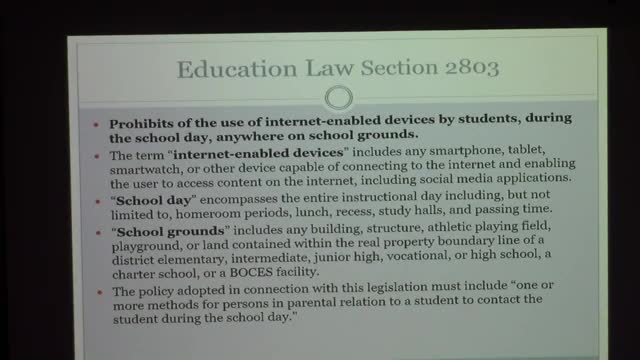
Summary
Doctor Egan presented a first reading of changes to the district—s acceptable use policy to comply with state law banning student use of internet-enabled devices during the school day on school grounds.
Doctor Egan presented a first reading of revisions to the district—s computer network and acceptable use policy to align Kings Park Central School District with a change in state law that "prohibits the use of Internet enabled devices by students during the school day anywhere on school grounds," he said.
The draft policy would remove the district—s prior carve-outs for passing time and lunch and would require building-level procedures, on-site storage options and communications to parents before the September start of school. "The law is very specific," Doctor Egan said, noting the statute also requires the district to post the policy to its website by Aug. 1 and to provide one or more on-site storage methods such as student lockers.
Why it matters: the law narrows when students may use phones and other internet-enabled devices and will change day-to-day routines for many secondary students. Egan told the board most of the immediate impact will be on ninth-, tenth- and eleventh-grade students, who are accustomed to phone use during passing time and lunch.
Board members and administrators discussed implementation approaches that ranged from no-cost options (lockers, backpacks) to paid solutions (locking pouches, mini-lockers or software that would lock/unlock devices). Egan said community feedback from a district survey (about 40 responses) favored no-cost approaches roughly three-to-one over paid solutions. He also said the state budget included $13,500,000 intended to help districts, but "the state has yet to make a mechanism where districts can apply for that money."
The draft preserves statutory exemptions Egan described: use for an authorized instructional purpose, management of a student's health care needs, emergency use as defined by the school or district, language-translation assistance and case-by-case allowances for students who are caregivers or where use is otherwise required by law. He said building procedures will need to address how teachers and administrators approve instructional uses and how parents can contact students during the school day.
Egan said the district is exploring technology solutions: ParentSquare is developing a feature to let parents message a student through the district-managed Chromebook rather than a phone. The district will produce a Q&A for families this summer and return with a second reading of the policy on July 1.
Discussion vs. decision: the board received the first reading; no policy vote was taken. The superintendent's office will draft building-level procedures and a Q&A for parents ahead of the July 1 second reading and the statutorily required Aug. 1 posting.
Next steps: second reading and vote set for the board—s July 1 reorganization meeting; building procedures and family communications to be developed during the summer.