
Commission fails to advance rezoning request for Larkin Lane property after neighborhood opposition
Get AI-powered insights, summaries, and transcripts
Subscribe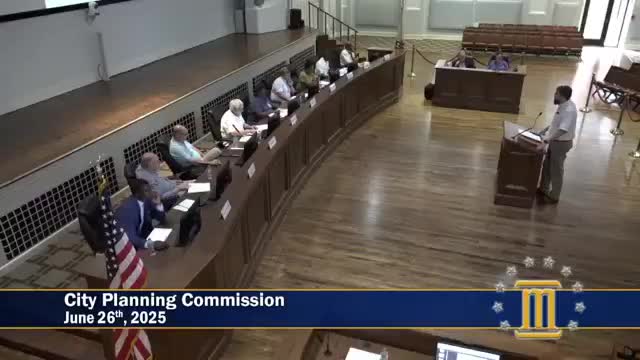
Summary
A request to rezone 10.65 acres at the southern end of Larkin Lane from R-60 to R-50 did not progress after commissioners failed to second a motion; proponents said the change would allow single‑family lots consistent with nearby R‑50 property, while neighbors cited traffic, lot‑size and property‑value concerns.
A rezoning request to change about 10.65 acres at the southern end of Larkin Lane from R-60 to R-50 did not move forward after the Montgomery City Planning Commission lacked a second on a motion to approve.
The applicant, represented by Chris Bostic of Pilgrim and Bostic Engineering on behalf of FHM Company LLLP, said the request responds to a prior denial of a different lot configuration and that matching R-50 with adjacent Eliza Place would be consistent with nearby development. “We were turned down because of potential depression of property values if we built these smaller lots next to the R‑50 lots on Eliza Place to the north,” Bostic said, and added that he had sought a second community meeting but was told there was no interest.
Residents and neighborhood leaders urged commissioners to retain larger lots. Keith Anderson, president of the Bellhurst Homeowners Association, recommended keeping R-60 zoning to preserve lot sizes and limit traffic, saying the change would increase the number of cars using Larkin Lane and affect about 55 homes near the intersection. Richard Dean, speaking for neighbors, reviewed historical rezoning in the area and said most surrounding lots were R-75 or larger; he later urged the commission to keep the current R-60 classification.
Royal Dumas, representing FHM, said a traffic study and hydrology review would be required at the planning stage and that legal arguments about inverse condemnation were not a valid reason to deny the rezoning. “We’ve researched that. That is simply not the case,” Dumas said, replying to neighbor concerns.
Commissioners debated whether neighborhood opposition constitutes a valid legal objection; planning staff explained public sentiment may be considered but cannot alone be a formal statutory basis to deny an application when the proposed zoning is in character with surrounding development.
A motion to approve the rezoning was made, but no commissioner seconded the motion and the motion failed. The transcript records one attempt to move to approve, a later motion to approve that failed for lack of a second, and discussion of alternate options including R-60 (with or without multifamily allowance) as a compromise. There was no formal vote recorded to disapprove at that meeting; the item did not advance.
Next steps: The applicant may withdraw the request, return with revised proposals, or await a future meeting; if the applicant pursues the rezoning again, required engineering studies (traffic, hydrology) and community outreach are likely to be part of the record before any vote.
Speakers included the applicant’s engineer, multiple neighborhood association officers and residents, and planning staff who explained procedural and legal limits on objections.