
San Diego Community Power warns federal tariff and tax-credit proposals could raise procurement costs; board asks staff for consumer communications plan
Get AI-powered insights, summaries, and transcripts
Subscribe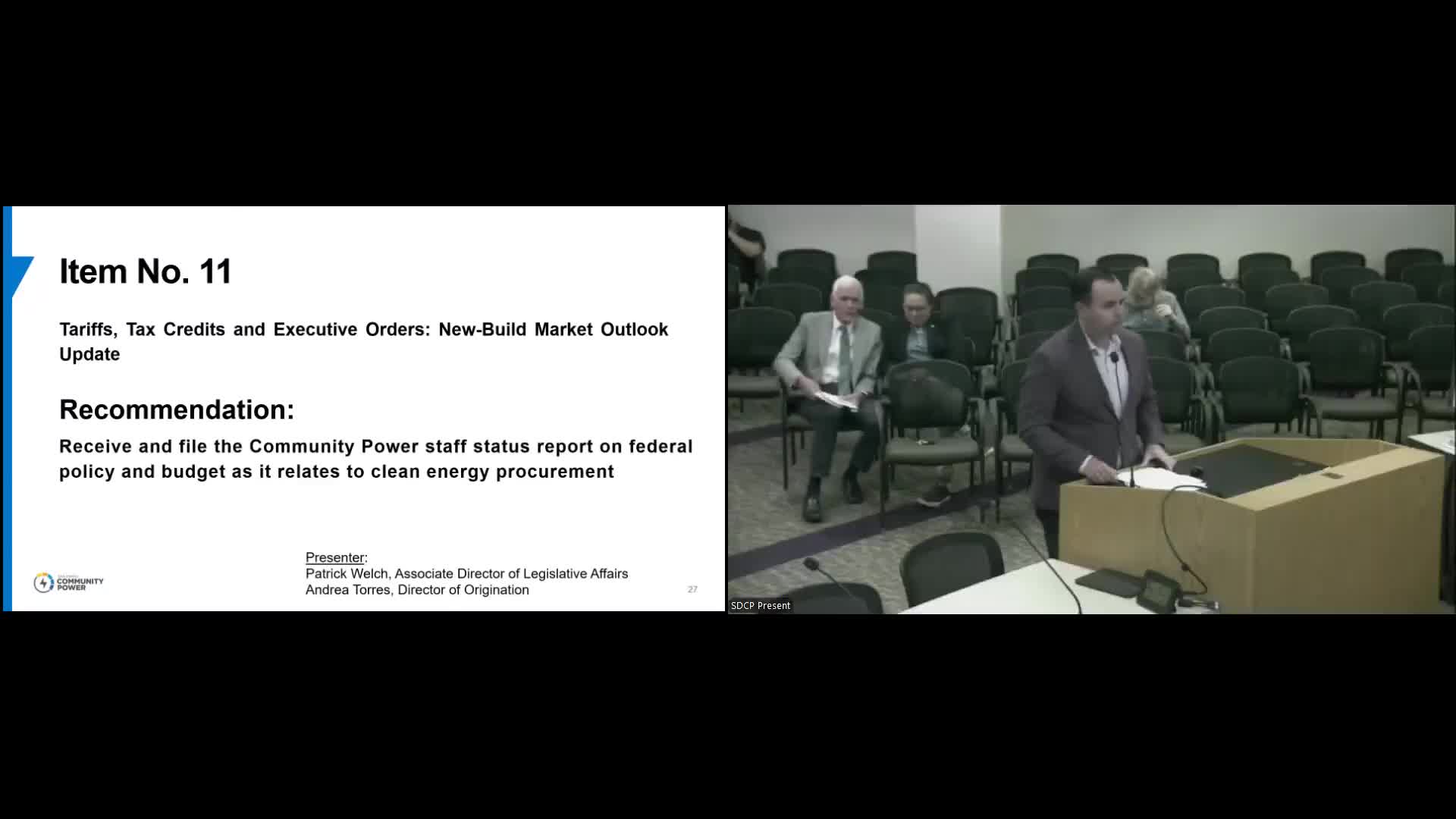
Summary
Staff told the San Diego Community Power board that competing congressional plans and new tariffs are creating uncertainty for utility-scale projects and tax credits; directors asked staff to prioritize projects with supply‑chain mitigation and to return with a consumer communications plan in August.
San Diego Community Power staff told the board on June 26 that federal budget reconciliation proposals and a new wave of trade tariffs are creating near‑term uncertainty for utility‑scale renewable procurement and consumer clean‑energy tax credits.
The update from Patrick Welsh, SDCP associate director of legislative affairs, and Andrea Torres, SDCP director of origination, said House and Senate reconciliation proposals differ in how and when they would wind down investment and production tax credits and add sourcing restrictions that could affect projects that rely on components from China and other countries.
"The bill that the house passed in May would change, all the tax credits and sunset them effectively on 12/31/2028," Welsh said. He added that the Senate’s approach would wind down solar and wind credits beginning in 2026 but keep incentives for other technologies longer. Welsh said timing is uncertain and lawmakers were trying to resolve a large reconciliation bill by the July 4 congressional recess.
In a separate presentation, Torres summarized recent tariff volatility and its likely effects on project costs. "Interpreting tariff policy and quantifying the direct and indirect economic impacts of tariffs is pretty complex and challenging," she said, and noted that manufacturers and project developers have responded unevenly as supply chains shift to Southeast Asia and other regions.
Why it matters: SDCP staff said the agency’s pipeline benefits from projects already under construction or with safe‑harbor equipment, but many contracted projects are still vulnerable. That could raise procurement costs and, ultimately, customer bills unless mitigations are found.
Board discussion focused on what SDCP can control locally and how to inform customers. Vice Chair (board member) and several directors praised staff’s work and asked about mitigation options. Director Yamani pressed staff to explain what “prioritizing projects that have project‑specific mitigation strategies” means; Torres answered that larger developers can shift supply across their pipelines or use contractual leverage with manufacturers to reduce tariff exposure.
Several directors urged SDCP to pursue local and state levers — distributed energy resources, virtual power plants and demand‑reduction programs — that would reduce reliance on at‑risk utility‑scale procurement. Director Ilo Rivera asked staff to convene city and county partners to explore local partnership opportunities.
Directives and next steps: The board asked staff to prepare a consumer communications plan and return with options in August so the agency can notify ratepayers quickly if federal changes translate into higher prices. Karen Burns, SDCP CEO, agreed staff would present conceptual options in August and follow with detailed analysis once market impacts are clearer.
The board received the briefing as an informational item; no vote was required.
Quotes used in this story come from SDCP staff and board members during the June 26, 2025 board meeting.