Get Full Government Meeting Transcripts, Videos, & Alerts Forever!
Get email alerts on the Heat Safety topic
No spam. Unsubscribe anytime.
Parks, fire and heat-response teams install locked ice machines at busy trailheads to aid rescues
Summary
City parks and Phoenix Fire Department officials said locked ice machines have been installed at two popular trailheads to support heat-relief outreach and rapid prehospital cooling for heat-stroke patients.
City parks staff and Phoenix Fire Department officials told the Parks and Recreation Board that locked ice machines were installed at two of the city’s busiest trailheads to support outreach and rapid-cooling treatments for hikers with heat-related illness.
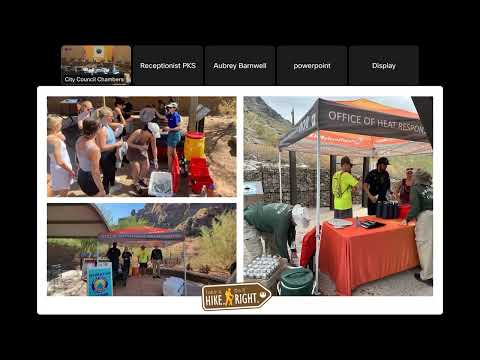
Deputy Parks and Recreation Director Jared Rogers said the units — installed at Piestewa Peak and Echo Canyon trailheads — were first made available on June 6 and were funded and sited through a cross-department partnership that includes the Office of Heat Response and Mitigation, Parks and Recreation, the Phoenix Fire Department and Community Emergency Response Team (CERT) volunteers. “The office of heat provided funding … for the installation of ice machines at both Piestewa and Echo Canyon Trailheads,” Rogers said.
The machines are locked and not intended for general public use, Rogers added; the department provides chilled drinking water at the sites and will add signage explaining the ice machines’ purpose. The initial cost to stock the machines for the first month was “just over $400,” Rogers said.
Deputy Fire Chief Maki Lloyd described how the ice supports a prehospital “ice and cold water immersion” protocol the department began in 2024 in partnership with local hospitals. Lloyd said the treatment is used for patients with core temperatures greater than 104 degrees Fahrenheit and altered consciousness and that early cooling substantially improves outcomes. “In 2023, heat stroke typically had a mortality rate of between 60 to 70 percent,” Lloyd said. “We found in 2024 … the patients had a survivability rate of over 80 percent.”
Lloyd recounted a recent case in which crews began rapid cooling on a hiker while still on the mountain; the patient arrived in the parking lot with a temperature of 104.4 degrees Fahrenheit and was discharged from the hospital six days later, neurologically intact.
Board members asked how sites were selected. Rogers said staff used rescue data and technical-rescue team input to choose locations with high rescue frequency and strong hiker traffic, balancing that with site power availability. Rogers said staff are assessing additional sites, including Pima Canyon at South Mountain Park, where solar power capacity or hardwired power solutions may be required.
The board and staff said they will continue to coordinate outreach, add explanatory signage, and evaluate additional trailheads for machines in coming months.