Get Full Government Meeting Transcripts, Videos, & Alerts Forever!
Get email alerts on the Jrotc Stem Leadership Camp topic
No spam. Unsubscribe anytime.
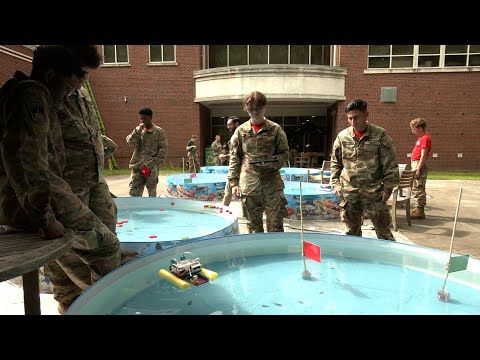
JROTC camp blends leadership training, STEM lessons and industry visits for Savannah‑Chatham County cadets
Summary
Cadets and staff described a JROTC leadership camp run through the GRTC program that combines physical challenges, STEM activities and local industry visits to prepare students for college, careers or military service.
Cadets and program staff from the Savannah‑Chatham County Public School System’s GRTC program described a weeklong JROTC leadership camp that pairs physical challenges with STEM lessons and visits to local industry and a university campus.
The camp “infused STEM and industry visits” into its leadership curriculum, staff said, to help cadets see career pathways near Savannah. Cadet 5, a cadet, said the program’s goal is “that we are raising students and cadets up to be the next in line, to take on those industries. Whether they go to college, whether they go straight into the workforce, whether they go into the military, whether they start their own business, we're providing them those important skills to be successful no matter what journey they choose.”
Why it matters: the staff and cadets framed the camp as supporting the district’s mission of educating young people by building confidence and practical skills. “Not only are they building confidence by overcoming their fears with these physical challenges, but by bringing in those STEM challenges, they realize that they're a lot smarter than they thought they were,” Cadet 1 said.
Cadets described hands‑on STEM learning tied to physical activities and local contexts. Cadet 6 said the camp connects STEM to activities such as gear‑ratio calculations used in climbing and other exercises: “So far, I've gotten into the importance of STEM in each of the activities that we're doing in JROTC and how they tie together.” Cadet 7 recounted outdoor components including rock‑wall climbing, kayaking and a nature study: “We did kayaking. We was trying to see alligators and things like that,” and “Learn about spiders and the history of around the, lake that we went to and the small business aspect of it.”
The camp included an academic campus visit; a cadet said they toured the Armstrong campus of Georgia Southern University. Cadet 2 said the program also offers media skills: “This year, I've taken a lot of pictures and edited a lot of videos. It's kinda stressful, but I I enjoy it. This year, I'm more mentoring than I am learning.” Several cadets described a shift from being new participants to mentoring newer cadets.
Program staff framed employability and “soft skills” as part of the STEM pillar. Cadet 5 said the camp emphasizes that participants are “scientists tech technicians, engineers, mathematicians all the time,” and that showing local careers that use those skills is part of the effort to make STEM “relevant to them that are happening right now, right around us in the Savannah area.”
Cadets described personal change and increased confidence. “When you come here, you're a completely different person from when you leave,” Cadet 2 said. Cadet 3, recalling challenges on the first day, said, “I failed my first day… Hey. Good job, miss Alexander. You slowly build that confidence with others telling you you got this, you got this, and that stress slowly get gets away.”
No formal board action, funding decisions or legal authorities were discussed in the provided transcript. The account consists of participant remarks about program content and experience, not policy decisions.