Get Full Government Meeting Transcripts, Videos, & Alerts Forever!
Get email alerts on the Budget And Funding topic
No spam. Unsubscribe anytime.
Committee flags funding uncertainty for conservation staff; seeks more-secure contracts
Summary
Ashland County conservation staff outlined how several positions are funded by competitive federal grants and state programs and said they are pursuing NRCS cooperative agreements and county funding to reduce year-to-year risk.
County conservation staff told the Land Conservation Committee that several core positions rely on grant and state funding and that the department is pursuing more secure multi-year contracts to reduce vulnerability.
Mary Jo, Ashland County's county conservationist, reviewed staffing and funding sources for the department. She said the county conservationist position is fully funded through the Wisconsin Department of Agriculture, Trade and Consumer Protection (DATCP). The administrative assistant position is shared with zoning and paid from county levy dollars. The civil engineering technician is funded with a combination of DATCP and county funds. The land-and-water specialist position is funded by Wisconsin DNR grants and county dollars.
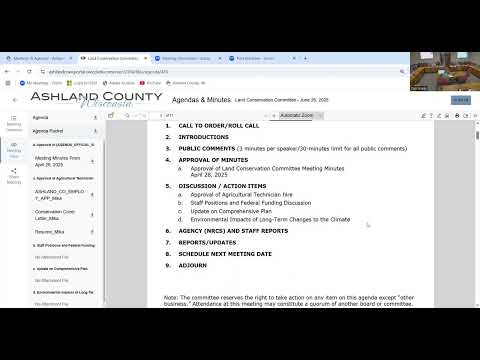
Mary Jo said the agriculture technician position the committee is filling has been funded through a National Association of Conservation Districts (NACD) grant that reimburses 100% of salary and is annual and competitive; the department has held the grant for four consecutive years. She said the department is working to secure a two- or three-year NRCS Cooperative Agreement (a noncompetitive state-level contract administered by the Natural Resources Conservation Service) to provide multi-year stability, but NRCS funding itself comes from federal sources and could be affected by federal budget changes.
The watershed project coordinator position is funded by a Great Lakes Restoration Initiative grant that supports natural flood-management work and construction of in-stream ravine flood projects; Mary Jo said the current grant is about $300,000 and a new three-year contract will begin in October. She added the department also administers a DACAP grant (DATCP) and a roughly $100,000 NACD grant that funds the ag tech position. The department's annual DACAP allocation pays for staff and conservation projects and totals a little over $200,000 for the county programs discussed.
Committee members asked whether federal budget actions could interrupt funding streams. Mary Jo said that while she felt confident in the NACD grant in the near term, the federal administration's priorities can make funding volatile and the department is exploring NRCS cooperative agreements and county absorption of positions as longer-term solutions.
The committee discussed the wildlife damage program, which is administered through county invoicing while field work is provided by APHIS (Ethan Rossing covers Ashland County). Mary Jo said the county pays invoices and seeks reimbursement from the state, and the agriculture technician position will include administration of wildlife-damage billing.
The committee asked for clarity on which positions are fully county-funded and which rely on grants; Mary Jo supplied the funding mixes and emphasized that annual grants require staff time to renew. Members urged the department to plan for longer-term funding and to report back to the committee on any secured NRCS cooperative agreements or county-level decisions to absorb positions.