
South Burlington leaders set FY26 priorities: cemeteries, TDR reporting and legal review of building-energy enforcement rise; many items moved to 'bike rack'
Get AI-powered insights, summaries, and transcripts
Subscribe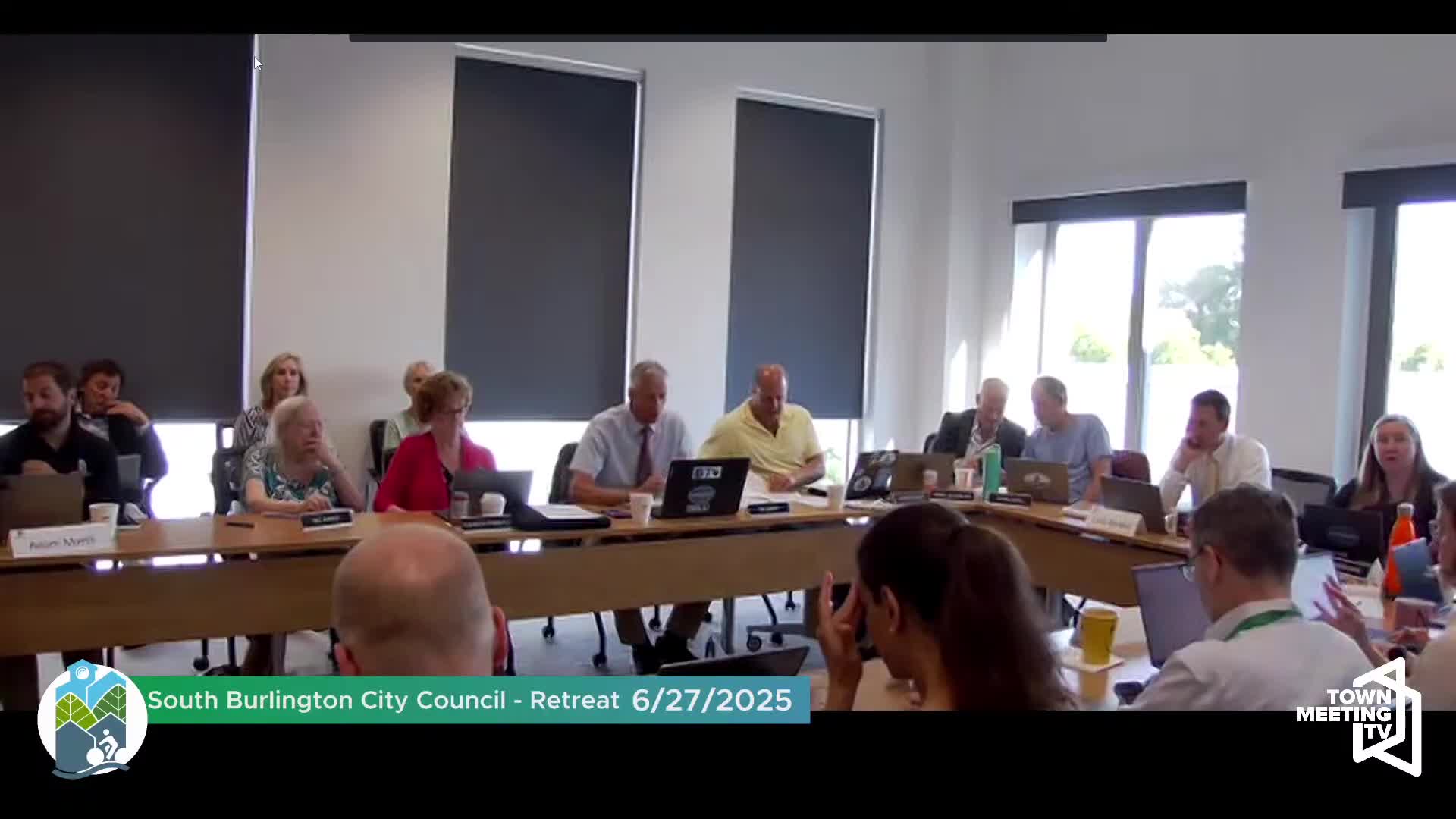
Summary
City leadership and councilors refined FY26 priorities on June 27, elevating cemetery administration, requesting TDR status reporting, and ordering a legal review of municipal authority on building-energy enforcement; many other proposals were parked on a 'bike rack' for future years.
South Burlington City leadership and the city council met in a working session to narrow policy priorities and strategies for fiscal year 2026, endorsing several staff requests and tabling many ideas for future consideration.
City Manager Jesse Baker opened the meeting, describing the session as "our annual working meeting between the leadership team and the city council to develop our shared work plan for FY26." Staff presented a leadership-team package of 49 recommended initiatives organized by capital projects, master plans, operations, partnerships, ordinance updates and study/research items.
Council discussion and a dot-prioritization exercise produced several explicit outcomes: the council moved cemetery governance and administration from the bike rack to active work, instructed staff to provide reporting on transfer-of-development-rights (TDR) activity, and asked the city attorney and staff to review municipal authority to enforce building-energy or thermal-code requirements. Councilors and staff also agreed to advance a public-tree plan (public trees/street trees) as a priority and to keep a long list of other items on a 'bike rack' for future years.
Planning Director Paul Connor summarized legal uncertainty around local enforcement of energy codes, saying the Chittenden County Regional Planning Commission's legal review indicated "it's unclear whether municipalities have enforcement authority on the energy codes." The council directed staff to pursue a legal review and to return with a recommended path (education, permitting changes, or ordinance drafting) rather than immediate enforcement.
Cemetery work moved to active status after members described a multi-part need: adopt rules and regulations, appoint or fund a cemetery administrator to house operations and lift a local moratorium on plot sales, and begin work on beautification projects (Eldridge Cemetery was cited as receiving a $50,000 anonymous gift for improvements). Jesse Baker summarized the implementation step: "Cemeteries moving to off the bike rack to regular work. We've already started that."
Councilors and staff also agreed on process items: leadership will integrate committee proposals where they overlap with the leadership team's recommendations, staff will provide a crosswalk of committee work plans, and the council requested a staff briefing and, in one case, an executive session to discuss land acquisition negotiations tied to the City Green project.
Bigger context: staff noted FY26 will include an array of ongoing modernization projects (new permitting and finance systems), dozens of master-plan deliverables and approximately $84,000,000 of capital projects in the pipeline (not all expected to be spent in FY26). Leadership also flagged upcoming staffing transitions (police chief, library director, stormwater team and a deputy city manager recruitment). Daily government operations — estimated roughly as 18,000 public-safety calls and maintenance of 166 miles of roads, paths and sidewalks — will continue alongside new initiatives.
Ending: The working meeting produced an updated staff worksheet that staff will translate into a formal FY26 policy-and-strategies proposal for council adoption at a future meeting. Key follow-ups recorded in the session were: (1) advance cemetery administration and rules, (2) legal analysis of municipal authority to inspect/enforce building energy requirements, (3) quarterly-style reporting on TDR usage and remaining credits, (4) move the public-tree plan into active consideration, and (5) schedule an executive-session briefing on City Green land-acquisition negotiations.