Hunt County emergency manager seeks money for 2026 hazard mitigation plan and other emergency needs
Loading...
Summary
Richard Hill, director of Hunt County Homeland Security, told commissioners the county must update its hazard mitigation plan and asked municipalities to share costs if outside grants fall short.
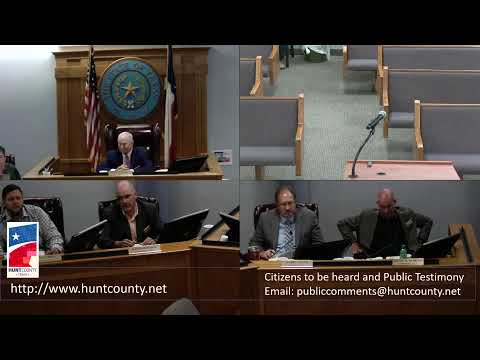
Richard Hill, director of Hunt County Homeland Security, presented the department’s budget items and several countywide emergency management issues at the June 27 commissioners court session, including an urgent need to prepare an updated hazard mitigation plan before the county’s current plan expires in mid‑2026.
Hill told commissioners the federal and state reimbursement programs for mitigation planning have changed; a private contractor now offers planning services and can help prepare a reimbursement grant application to the Texas General Land Office, which can reimburse up to $100,000. Hill said initial estimates from vendors place the total cost of the plan in the $150,000–$200,000 range and that the county would need to apportion net costs among municipalities and unincorporated areas if the grant does not fully cover expenses.
“If you do not have a current hazardous mitigation plan in effect and there is a presidential declared disaster in your area, you don't get any money,” Hill said, describing the federal requirement that an approved plan be in place to access certain post‑disaster funds. He urged early engagement with cities and other local entities to secure participation and budgeting for their shares.
Hill described additional items in his budget: a proposed training increase (from $5,000 to $7,500) and maintenance expenses for county generators bought with prior federal grant funds. He also raised a recently enacted state requirement — a statewide registry (referred to in the meeting as the STEERS program) — that will obligate emergency management offices to attempt outreach to registered residents with special needs during disasters; Hill said local policy and minimal contingency funds will be needed to implement outreach and response requirements.
On procurement and planning costs, Hill said the county’s prior hazard mitigation work came via the regional Council of Governments (COG) at little local direct cost; that federal/state funding for the COG role has ended and the COG position was eliminated, so private contractors now are being considered. He noted the TDEM (Texas Division of Emergency Management) must approve the county plan and FEMA also participates in validation for reimbursement eligibility.
Hill also summarized department staffing and requested a limited equalization of certain pay lines (three positions) to align with county compensation changes in recent years; commissioners asked for detailed justification and noted the county’s tight budget situation. No procurement, contract award or budget appropriation was approved during the session; commissioners requested follow‑up information and indicated they would begin outreach to city managers to assess municipal participation in a shared mitigation plan cost.