Get Full Government Meeting Transcripts, Videos, & Alerts Forever!
Get email alerts on the Juvenile Diversion topic
No spam. Unsubscribe anytime.
Hunt County judge asks commissioners to fund part‑time clerk for new juvenile diversion mandate
Summary
A Hunt County court official told commissioners the state-required juvenile diversion program, effective Jan. 1, 2025, has increased local court workload and asked the commissioners to fund a part‑time backfill to maintain court operations and language access.
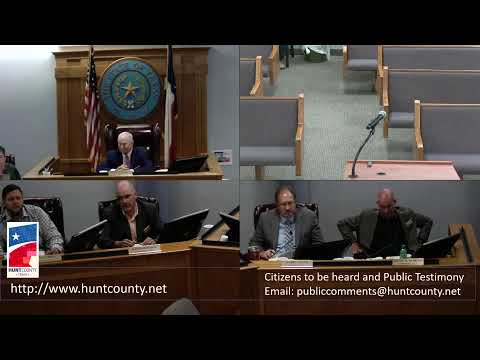
Judge Stovall called a special session of the Hunt County Commissioners Court on June 27, 2025, to hear budget presentations. Clay, a court official who oversees juvenile diversion work in the county’s magistrate court, told the court an unfunded state mandate requires a local administrator to build and monitor diversion plans for juveniles and asked commissioners to fund a part‑time position to backfill clerks and support the new workload.
Clay said the state mandate requires diversion be offered immediately to juveniles charged with Class C offenses committed before their 17th birthday and that a plan must be written, monitored and, when completed successfully, kept out of the regular court record. “We have an additional unfunded mandate from the, from the state of the juvenile diversion program,” Clay said. He told commissioners the work of building and overseeing diversion plans cannot be handled in existing court records systems and must be tracked separately.
The request was framed as a staffing backfill rather than a new full‑time hire: “I only want a part time person now,” Clay said, and later estimated a part‑time position at about 25 hours per week. Commissioners and staff discussed pay ranges and funding: one commissioner said part‑time pay might run $15–$20 per hour; the court discussed that would translate roughly to a $20,000 annual cost if the position remained under the county’s part‑time hour limits.
Clay provided court workload figures to illustrate rising demand: he reported total case openings last year of 1,945 with 1,248 closings (closure rates are tracked as a success metric), and noted juvenile caseloads were increasing compared with prior years. He said the court has been using remote appearance technology to reduce continuances and reach out‑of‑area counsel, but that when clerks must move from the public counter to court administrative tasks the front counter is effectively closed and service to the public suffers.
Commissioners asked whether diversion statistics appear in their standard reports; Clay said diversion work is tracked outside the county’s main case system and will not show up in routine automated reports unless a matter proceeds to court. He told commissioners he had explored state and federal grant opportunities but did not know whether the county had applied and said a county grant writer position could help secure personnel funding in the future.
No formal vote was taken on the staffing request during the session. The discussion closed with commissioners asking budget and staffing questions and seeking cost estimates to weigh against other county priorities during a year when the county faces a reported $2.5 million budget gap.
The commissioners later adjourned the meeting at 10:48 a.m.