Get Full Government Meeting Transcripts, Videos, & Alerts Forever!
Get email alerts on the Zoning Board Reform topic
No spam. Unsubscribe anytime.
City council hearing advances debate on formal ZBA reforms; petition kept in committee
Summary
A Boston City Council hearing on a home rule petition to restructure and increase oversight of the Zoning Board of Appeal drew questions about transparency, staffing and neighborhood impacts. The council kept the petition in committee and requested additional data from city departments.
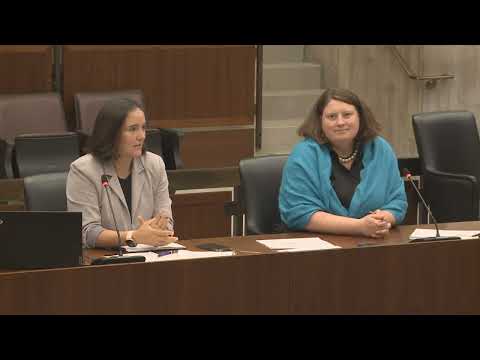
Councilor Gabriela Colleta Zapata, chair of the Boston City Council Committee on Government Operations, opened a hearing June 27 on a home rule petition (docket 0613) aimed at restructuring the Zoning Board of Appeal (ZBA) and increasing public transparency.
The petition, sponsored by Zapata and referred to the committee March 5, 2025, would expand the ZBA from seven to nine members with nine alternates, change nomination and appointment procedures to include professional and neighborhood representatives, add term limits, strengthen conflict-of-interest restrictions and require electronic and mailed notice and a searchable database of variance decisions. "This petition would formally restructure and modernize the ZBA," Zapata said at the hearing. "This reform is about restoring the public's trust and ensuring that zoning decisions are legally sound, transparent, and grounded in community and professional expertise."
The hearing mixed policy arguments, technical detail from municipal staff and neighborhood testimony. Kathleen Onifor, deputy director of zoning at the Boston Planning Department, described the scope of the problem the petition aims to address, saying about "99 percent of residential parcels in the city had zoning that fails to match what's there," which she noted was 99.6 percent in the department's analysis. Planning staff told the committee that because the code often does not match existing building patterns, many projects require case-by-case relief from the ZBA: roughly one in three long-form building permit applications need zoning relief, the planning department reported. In the last year the ZBA issued decisions on about 739 cases; 525 of those included a variance, officials said.
City departments described existing transparency tools and limits. Commissioner Tanya Del Rio of the Inspectional Services Department (ISD) said the ZBA is an independent board and that ISD provides administrative support: "the ZBA is an independent board. So city hall, the administration, ISD planning employees, we are making decisions as far as the permitting process... and if ISD's planning zoning division decision is to be appealed, that goes to that independent board." Del Rio noted that decisions since 2017 are posted online at ISD's zoning board page and that planning department recommendations and a zoning tracker are available on the Planning Department site.
The petition would add new oversight: quarterly (committee members later discussed annual reporting as more feasible) public reports that would break down variance approvals by neighborhood and zoning district and require justification when hardship standards are not met, plus a council variance-review panel and an independent, neutral staffer to assist residents at hearings. Councilors and staff debated how that oversight would work in practice; Councilor Ed Fitzgerald raised concerns that asking the same body that grants variances to produce reports that identify cases that did not meet hardship standards could create legal and administrative conflicts. Planning staff recommended annual rather than quarterly reports and said the underlying decisions and legal explanations are already available in decision letters.
Councilors raised several recurring neighborhood concerns. Councilor Flynn (District 2) pressed for more in-person hearings and stronger enforcement of notice and community outreach, and said roof decks have become a consistent quality-of-life complaint: "Roof decks for me as a district councilor are a nuisance," he said, citing summertime parties and noise impacts on neighbors. Staff said the ZBA has discretion on individual proposals and that planning recommendations consider block context, setbacks and building code constraints.
Administration officials and councilors also discussed East Boston, which the planning department rezoned in May 2024 (Article 53). Planning staff provided an itemized accounting of variances granted since the update: nine variances granted under the updated East Boston zoning (most involving existing, nonconforming buildings and many preserving interior changes rather than large exterior expansions) and 11 cases granted under the prior zoning where applications were filed before the rezoning effective date. Staff said some pending decisions were not yet recorded and that caseloads remain high.
Department capacity and costs were a persistent theme. ISD staff described a small process-improvement team (three management analysts) and said ZBA administrative support consists of several staff (approximately five dedicated support staff plus legal review), the ombudsperson role is shared among community liaisons, and compiling the proposed neighborhood-level reports would require reassigning staff time or additional budget. Staff estimated certified mail for legal notices at roughly $7–$8 per piece and said they already provide required mailed notices and published ads; they also maintain an ISD newsletter that lists hearings.
Public testimony at the hearing reflected mixed views. Brian Gannon, an East Boston resident, urged that variances stop being used to rewrite neighborhood rules through litigation and said developers sometimes treat hardship arguments as financial rather than site-based. Sue Sullivan, executive director of the Newmarket Business Improvement District, praised existing review steps and cautioned against adding oversight that would create a redundant process. Victor Brogna, chair of the North End Waterfront Residents Association Zoning Licensing and Construction Committee, urged a broader study of the ZBA's role and suggested a higher legal threshold for relief where new neighborhood zoning had just been adopted.
The committee did not vote on the petition. Councilor Flynn requested a breakdown of approved units in Article 80 projects by district and neighborhood over the last 10 years; staff agreed to provide the data but said compiling it would require resources. At the close, Zapata said the committee would keep docket 0613 in committee for further work and possible future working sessions.
The hearing underscored competing priorities: neighborhood predictability and enforcement of newly adopted zoning, the ZBA's role as an independent appeals body, and the administrative capacity needed to produce the kinds of reports and outreach the petition would require. Councilors and staff signaled common ground on several reforms — expanded notice, searchable decision records, an ombudsperson and stronger conflict-of-interest rules — while debate continues about reporting frequency, legal implications of oversight, and resource needs.